I’ve seen owners save real money and get their evenings back by outsourcing the books — and I’ve seen a few get burned by picking the cheapest option with no controls. The difference is almost never the country. It’s how you set it up.
What accounting outsourcing India actually means
Accounting outsourcing means handing your day-to-day financial work — bookkeeping, reconciliations, payroll, and reporting — to an outside team instead of hiring in-house. When that team is based in India, you tap one of the world’s largest pools of trained accountants at a lower cost, often while you sleep.
India has been the leading destination for finance and accounting outsourcing for years, with deep experience, strong English, and a mature services industry represented by bodies like NASSCOM. You keep ownership of your books and data; the team does the work through secure, cloud-based access.
Why businesses outsource accounting to India
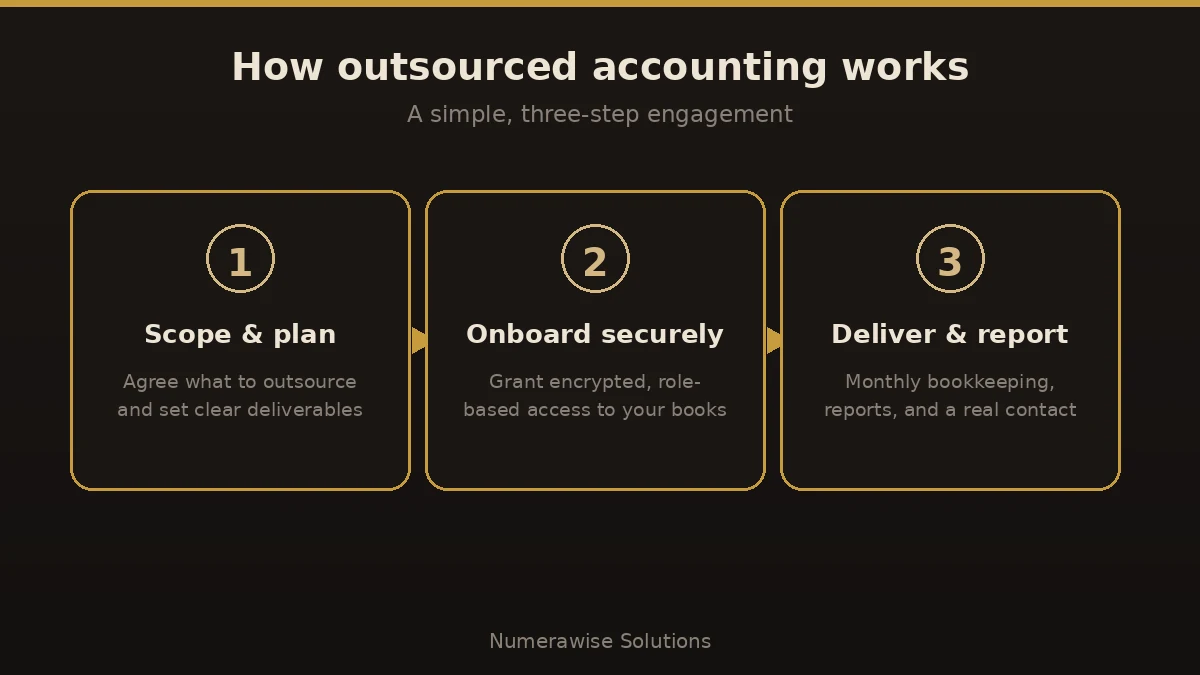
The pull is practical, not just about price. The four reasons owners cite most:
- Lower cost. Skilled work at a fraction of local salary-plus-benefits cost.
- A deep talent pool. A large base of qualified accountants, including chartered accountants (CAs).
- Time-zone advantage. Work handed off in your evening is ready the next morning.
- Scalability. Add or reduce capacity as busy season, growth, or slow months demand.
What you can (and shouldn’t) outsource
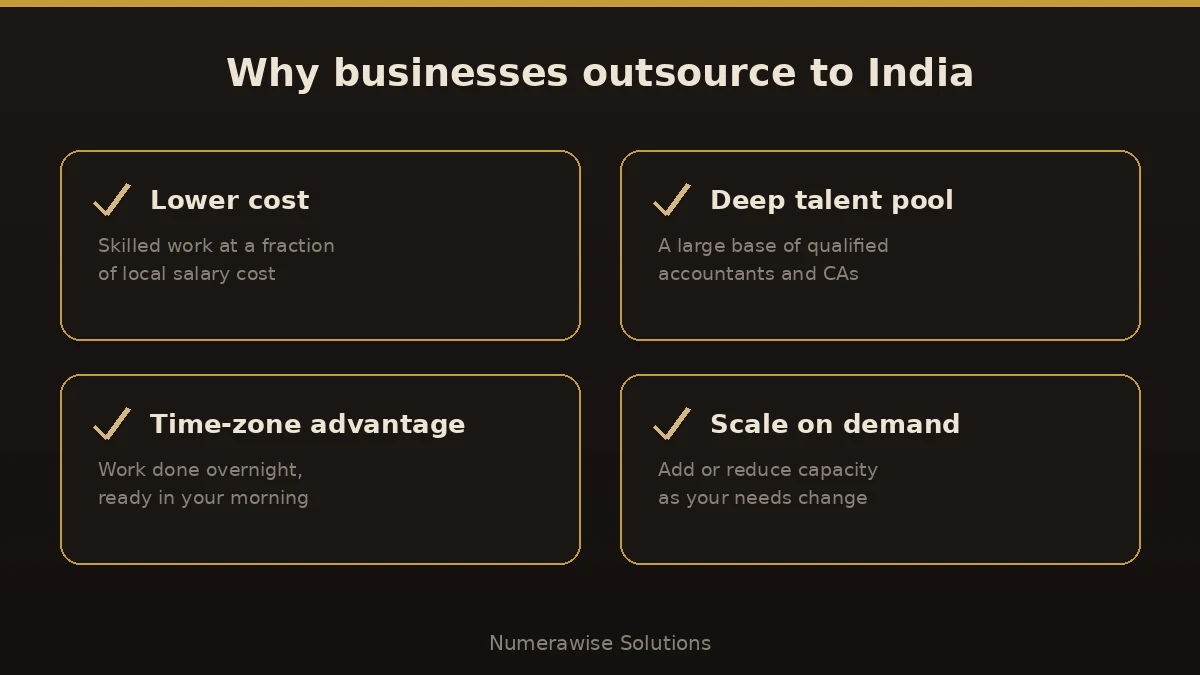
Most routine, rules-based financial work outsources well. Judgment-heavy or signature-level work usually stays with you or your CPA.
| Great to outsource | Keep close |
|---|---|
| Bookkeeping and reconciliation | Final tax filing and sign-off |
| Accounts payable and receivable | Big financial decisions |
| Payroll processing support | Approving payments |
| Management reports and clean-up | Client and banking relationships |
In practice, an India-based team keeps your bookkeeping services current and your payroll services on schedule, then hands clean, tax-ready books to your CPA.
What does it cost?
Pricing usually comes as a flat monthly fee or an hourly rate, and it scales with volume and complexity. The honest headline: outsourcing to India typically costs far less than a full-time in-house hire once you add salary, benefits, payroll taxes, software, and management time. Ask for a scope-based quote — a real number tied to your transaction volume beats any ballpark online.
Is your data safe? The DPDP Act and security
This is the question every serious owner asks, and it deserves a straight answer. Data security is about controls, not geography.
India now has a comprehensive privacy law — the Digital Personal Data Protection (DPDP) Act, 2023, with its operational rules notified in late 2025. Reputable providers respond with encrypted data transfers, role-based access, and binding contracts that cover security, audits, and liability. Look for:
- Encryption in transit and at rest, and cloud access instead of files flying around by email.
- Role-based permissions so people only see what they need.
- A signed confidentiality and data-processing agreement.
- Named contacts and clear accountability.
Done properly, outsourcing is often safer than one in-house person with the keys to everything, because duties are separated and access is logged.
Benefits of getting it right
- Real cost savings versus hiring in-house.
- Time back to run the business instead of the ledger.
- A whole team instead of a single point of failure.
- Cleaner, more consistent books and on-time reporting.
- Flexibility to scale up for busy season and down when it’s quiet.
Common mistakes to avoid
- Chasing the lowest price. Rock-bottom rates often mean no controls, no continuity, and rework.
- Skipping the security check. No encryption, no signed agreement, no deal.
- Vague scope. If nobody agreed exactly what’s included, expect gaps and surprise invoices.
- No named contact. “Someone on the team” is not accountability.
- Outsourcing a mess. Clean up and reconcile first, or you just move the chaos offshore.
Best practices for a smooth partnership
- Write down exactly what’s in scope — and what isn’t.
- Insist on encrypted, role-based access and a signed data agreement.
- Standardize on cloud software like QuickBooks Online so everyone sees the same numbers.
- Set a regular reporting rhythm and one named point of contact.
- Start with a pilot month before handing over everything.
- Review the first few deliverables closely, then settle into a routine.
Why work with Numerawise Solutions
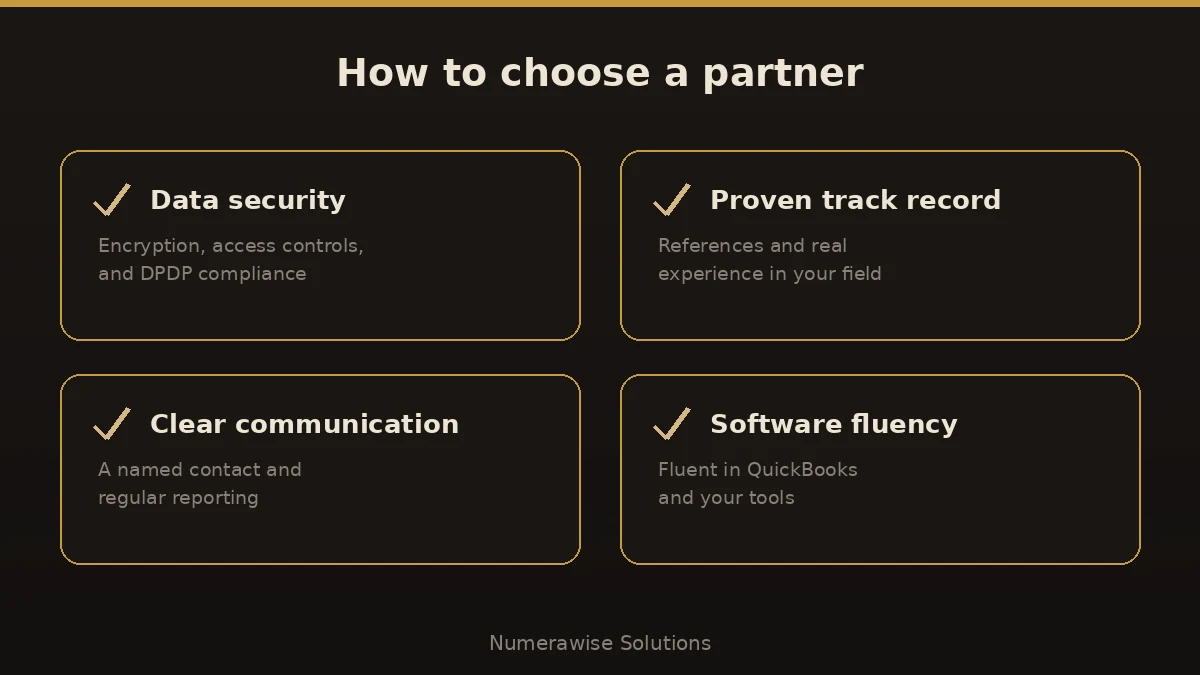
At Numerawise Solutions, we deliver outsourced bookkeeping built the right way: secure, cloud-based access, a named contact who answers your emails, and QuickBooks specialists who keep your books accurate and tax-ready. You get the efficiency that makes accounting outsourcing India so popular, paired with clear communication and real accountability — not a faceless portal. We scope the work with you, start with a clean, reconciled baseline, and scale up or down as your business needs change.
The bottom line
Accounting outsourcing India works when you treat it like a partnership, not a bargain hunt. Define the scope, demand real security and a signed agreement, pick a team fluent in your software, and start with a pilot. Do that, and you get lower costs, cleaner books, and your time back — without giving up control or peace of mind. The country isn’t the risk; skipping the setup is. Choose carefully, and outsourcing becomes one of the smartest moves a growing business can make.
Key takeaways
- Accounting outsourcing India means handing routine financial work to a skilled team abroad for less than an in-house hire.
- The wins are cost, talent, time-zone coverage, and the ability to scale.
- Data security comes from controls — encryption, role-based access, and a signed agreement under India’s DPDP Act.
- Outsource routine work; keep sign-off, approvals, and relationships in-house.
- Define scope, start with a pilot, and pick a partner with a real track record.
Quick answers.
What is accounting outsourcing India?
It means hiring an India-based team to handle your day-to-day financial work — bookkeeping, reconciliations, accounts payable and receivable, payroll support, and reporting — instead of doing it in-house. You keep ownership of your books and data; the team works through secure, cloud-based access, usually for a flat monthly fee.
Why do businesses outsource accounting to India?
Mainly for cost, talent, and time zones. India offers a large pool of qualified accountants at lower cost than local hiring, and its time-zone difference means work handed off in your evening is ready the next morning. Businesses also value the flexibility to scale capacity up or down.
How much does accounting outsourcing to India cost?
It varies with transaction volume and complexity, but it typically costs far less than a full-time in-house hire once you add salary, benefits, payroll taxes, and software. Providers usually charge a flat monthly fee or hourly rate. Ask for a scope-based quote for an accurate number tied to your actual work.
Is my financial data safe when outsourcing to India?
It can be very safe with the right controls. India’s Digital Personal Data Protection (DPDP) Act, 2023 governs how personal data is handled, and reputable providers use encryption, role-based access, and signed data-processing agreements. Security depends on the provider’s controls and contract, not the country itself.
What accounting tasks should I not outsource?
Keep judgment-heavy and signature-level work in-house: final tax filing and sign-off, approving payments, major financial decisions, and client or banking relationships. Routine, rules-based work — bookkeeping, reconciliation, AP/AR, and payroll processing — outsources cleanly and is where most of the savings come from.
Will I lose control of my books if I outsource?
No. You keep ownership of your accounting file and bank access, and the outsourced team works inside your cloud software with permissions you set. Good providers give you a named contact, regular reports, and clear scope, so you stay in control while the routine work gets handled for you.
How do I choose an accounting outsourcing partner in India?
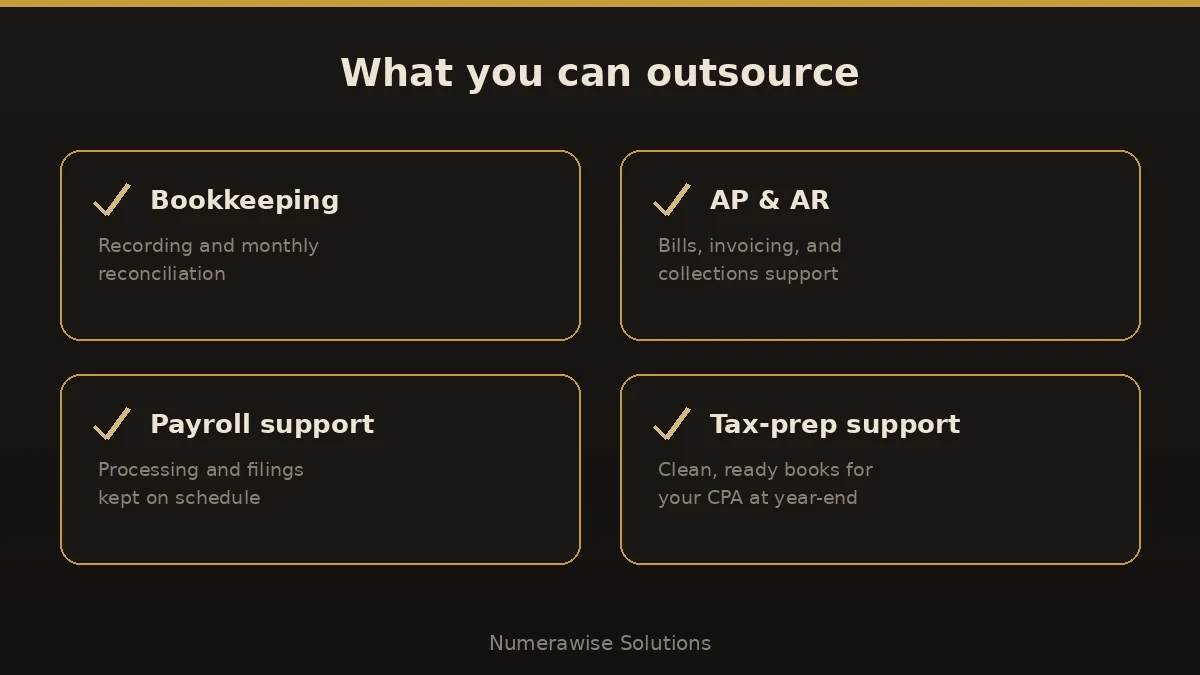
Check four things: data security (encryption, access controls, a signed agreement), a proven track record with references, clear communication with a named contact, and fluency in your software such as QuickBooks. Start with a pilot month before handing over everything, and avoid choosing on price alone.
Does accounting outsourcing India work for small businesses?
Yes. Small businesses often benefit most, because they get a full team’s coverage and clean, tax-ready books without the cost of hiring. The service scales with you, so you can start small — just bookkeeping, say — and add payroll or reporting later as you grow.
What is the difference between outsourcing and offshoring accounting?
Outsourcing means hiring an outside firm to do the work; offshoring means that work happens in another country. Accounting outsourcing to India is both — an external team, based offshore. Either way, you keep ownership of your data and set the scope; the provider delivers the work under contract.
Get a free scoping call.
Tell us what you’re working on. We respond same business day.

Ram · Founder & Principal
Founder of Numerawise Solutions, established MMXXIV in Atlanta. Intuit ProAdvisor Gold tier. Former Intuit Technical Support engineer. Has personally led two hundred accounting software conversions for US small businesses since founding the practice. Reachable directly at [email protected].
Free: The Clean-Cutover Checklist
The step-by-step checklist we use to migrate businesses to QuickBooks without losing data — bank rec, opening balances, payroll YTD, and the validation tie-out. Get it in your inbox.
No spam — just the checklist and the occasional QuickBooks tip.