Whether you handle it yourself or hand it off, the fundamentals behind bookkeeping checklist for small business are the same: track it, match it, report it — consistently.
Owners rarely fall behind on the books because they’re careless. They fall behind because the business is winning and bookkeeping sits at the bottom of a very long list. Closing that gap is precisely what a dependable bookkeeping service is for.
That’s the work our team does every day. We pick up the recording, reconciling, and reporting, coordinate with your CPA at tax time, and pair the books with payroll and sales-tax support so a single team covers the whole back office.
Bookkeeping Checklist for Small Business: a simple system
- Separate accounts. One business checking account and one business card. Personal stays personal.
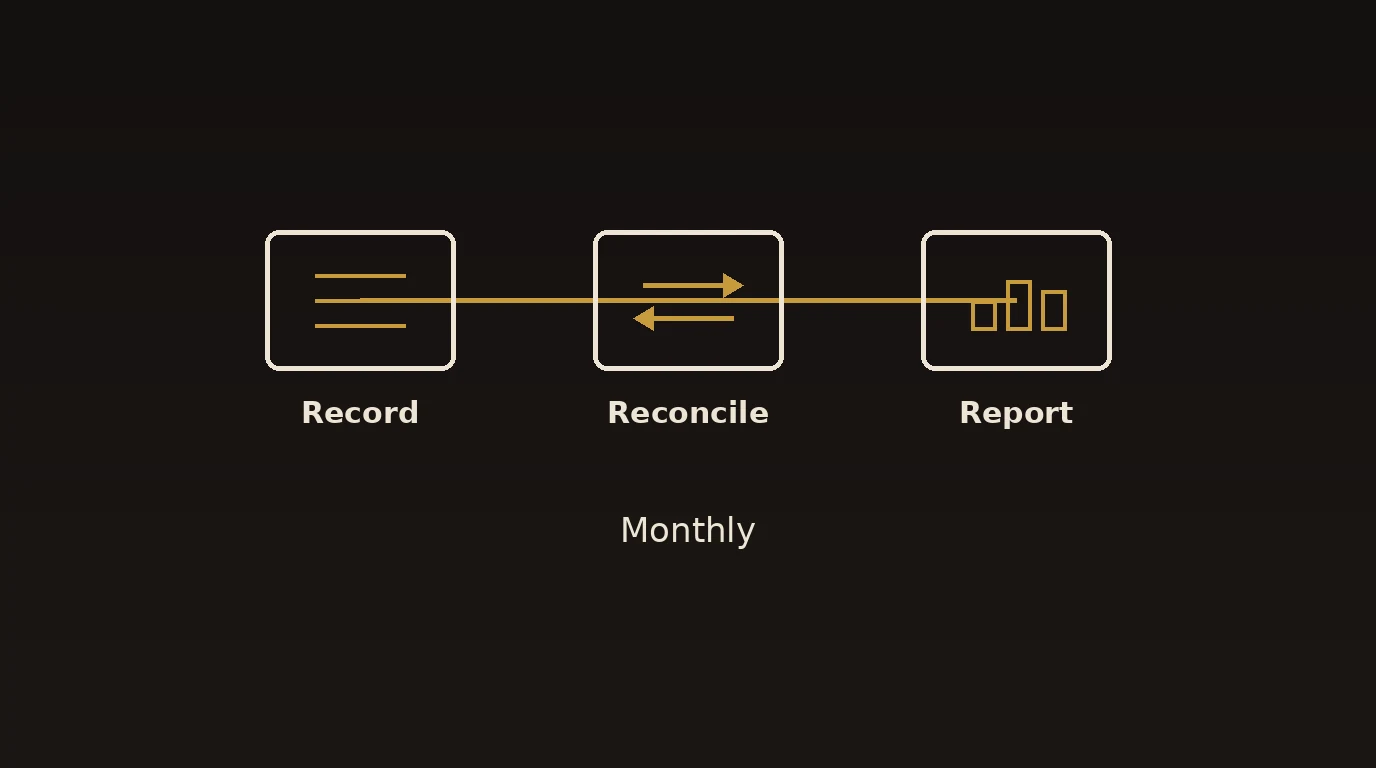
- Record as you go. Ten minutes a week beats a miserable afternoon at month-end. The five-step loop, and the cash-versus-accrual choice behind it, is in how to record your business transactions.
- Reconcile monthly. Match your books to every bank and card statement. Every entry has two sides, which is what makes the match possible; the mechanics are in double-entry bookkeeping explained.
- Categorize correctly. Wrong category, wrong tax — and buried deductions.
- Save receipts digitally. Snap it and attach it to the transaction.
- Review reports. Ten minutes with your P&L and balance sheet each month.
- Close the period. Lock it so filed numbers don’t quietly change.
Your monthly bookkeeping checklist
| Task | Frequency |
|---|---|
| Record income and expenses | Weekly |
| Reconcile bank and card accounts | Monthly |
| Review P&L and balance sheet | Monthly |
| Set aside tax money | Monthly |
| Track 1099 vendors | Year-round |
| Close the books | Monthly |
Benefits of a simple system
- You always know where you stand.
- Tax season is a handoff, not a scramble.
- Errors get caught in days, not months.
- You make decisions on real numbers.
Common mistakes to avoid
- Mixing personal and business spending. It muddies every report and weakens your LLC protection.
- Skipping monthly reconciliation. If the books don’t match the bank, they’re fiction.
- Guessing at expense categories. Wrong category, wrong tax — and buried deductions.
- Ignoring accounts receivable. Unpaid invoices are interest-free loans to your customers.
- Waiting until tax season. A year of catch-up costs far more than staying current.
- DIY-ing past your capacity. The mistake is white-knuckling it long after the business outgrew a spreadsheet.
Best practices that keep books clean
- Separate business and personal finances from day one.
- Reconcile every account monthly — bank, credit card, and loans.
- Use QuickBooks Online instead of manual spreadsheets, and connect your bank feeds.
- Review your profit and loss and balance sheet monthly, not just at tax time; if someone else keeps the books, use the 30-minute monthly review to check their work.
- Attach receipts to transactions so nothing is a mystery six months later — and write the business purpose in the same moment, because that is the one element nobody reconstructs later. See how to record business expenses correctly for what to capture and how long to keep it.
- Set aside money for taxes every month, and close each period on a checklist.
Why choose Numerawise Solutions
At Numerawise Solutions, bookkeeping is the core of what we do — not a side service. We’re QuickBooks specialists who handle setup, cleanup, and full QuickBooks setup and migration, and we pair the books with payroll services and outsourced bookkeeping so one team covers your whole back office. You get accurate monthly reports, a real person who answers when you email, and books that stay ready for your CPA all year.
If the routine starts eating hours you should spend on customers, our bookkeeping services takes it off your plate.
The bottom line
Good bookkeeping isn’t hard — it’s consistent. Follow a simple system, keep this checklist handy, and bookkeeping checklist for small business stops being a yearly chore and becomes a steady, dependable part of your operation.
Key takeaways
- Separate accounts, record weekly, reconcile monthly.
- Use a checklist and close each period.
- Go digital with receipts.
- Hand it off when it outgrows a spreadsheet.
Quick answers.
What is the simplest way to keep small business books?
Use a dedicated business account, record transactions weekly, reconcile monthly, and review your profit and loss. Cloud accounting software with connected bank feeds does most of the heavy lifting. The key is consistency — small and steady beats a quarterly panic every time.
What should be on a monthly bookkeeping checklist?
Record income and expenses, reconcile every bank and card account, review your P&L and balance sheet, set aside tax money, track 1099 vendors, and close the period. Running the same checklist each month keeps errors small and your reports trustworthy.
Can I do my own small business bookkeeping?
Yes, especially when you’re small and disciplined and understand the basics. The trade-off is time and the risk of compounding errors. Most owners start on their own and hand it off once bookkeeping competes with running the business or the numbers stop being trustworthy.
Do I need accounting software or is a spreadsheet fine?
A spreadsheet can work for a brand-new, very simple business, but it’s error-prone and hard to reconcile. Software like QuickBooks connects your bank feeds, reduces manual entry, and produces reliable reports — well worth it once you have real transaction volume.
How often should I reconcile my books?
Monthly, at minimum — every bank account, credit card, and loan. Monthly reconciliation catches errors and fraud while they’re fresh and keeps your reports accurate. Waiting longer turns routine work into a difficult, error-prone cleanup.
How do I organize receipts and documents?
Go digital. Photograph receipts and attach them to the matching transaction in your accounting software, and keep bank statements and filings in one organized place. The IRS accepts digital copies, and it means nobody has to guess what a charge was six months later.
How long should I keep bookkeeping records?
As a general rule, keep income records, receipts, statements, and tax filings for at least three to four years; some payroll and tax records longer. Digital storage makes this painless and protects you if you’re ever reviewed.
When should I stop doing my own books?
When the routine competes with running the business, when reconciliations fall behind, or when you can’t answer basic questions about cash flow. That’s the point where handing off to a professional saves more than it costs.
Get a free scoping call.
Tell us what you’re working on. We respond same business day.

Ram · Founder & Principal
Founder of Numerawise Solutions, established MMXXIV in Atlanta. Intuit ProAdvisor Gold tier. Former Intuit Technical Support engineer. Has personally led two hundred accounting software conversions for US small businesses since founding the practice. Reachable directly at [email protected].
Free: The Clean-Cutover Checklist
The step-by-step checklist we use to migrate businesses to QuickBooks without losing data — bank rec, opening balances, payroll YTD, and the validation tie-out. Get it in your inbox.
No spam — just the checklist and the occasional QuickBooks tip.