Books don’t fall apart in one dramatic moment. They drift — one skipped reconciliation, one bank rule that miscategorized 400 transactions, one bookkeeper who left in June. This guide walks through what a real cleanup involves, what it costs, how long it takes, and the Georgia-specific traps that catch business owners here more than anywhere else. That’s the honest case for bookkeeping cleanup in Atlanta GA.
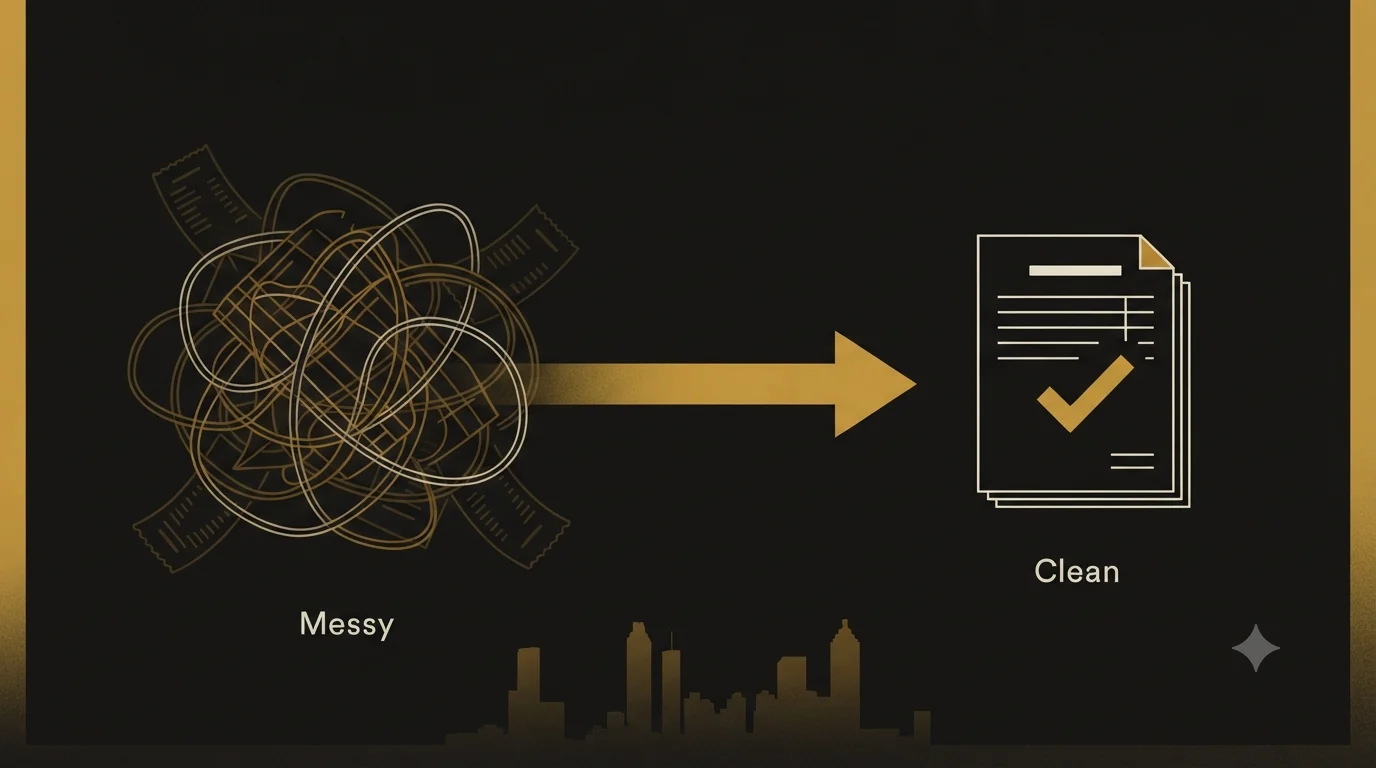
What is bookkeeping cleanup?
Bookkeeping cleanup is the process of correcting, reconciling, and reorganizing a set of financial records so they accurately reflect what actually happened in the business. It fixes existing data — the accounting equivalent of untangling a knot, not building a new rope. A proper cleanup ends with three things true at the same time:
- Every bank and credit card account reconciles to the statement, penny for penny.
- Every transaction sits in the right account, with the right date and the right class or job.
- The balance sheet contains only real balances — no mystery accounts holding the difference.
That third point is where most DIY attempts fall apart.
Cleanup vs. catch-up bookkeeping: they’re not the same
People use these interchangeably. They’re different jobs with different price tags, and knowing which you need saves you money.
| Bookkeeping cleanup | Catch-up bookkeeping | |
|---|---|---|
| The problem | Data exists but it’s wrong | Data doesn’t exist yet |
| Typical trigger | Balance sheet won’t tie, CPA rejected the file | Nobody’s touched the books since March |
| Main work | Diagnosing errors, undoing bad entries, reconciling | Entering transactions, categorizing, reconciling |
| Hardest part | Figuring out why it’s wrong | Volume |
| Cost driver | Complexity of the mess | Number of months and transactions |
| Typical range | $1,500–$9,000+ | $300–$600 per month behind |
Most real engagements are both — you’re 14 months behind and the last 14 months that were entered are wrong. That’s normal; don’t be embarrassed by it. If you’re mostly behind rather than mostly broken, our catch-up bookkeeping is the cheaper starting point.
Signs your Atlanta business needs a bookkeeping cleanup
You probably already suspect it. These are the tells we see most:
- Your bank accounts haven’t reconciled in 60+ days. The single biggest red flag.
- “Uncategorized Income” or “Uncategorized Expense” has a real balance. Anything above a few hundred dollars means transactions are guessing.
- Opening Balance Equity isn’t zero. After setup, this account should be empty. Money parked here is unexplained.
- Undeposited Funds keeps growing. Payments recorded but never matched to deposits — we’ve seen this hold six figures of phantom money.
- Your P&L shows a profit you can’t feel in your bank account — or a loss when you know you had a good year.
- Accounts Receivable includes invoices from 2022. Either paid and never applied, or never getting paid. Both need fixing.
- Your CPA charges you extra every year to “clean up the file.” You’re already paying for cleanup — at CPA rates.
- You can’t answer “what did we make last quarter?” without opening your bank app.
Any two of these together means the books aren’t giving you information. They’re giving you noise.
What a cleanup actually covers: a step-by-step look
Here’s the sequence a competent firm follows. Order matters — skip a step and you’ll redo the ones after it.
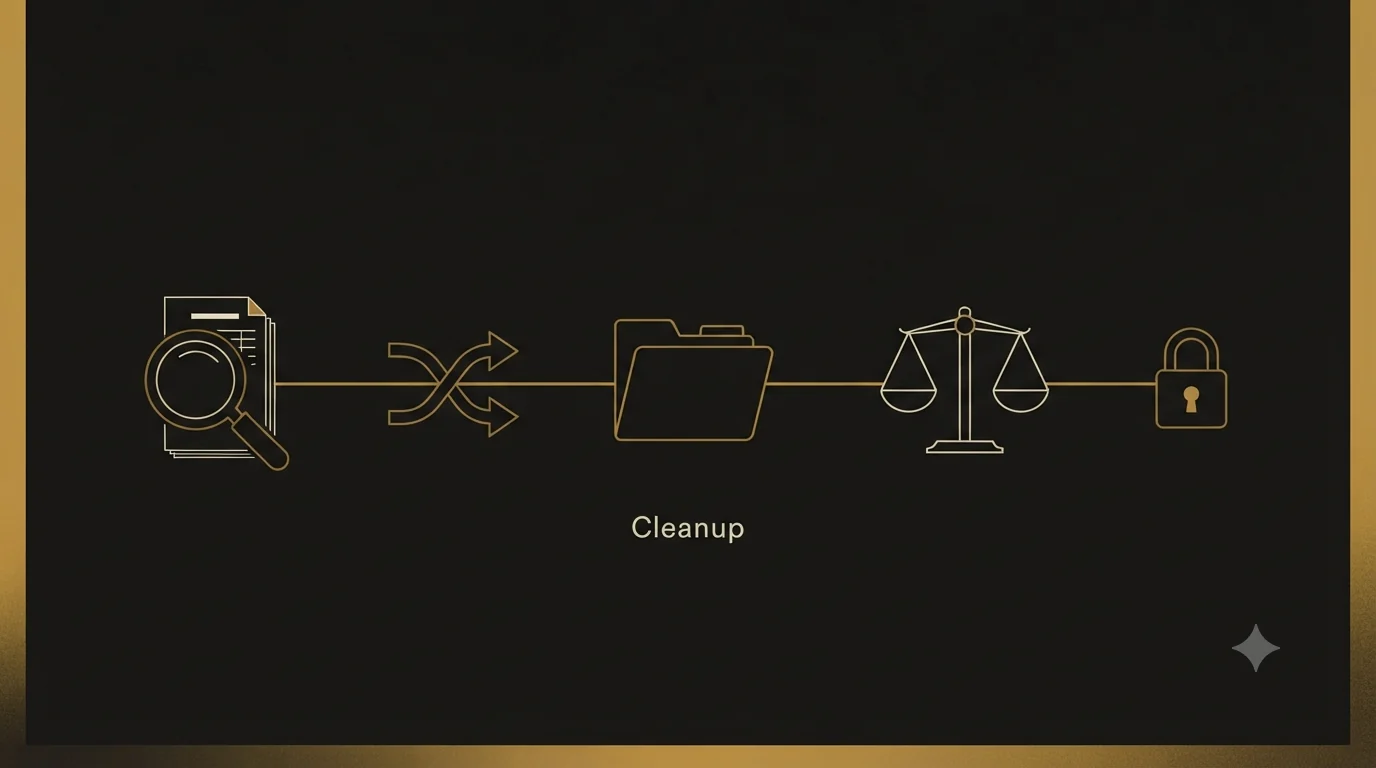
Step 1: Diagnostic review
Before touching anything, we pull the balance sheet, P&L, trial balance, and the audit log. The audit log matters more than people realize — it shows what was changed, when, and by whom, including deleted transactions and backdated edits. This is also where we check the chart of accounts: a COA that grew organically usually has three accounts that mean the same thing and one doing four jobs.
Step 2: Establish a clean starting point
You need a date where the books are known-good. Sometimes that’s the last CPA-adjusted year-end; sometimes it doesn’t exist and we create one. Never clean forward from a date you haven’t verified — you’ll build correct work on a broken foundation.
Step 3: Bank and credit card reconciliation
Month by month, in order, no skipping ahead. Two things surface here that surface nowhere else: duplicate transactions (usually from a bank feed connected twice) and missing deposits. Both distort revenue. If prior reconciliations were forced through with a “reconciliation discrepancy” adjustment, we unwind those — that account is where bad reconciliations go to hide.
Step 4: Fix the categorization
This is the slow part. Every miscategorized transaction gets moved to the right account. Common culprits in Atlanta small businesses:
- Owner draws recorded as expenses — inflates deductions and creates real tax exposure.
- Equipment purchases expensed instead of capitalized — a $12,000 skid steer isn’t “Supplies.”
- Credit card payments recorded as expenses — the expense hit when you swiped; recording it again double-counts.
- Personal charges left in the business account — they need to come out, usually to Owner’s Draw.
- Bank rules auto-categorizing everything from one vendor to one account — Home Depot isn’t always Materials.
Step 5: Clean the balance sheet
Every balance sheet account gets tied to something real: Cash to the bank statement, A/R to open invoice detail a customer would recognize, A/P to unpaid vendor bills you can put your hands on, Loans to a lender statement or amortization schedule, Payroll liabilities to your provider’s reports and filed returns, and Sales Tax Payable to your filed Georgia returns. If a balance can’t be explained by a document, it isn’t real.
Step 6: Adjusting entries and handoff
Depreciation, accruals, loan-interest splits, and any prior-year adjustments the CPA provided — then a written summary of what changed and why, because your CPA will ask, and “the bookkeeper fixed it” isn’t an answer that holds up.
Georgia-specific issues that show up in messy books
This is where a local firm earns its fee. National platforms miss these constantly.
Sales tax doesn’t match filed returns
Georgia’s state sales tax rate is 4%, but local option taxes stack on top. Inside the City of Atlanta you’re dealing with a combined rate meaningfully different from unincorporated Gwinnett or Cherokee County, and businesses that deliver across county lines get this wrong constantly. The cleanup issue usually isn’t the rate — it’s that Sales Tax Payable in QuickBooks doesn’t match what was actually remitted to the Georgia Department of Revenue. Someone paid the return but recorded the payment as an expense, so the liability never cleared. Always reconcile the liability account against filed returns in the Georgia Tax Center, not against what the software calculated.
Payroll liabilities that never clear
Georgia withholding goes to the DOR; unemployment goes to the Georgia Department of Labor. They’re separate filings on separate schedules, and the liability accounts get commingled all the time. We also see payroll recorded as a single lump-sum expense equal to the net cash that left the bank — that’s wrong, because it hides employer taxes entirely and understates true labor cost.
Construction job costing
Metro Atlanta runs on construction, and construction books break in specific ways: costs booked to the wrong job, no separation between direct and indirect costs, over/under billing never recorded, and everything dumped into a single “Cost of Goods Sold” account with no job detail. A cleanup that ignores job costing gives you a correct P&L that still can’t tell you which jobs made money.
Atlanta occupation tax certificates
Businesses operating inside city limits need a current occupation tax certificate, and renewal fees are gross-receipts based. If your revenue number in QuickBooks is wrong, your renewal is wrong too. Cleanup has downstream effects people don’t expect.
Benefits of a proper bookkeeping cleanup
The obvious benefit is that your taxes get filed. Here’s what else changes.
- You stop overpaying your CPA. When they spend eight hours untangling your file before preparing a return, you paid CPA rates ($200–$400/hr) for bookkeeping work.
- You can actually get financing. Every Atlanta bank wants two to three years of financials; a balance sheet that doesn’t balance ends the conversation.
- You find money. Duplicate vendor payments, unused software subscriptions, invoices never sent, deductions nobody claimed.
- You reduce audit risk. Cleanup removes round numbers, large miscellaneous categories, and personal expenses mixed into business deductions.
- You can price your work correctly. Once job costing is right, you often find a service line has been losing money for two years.
- You sleep better. Not a small thing.
Common mistakes that make cleanup harder
- Deleting transactions instead of correcting them. Deleting a reconciled transaction breaks its reconciliation — and every one after it. Void or correct, almost never delete.
- Using journal entries to force the balance sheet. A JE to A/R makes the number look right and destroys the customer detail underneath. Fix the source transaction.
- Starting a brand-new file. You lose history, comparatives, and job data. Start fresh only when the file is genuinely unrecoverable — rarer than people think.
- Cleaning out of order. Categorizing before reconciling means categorizing duplicates. Reconcile first, always.
- Letting bank rules run unsupervised. One bad rule silently miscategorizes hundreds of transactions over a year.
- Hiring the cheapest option. A $15/hour bookkeeper who’s never seen a Georgia sales tax return produces something that only looks finished.
- Not closing the books after. Set a closing date with a password — it takes 30 seconds and protects months of work.
Best practices to keep your books clean after cleanup
- Reconcile every account monthly. Errors caught in 30 days take minutes; errors caught in 30 months take days.
- Set and lock a closing date after each month closes.
- Keep business and personal completely separate. One business checking account, one business card.
- Review the balance sheet, not just the P&L. That’s where errors accumulate.
- Keep a real chart of accounts. Prune unused accounts; use classes and jobs for detail.
- Zero out Undeposited Funds monthly. A balance at month-end means something’s wrong.
- Attach documentation in the software. Six months later, nobody remembers what that $4,200 wire was for.
- Reconcile sales tax and payroll liabilities to filed returns quarterly. To the actual filings, not the software.
- Get a second set of eyes annually. Even good bookkeepers develop blind spots.
Why choose Numerawise Solutions for bookkeeping cleanup in Atlanta GA
We’re an Atlanta-based accounting firm, and cleanup is a large part of what we do — not a side service we tacked on.
- We know the software at a technical level. QuickBooks Desktop and Online, Sage 50, Xero, and FreshBooks, including full data migrations between them. When a file is broken at the data layer, we fix it rather than work around it.
- We understand Georgia compliance. DOR sales tax, Georgia withholding, DOL unemployment, Atlanta occupation tax — things we file, not things we look up.
- We’re built for construction and job costing. Prevailing wage, over/under billing, equipment allocation, WIP schedules.
- You get a written record. Every cleanup ends with documentation of what changed and why, formatted so your CPA can use it directly.
- We can stay on after. Cleanup is often the front door to ongoing outsourced bookkeeping services or payroll services — but there’s no obligation.
If you’re switching platforms as part of the cleanup, our QuickBooks migration services handle the conversion and the cleanup as one project instead of two.
Conclusion
Books rarely break because someone was reckless. They break because running a business takes everything you have, and reconciliation is never the loudest thing on the list. Then a lender asks for financials, or a CPA opens the file in March, and suddenly it’s the only thing on the list.
The good news: this is fixable, almost always, and usually faster than you’d guess. A messy QuickBooks file isn’t a moral failure — it’s a project with a defined start and end. If you’re weighing bookkeeping cleanup in Atlanta GA, start with the diagnostic; find out how deep the problem goes before you commit to a price or timeline. Any firm that quotes a flat fee without opening your file first is guessing. Get it fixed once, then set the closing date, reconcile monthly, and don’t let it happen again.
Key takeaways
- Cleanup fixes existing wrong data; catch-up enters missing data. Most businesses need both.
- Reconcile first, categorize second. Doing it backward means doing it twice.
- Uncategorized accounts, a non-zero Opening Balance Equity, and a growing Undeposited Funds balance are the three clearest signs your books need help.
- Georgia adds real complexity — DOR sales tax reconciliation, split DOR/DOL payroll filings, and film-credit documentation trip up out-of-state providers.
- Expect $1,500–$9,000+ depending on complexity, and 2–8 weeks depending on scope.
- Set a closing date with a password the day your cleanup finishes — it’s free and protects everything you paid for.
Quick answers.
How much does bookkeeping cleanup in Atlanta GA cost?
Most cleanups run $1,500 to $9,000, though complex multi-entity or construction files go higher. Price depends on how many months need work, transaction volume, how many accounts need reconciling, and how badly the existing data was entered. A file that’s simply behind costs far less than one where someone actively made things worse. Always ask for a diagnostic before a quote.
How long does a bookkeeping cleanup take?
A single year for a small service business typically takes two to three weeks. Two or three years with payroll, multiple bank accounts, and job costing can run six to eight weeks. The bottleneck is usually document collection, not the accounting work. If you can hand over every bank statement on day one, you’ll cut the timeline meaningfully.
What's the difference between cleanup and catch-up bookkeeping?
Cleanup fixes data that exists but is wrong. Catch-up enters data that was never recorded. If your books show numbers you don’t trust, that’s cleanup. If your books show nothing at all since March, that’s catch-up. Most real projects involve both — you’re behind and what was entered has problems. Pricing differs, so it’s worth clarifying upfront.
Can I do a bookkeeping cleanup myself?
You can, if the mess is small and you understand double-entry accounting. But most owners spend 20+ hours and still end up with a balance sheet that won’t tie, because the errors compound in ways that aren’t obvious from the front end. If your Opening Balance Equity isn’t zero or reconciliations were forced through, get help — those are structural problems.
How far back should a cleanup go?
Usually to your last CPA-adjusted year-end — that’s a verified starting point. If no clean point exists, we typically go back three years, matching the IRS standard assessment window. Going further rarely helps unless there’s a specific reason: an audit, a business sale, or a loan requiring longer history.
Will a bookkeeping cleanup trigger an IRS audit?
No. Correcting your records doesn’t flag anything. If cleanup reveals that a previously filed return was materially wrong, you may need an amended return — and that’s your CPA’s call, not your bookkeeper’s. But accurate books reduce audit risk. Messy records with large miscellaneous categories and round numbers are what draws attention.
Do I need a local Atlanta firm, or will a national service work?
National services handle straightforward books fine. Where they struggle is Georgia specifics — DOR sales tax reconciliation, the split between DOR withholding and DOL unemployment filings, film-credit documentation, and Atlanta occupation tax. If your business is simple, national is fine. If you’re in construction, production, or multi-county sales, local knowledge saves real money.
What do I need to provide for a bookkeeping cleanup?
Bank and credit card statements for every month in scope, prior-year tax returns, payroll reports, loan statements with amortization schedules, filed sales tax returns, and admin access to your accounting file. Missing documents are the most common cause of delay, so gather everything before the engagement starts rather than in pieces along the way.
Should I start a new QuickBooks file instead of cleaning up the old one?
Almost never. A new file loses your history, comparatives, customer and job detail, and every prior-year number. A fresh file only makes sense when the existing one is corrupted, has an unrecoverable structural problem, or the cleanup cost genuinely exceeds rebuilding. In fifteen-plus files out of twenty, cleanup is faster, cheaper, and leaves you with more.
How do I keep my books clean after the cleanup?
Reconcile every account monthly, set a password-protected closing date, and keep business and personal spending completely separate. Review the balance sheet — not just the P&L — each month. Zero out Undeposited Funds. Attach receipts inside the software. These habits take about two hours a month and prevent the entire problem from recurring.
Get a free scoping call.
Tell us what you’re working on. We respond same business day.

Ram · Founder & Principal
Founder of Numerawise Solutions, established MMXXIV in Atlanta. Intuit ProAdvisor Gold tier. Former Intuit Technical Support engineer. Has personally led two hundred accounting software conversions for US small businesses since founding the practice. Reachable directly at [email protected].
Free: The Clean-Cutover Checklist
The step-by-step checklist we use to migrate businesses to QuickBooks without losing data — bank rec, opening balances, payroll YTD, and the validation tie-out. Get it in your inbox.
No spam — just the checklist and the occasional QuickBooks tip.