Whether you’re weighing hiring a bookkeeper for a small business or just trying to figure out who does what, this guide lays out the roles, the timing, and the costs in plain language.
The right bookkeeping isn’t a compliance chore you dread each spring — it’s the quiet system that tells you what earns, what leaks, and what you can afford next. Set up well, it runs in the background and pays for itself.
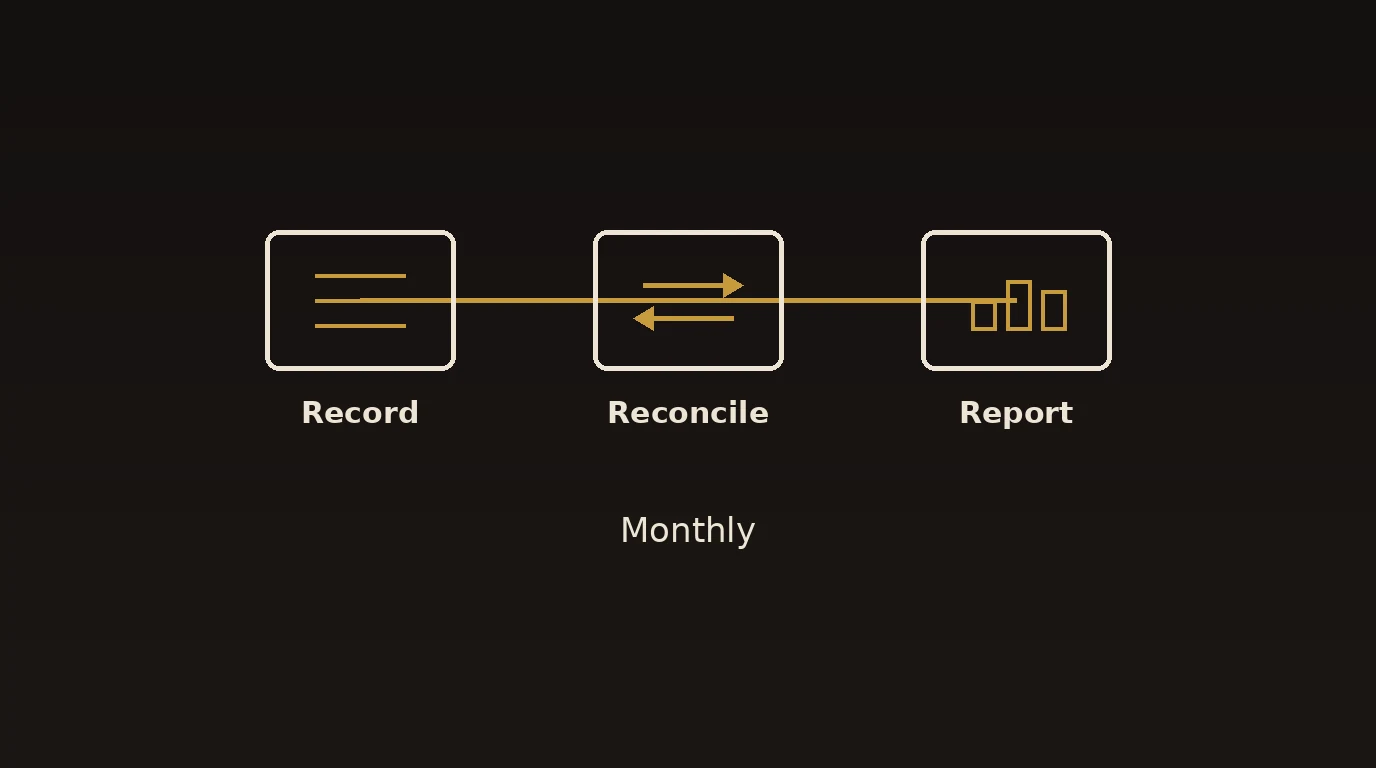
At Numerawise Solutions, we run your day-to-day bookkeeping as a done-for-you monthly service: we connect securely to your bank feeds and QuickBooks, record and categorize as the month unfolds, reconcile every account, and hand you a clean report package you can act on. You keep full ownership of your data — we just keep it accurate.
Hiring a Bookkeeper for a Small Business
People use the terms interchangeably, but they are different jobs.
Bookkeeper vs. accountant: what each does
| Bookkeeper | Accountant / CPA | |
|---|---|---|
| Main job | Records daily transactions | Interprets and advises |
| Typical tasks | Data entry, reconciling, reports | Tax strategy, filings, audits |
| Timing | Ongoing (weekly/monthly) | Periodic (quarterly/yearly) |
| Think of them as | Your scorekeeper | Your coach |
When should a small business hire a bookkeeper?
Bring one in when the books consistently fall behind, when your P&L doesn’t match your bank balance, when tax season is a fire drill, or when you’re spending hours on data entry that belong in sales. Two or more of those, and a bookkeeper pays for themselves fast.
Benefits of getting the roles right
- Lower CPA fees, because they advise instead of fixing your file.
- Accurate books you can borrow and plan against.
- Fewer surprises at tax time.
- Time back for the work only you can do.
Common mistakes to avoid
- Mixing personal and business spending. It muddies every report and weakens your LLC protection.
- Skipping monthly reconciliation. If the books don’t match the bank, they’re fiction.
- Guessing at expense categories. Wrong category, wrong tax — and buried deductions.
- Ignoring accounts receivable. Unpaid invoices are interest-free loans to your customers.
- Waiting until tax season. A year of catch-up costs far more than staying current.
- DIY-ing past your capacity. The mistake is white-knuckling it long after the business outgrew a spreadsheet.

Best practices that keep books clean
- Separate business and personal finances from day one.
- Reconcile every account monthly — bank, credit card, and loans.
- Use QuickBooks Online instead of manual spreadsheets, and connect your bank feeds.
- Review your profit and loss and balance sheet monthly, not just at tax time.
- Attach receipts to transactions so nothing is a mystery six months later.
- Set aside money for taxes every month, and close each period on a checklist.
Why choose Numerawise Solutions
At Numerawise Solutions, bookkeeping is the core of what we do — not a side service. We’re QuickBooks specialists who handle setup, cleanup, and full QuickBooks setup and migration, and we pair the books with payroll services and outsourced bookkeeping so one team covers your whole back office. You get accurate monthly reports, a real person who answers when you email, and books that stay ready for your CPA all year.
Many businesses use our bookkeeping services for the day-to-day and coordinate with a CPA for filing — the two work best together.
The bottom line
The short version of hiring a bookkeeper for a small business: a bookkeeper keeps the record straight all year; a CPA interprets it and files. You want both, and clean books are what make the CPA’s job — and bill — smaller.
Key takeaways
- Bookkeeping records; accounting interprets.
- Hire a bookkeeper once the books eat your time or fall behind.
- Clean books lower your CPA costs.
- Most healthy businesses use both.
Quick answers.
What’s the difference between a bookkeeper and a CPA?
A bookkeeper records and reconciles daily transactions and produces monthly reports. A CPA uses those records for tax preparation, planning, and higher-level advice. They’re complementary — clean bookkeeping lowers your CPA costs because your accountant advises instead of fixing your file.
Do I need both a bookkeeper and an accountant?
Often, yes. A bookkeeper keeps your records accurate all year; a CPA handles returns, planning, and complex filings. When your books are clean and current, your accountant spends less time fixing errors and more time saving you money.
When should a small business hire a bookkeeper?
Consider it when the books fall behind, when you can’t answer basic cash-flow questions, when tax season is a scramble, or when data entry competes with running the business. If two of those sound familiar, a bookkeeper usually pays for itself.
Can a bookkeeper file my taxes?
Generally no — filing returns and signing off on tax positions is a CPA or licensed tax preparer’s job. A bookkeeper prepares clean, reconciled books and hands them off so the filing is quick and accurate. The two roles work together.
Is a CPA more expensive than a bookkeeper?
Yes. CPAs bill $200–$400 an hour, while bookkeeping is usually a flat monthly fee. Paying a CPA to clean your books before they can file means paying CPA rates for bookkeeping work — another reason to keep the books current.
Can one firm do both bookkeeping and tax work?
Some firms offer both or coordinate closely with a CPA. Even when they’re separate, the smoothest setup has your bookkeeper deliver clean, current books directly to your tax preparer so nothing falls between the two.
What does a bookkeeper actually do each month?
Records income and expenses, reconciles every bank and card account, tracks AP and AR, and produces a profit and loss, balance sheet, and cash-flow summary. Many also support payroll and sales tax. The goal is books you can make decisions from.
Will hiring a bookkeeper save me money?
Usually. Beyond time saved, a bookkeeper catches miscoded expenses and missed deductions, keeps you compliant, and lowers your CPA bill. For most owners, the fee is less than the hours and errors it replaces.
Get a free scoping call.
Tell us what you’re working on. We respond same business day.

Ram · Founder & Principal
Founder of Numerawise Solutions, established MMXXIV in Atlanta. Intuit ProAdvisor Gold tier. Former Intuit Technical Support engineer. Has personally led two hundred accounting software conversions for US small businesses since founding the practice. Reachable directly at [email protected].
Free: The Clean-Cutover Checklist
The step-by-step checklist we use to migrate businesses to QuickBooks without losing data — bank rec, opening balances, payroll YTD, and the validation tie-out. Get it in your inbox.
No spam — just the checklist and the occasional QuickBooks tip.