Margins in the restaurant business are thin. Industry surveys from the National Restaurant Association have long put average pre-tax profit somewhere between 3 and 5 percent, which means a few sloppy months of record-keeping can quietly erase a year of hard work. Restaurant bookkeeping in Alabama adds its own wrinkles on top of that: layered state and local sales taxes, tip rules that changed again in 2025, and a payroll exemption that expired mid-year and caught plenty of operators off guard.
We handle the books for food-service and hospitality businesses every week, and the same problems show up again and again. This guide covers what actually matters — how to set up your accounts, which Alabama taxes apply to your sales, how to handle tips and delivery apps, and the mistakes that cost owners real money.
Why restaurant bookkeeping in Alabama is its own animal
A restaurant is not a normal small business from an accounting standpoint. You process hundreds of small transactions a day across cash, cards, gift cards, and delivery apps. Your biggest expense — food — changes price weekly and walks out the door through waste, comps, and theft. And a large share of your payroll flows through tips, which come with their own reporting rules.
Alabama layers extra complexity on top. The state runs a destination-based sales tax system where the 4% state rate is only the starting point. Counties and cities add their own rates, and some localities are self-administered, meaning they want their own separate return. A restaurant in Birmingham, Mobile, or Montgomery can easily face a combined rate around 10%. Get any one of these pieces wrong and the errors compound daily — which is why generic bookkeeping habits that work fine for a consulting firm fall apart in a kitchen.
Alabama taxes every restaurant owner needs to track
Sales tax on prepared food
Here is the part that confuses new owners the most. Alabama cut its state sales tax on groceries to 2% effective September 1, 2025 (Act 2025-305). That reduced rate does not apply to restaurants. Prepared food, hot food, and anything sold for immediate consumption is still taxed at the full 4% state rate, plus your county and city rates on top. Alabama uses the federal SNAP definition of “food” to draw the line, and restaurant meals fall outside it. Practical implications for your books:
- Program your POS with the correct combined rate for your exact location, and re-check it whenever a local rate changes.
- Track sales tax payable as a liability the moment the sale happens. That money was never yours.
- If you sell packaged retail items alongside meals (bottled sauces, whole coffee beans), some may qualify for the reduced grocery rate — map those items separately in your POS.
Filing through My Alabama Taxes
Most restaurants file sales tax monthly, due by the 20th of the following month, through the state’s My Alabama Taxes (MAT) portal. State-administered county and city taxes can be filed there too. Self-administered localities require a separate filing directly with the city or county — missing one of these is a common audit trigger. One bright spot: Alabama offers a collection discount for filing and paying on time — 5% on the first $100 of state tax and 2% on the rest, capped at $400 a month.
Other obligations worth calendaring
| Obligation | What it covers | Typical timing |
|---|---|---|
| State & local sales tax | Tax collected on food, drinks, and taxable retail | Monthly, due the 20th |
| Payroll withholding (Form A-6 or A-1) | Alabama income tax withheld from staff wages | Monthly or quarterly |
| Annual withholding reconciliation (Form A-3) | Year-end summary with W-2s | January 31 |
| Business privilege tax | Alabama’s entity-level tax; amounts of $100 or less are now exempt from filing | Annually, if owed |
| Local business licenses | City and county licenses tied to gross receipts | Usually annual renewal |
| ABC Board licensing | Required if you serve beer, wine, or spirits | Annual, plus purchase rules |
If you serve alcohol, budget extra time for compliance. Alabama’s Alcoholic Beverage Control Board licenses on-premises sales, and liquor purchasing runs through state channels, which affects how you cost your bar program.
Setting up restaurant books that actually work
Build a chart of accounts made for food service
A default chart of accounts buries the numbers you need. At minimum, split your revenue into food sales, beverage sales, and alcohol sales, and mirror that split in your cost of goods sold. Add contra-revenue accounts for comps and discounts so you can see what you are giving away, plus liability accounts for sales tax payable, tips payable, and gift cards outstanding. Third-party delivery deserves its own income line and its own fee expense line — you will thank yourself the first time you compare in-house margins against DoorDash margins.
Post a daily sales entry from your POS
Whether you run Toast, Square, Clover, or Lightspeed, the end-of-day report should drive one clean journal entry each day: gross sales by category, discounts, sales tax collected, tips owed to staff, and the split between cash and card payments. Card revenue flows through a clearing account until the processor deposit hits the bank, usually one to three days later. This single habit solves half the reconciliation problems we see — a missing deposit or a fee change jumps out immediately instead of six months later.
Pick a reporting calendar that matches reality
Restaurants live and die by weekends, and calendar months contain different numbers of them. Many operators switch to thirteen 4-week periods (or a 4-4-5 calendar) so every period has the same number of Fridays and Saturdays. Comparing “Period 7 vs. Period 6” suddenly means something. If you stick with calendar months, at least compare against the same month last year rather than the prior month.
Cash or accrual?
Small restaurants often file taxes on a cash basis for simplicity, but manage the business on a modified accrual basis — recording inventory changes, accruing payroll, and matching vendor invoices to the period the food was used. Pure cash-basis books will tell you what is in the bank. They will not tell you whether Tuesday’s dinner service made money.
Payroll, tips, and the rules that changed
Tip reporting still matters — a lot
Employees must report cash tips to you, and you must withhold Social Security and Medicare on them. Larger operations — food and beverage establishments with more than ten employees on a typical business day — also file IRS Form 8027 annually. There is an upside buried in here: the FICA tip credit (claimed on Form 8846) refunds much of the employer payroll tax you pay on reported tips. For a full-service restaurant, this credit routinely runs into thousands of dollars a year, and it only works if tip reporting is clean.
The federal “no tax on tips” deduction changed behavior, not obligations
Under the 2025 federal tax law, employees can deduct up to $25,000 in qualified tips on their personal returns through 2028, and there is a companion deduction for overtime premium pay. Here is what owners get wrong: tips are still subject to payroll taxes, still go on the W-2, and still must be reported through your normal process. The deduction happens on the employee’s tax return, not in your payroll. If anything, accurate tip records matter more now, because your reporting is what lets employees claim the deduction.
Alabama’s overtime exemption is over
From January 2024 through June 30, 2025, Alabama exempted overtime wages from state income tax. That exemption expired and was not renewed. If your payroll system is still skipping state withholding on overtime, you are building a liability with every pay run. Verify the setting, and check whether any 2025 W-2 corrections are needed for the split year.
Wage basics for tipped staff
Alabama has no state minimum wage law, so federal rules apply: a $2.13 tipped cash wage with a tip credit up to the $7.25 federal minimum. You are responsible for proving that tips actually bring each employee to minimum wage every workweek. That proof lives in your payroll records — one more reason tip tracking cannot be an afterthought.
Prime cost: the number that decides whether you make money
If you track only one metric weekly, make it prime cost.
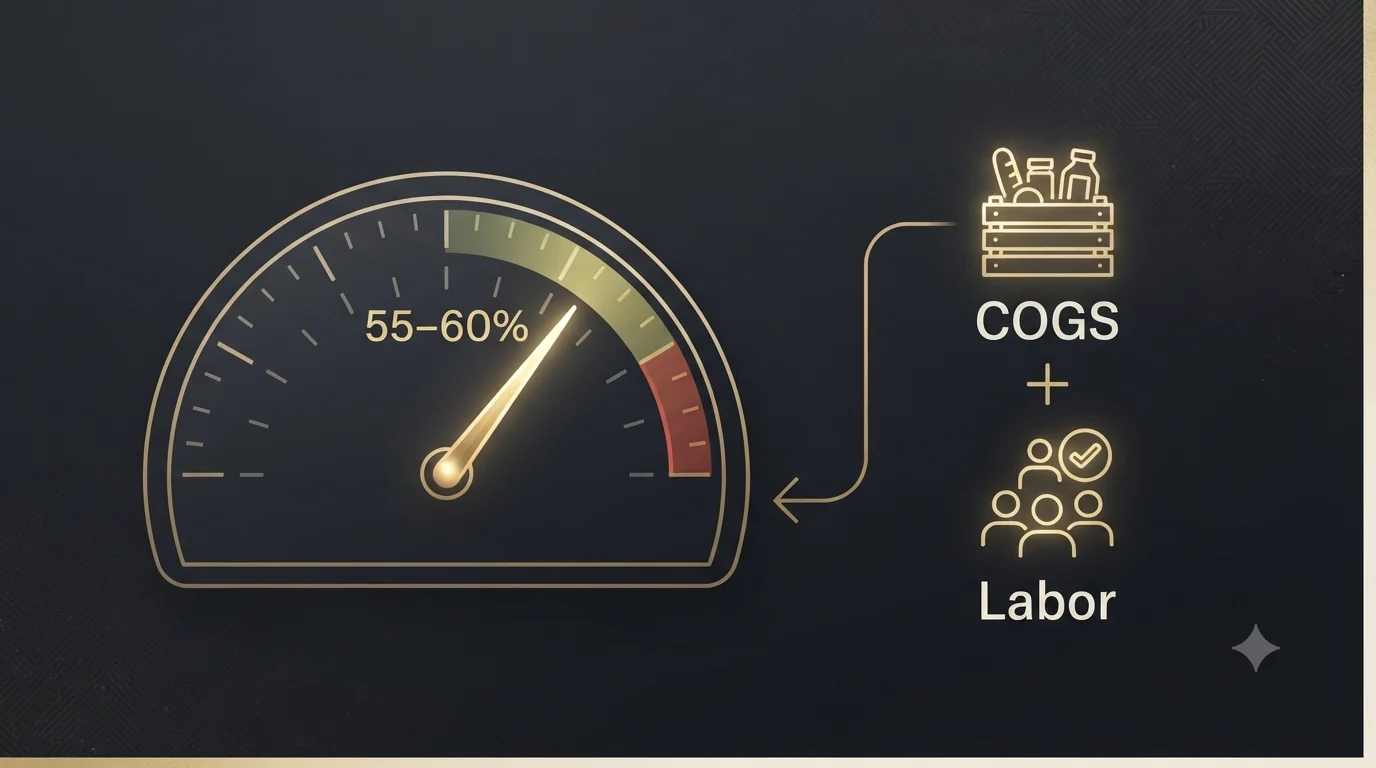
Prime cost = Cost of goods sold + Total labor cost (wages, payroll taxes, and benefits). Divide that by sales for the same period. Most healthy operations land between 55% and 60% of sales; creep past 65% and profit disappears fast.
Getting a real prime cost requires two habits:
- Count inventory weekly, or at least monthly, and adjust COGS for the change. Purchases alone are not food cost.
- Pull labor from actual payroll, including employer taxes — not just the wages on the schedule.
One example of why this matters: an operator we worked with showed a 31% “food cost” for months because deliveries were being expensed when paid, not when used. After proper inventory adjustments, real food cost was over 36%. That five-point gap was worth roughly $4,000 a month on their volume — money leaking through portioning and waste while the books said everything was fine.
Delivery apps, gift cards, and other modern headaches
Third-party platforms deposit net amounts — sales minus commissions, marketing fees, and adjustments. If you book the deposit as revenue, you understate both sales and expenses, and your food-cost percentage becomes fiction. Record gross sales from the platform statement, then book the fees as their own expense line. Also confirm, platform by platform, whether the app collects and remits Alabama sales tax on marketplace orders under the state’s marketplace facilitator rules. You want the tax remitted exactly once — not zero times, not twice.
Gift cards are a liability when sold, not revenue. Recognize the sale when the card is redeemed. Small detail, but it keeps December from looking artificially great and January from looking like a disaster.
Benefits of getting restaurant bookkeeping right
- Better pricing decisions. Accurate plate costs and category margins tell you which menu items carry the restaurant and which ones should go.
- Audit protection. Restaurants are frequent sales-tax audit targets in Alabama because they are cash-heavy. Clean daily records turn an audit from a crisis into an inconvenience.
- Loan and lease readiness. Bankers and landlords want current, credible financials. Books that reconcile get deals done faster.
- Theft and waste detection. Voids, comps, and inventory shrinkage show up in the numbers long before you catch them on camera.
- Real tax savings. The FICA tip credit, proper depreciation on equipment, and the on-time sales-tax discount all require organized records to claim.
- Less owner stress. Knowing your numbers weekly beats guessing quarterly, every time.
Many owners get these benefits fastest by handing the work to a firm that does it daily. Dedicated outsourced bookkeeping services typically cost less than one shift manager and pay for themselves in recovered credits and avoided penalties.
Common restaurant bookkeeping mistakes we see
- Booking net deposits as sales. The single most common error, and it distorts everything downstream.
- Wrong tax rate in the POS. Owners assume the reduced grocery rate applies to their food. It does not — prepared food is taxed at the full rate.
- No daily sales entries. Weekly or monthly lump entries make reconciliation nearly impossible and hide missing deposits.
- Skipping inventory adjustments. Without counts, your COGS is just a purchases report.
- Mixing personal and business spending. It muddies your margins and creates audit exposure.
- Missing self-administered local filings. Filing with the state does not always cover the city.
- Payroll settings frozen in time. The expired Alabama overtime exemption is the current example; systems left on autopilot keep making yesterday’s rules.
- Letting the books fall months behind. Late books mean late sales-tax returns, penalties, and blind decisions. A structured catch-up bookkeeping project can rebuild a full year from POS reports and bank statements — but the longer you wait, the more it costs.
Best practices worth adopting
- Post the daily sales journal entry from your POS close-out, every day, no exceptions.
- Run a weekly prime cost report and review it with your kitchen manager.
- Reconcile bank, merchant, and delivery-app statements monthly — three-way, not just the bank.
- Keep a compliance calendar for sales tax (the 20th), withholding filings, license renewals, and the January 31 A-3 reconciliation.
- Document every comp, void, and manager discount with a reason code in the POS.
- Review your P&L monthly as percentages of sales, not just dollars, and compare against the same period last year.
- Use software built to talk to your POS. QuickBooks paired with a daily sales integration covers most independents; a clean QuickBooks setup and migration upfront prevents years of workarounds.
Why choose Numerawise Solutions
Numerawise Solutions is a bookkeeping and accounting firm that works with restaurants, hospitality operators, and other service businesses across Alabama and the Southeast. Our team lives in QuickBooks Online and Desktop daily — building food-service charts of accounts, automating daily sales entries from POS systems, reconciling delivery platforms, and keeping sales-tax filings on schedule through My Alabama Taxes.
We also specialize in cleanup and migration work. If your books are behind, stuck in a legacy system, or held together by spreadsheets, we rebuild them properly and hand you financials you can actually use. Pricing is flat-rate and transparent, and everything is documented so you are never dependent on one person’s memory. Many restaurants keep us on for full outsourced bookkeeping with payroll included. You cook. We will count.
Final thoughts
Nobody opens a restaurant because they love reconciling merchant statements. But the operators who last are the ones who know their prime cost this week, not last quarter, and who never lose sleep over a sales-tax notice. Restaurant bookkeeping in Alabama rewards consistency: a daily sales entry, a weekly inventory count, a monthly three-way reconciliation, and a calendar that keeps the 20th of every month sacred.
Start with the basics in this guide. Fix your POS tax rates, separate your revenue categories, and get tips flowing through payroll correctly — especially now that the federal tip deduction makes accurate reporting valuable to your staff too. And if the backlog has grown past what a Sunday afternoon can fix, bring in help before penalties stack up. Clean books will not cook the food, but they will tell you whether the food is making you money.
Key takeaways
- Restaurant meals in Alabama are taxed at the full 4% state rate plus local rates — the 2% grocery rate does not apply to prepared food.
- Sales-tax returns are generally due the 20th of the following month through My Alabama Taxes; on-time filers earn a small discount.
- Alabama’s overtime withholding exemption expired June 30, 2025 — confirm your payroll system resumed state withholding on overtime.
- The federal tip deduction (through 2028) does not change employer obligations: tips still hit payroll taxes and W-2s.
- Track prime cost weekly and keep it in the 55–60% range.
- Record delivery-app sales gross, with fees as a separate expense.
- Daily sales entries plus monthly three-way reconciliation prevent most restaurant accounting disasters.