A restaurant owner in Sacramento once told us she had not looked at a profit-and-loss statement in eight months. Her POS said sales were up 12%. Her bank account said otherwise. When we rebuilt her books, the answer was sitting in three places nobody had checked: comped meals recorded as sales, a payroll burden that had quietly crossed 38% of revenue, and two quarters of use tax she did not know she owed.
That is the reality of restaurant bookkeeping in California. The margins are thin, the rules are stricter than almost anywhere else in the country, and the numbers move fast. A retail shop can review its books monthly and survive. A restaurant that waits 30 days to spot a food-cost problem has already lost the money. This guide covers what makes restaurant books different, the California-specific rules that trip up owners, and how to build a system that tells you where you stand every single week.
Why restaurant bookkeeping in California is its own discipline
General bookkeeping tracks money in and money out. Restaurant bookkeeping tracks perishable inventory, tipped labor, daily cash, and multi-rate sales tax — all at once, all the time. Here is what separates it from standard small-business books:
- High transaction volume. A busy restaurant runs hundreds of transactions a day across cards, cash, gift cards, and delivery apps. Each channel settles differently, and each needs to reconcile back to the POS.
- Perishable inventory. Your food inventory turns over every few days. Waste, spoilage, and portion creep hit your cost of goods sold immediately, not eventually.
- Tipped payroll. Tips flow through payroll, get taxed, and must be reported correctly — and California adds its own layer of rules on top of the federal ones.
- Razor-thin margins. Full-service restaurants often net 3–5%. There is no cushion for sloppy books.
And then California adds the hard mode: no tip credit, the highest labor-cost environment in the country, district-level sales tax rates, and city minimum-wage ordinances that change twice a year.
The chart of accounts: build it for a restaurant, not a generic business
Most bookkeeping problems we clean up start with a chart of accounts copied from a template built for consultants or contractors. A restaurant needs its own structure. The National Restaurant Association’s Uniform System of Accounts for Restaurants (USAR) is the industry standard, and it organizes your P&L around the numbers that actually run a restaurant.
Revenue accounts
Split sales by category at minimum: food, beverage (non-alcoholic), beer, wine, and liquor. If you sell alcohol, this split is not optional — your food-to-alcohol ratio matters for your ABC license, and your beverage cost percentages behave completely differently from food.
Cost of goods sold
Mirror your revenue categories. Food purchases go against food sales, wine purchases against wine sales. This is the only way to calculate a meaningful cost percentage per category. A blended “supplies” account tells you nothing.
Labor accounts
Separate front-of-house from back-of-house, and separate wages from the payroll burden — taxes, workers’ comp, and benefits. In California, that burden is heavy, and hiding it inside a single “payroll” line hides your real labor cost.
Prime cost: the number that runs your restaurant
Prime cost = COGS + total labor cost (including taxes and benefits). This single figure should sit at the top of every weekly review.
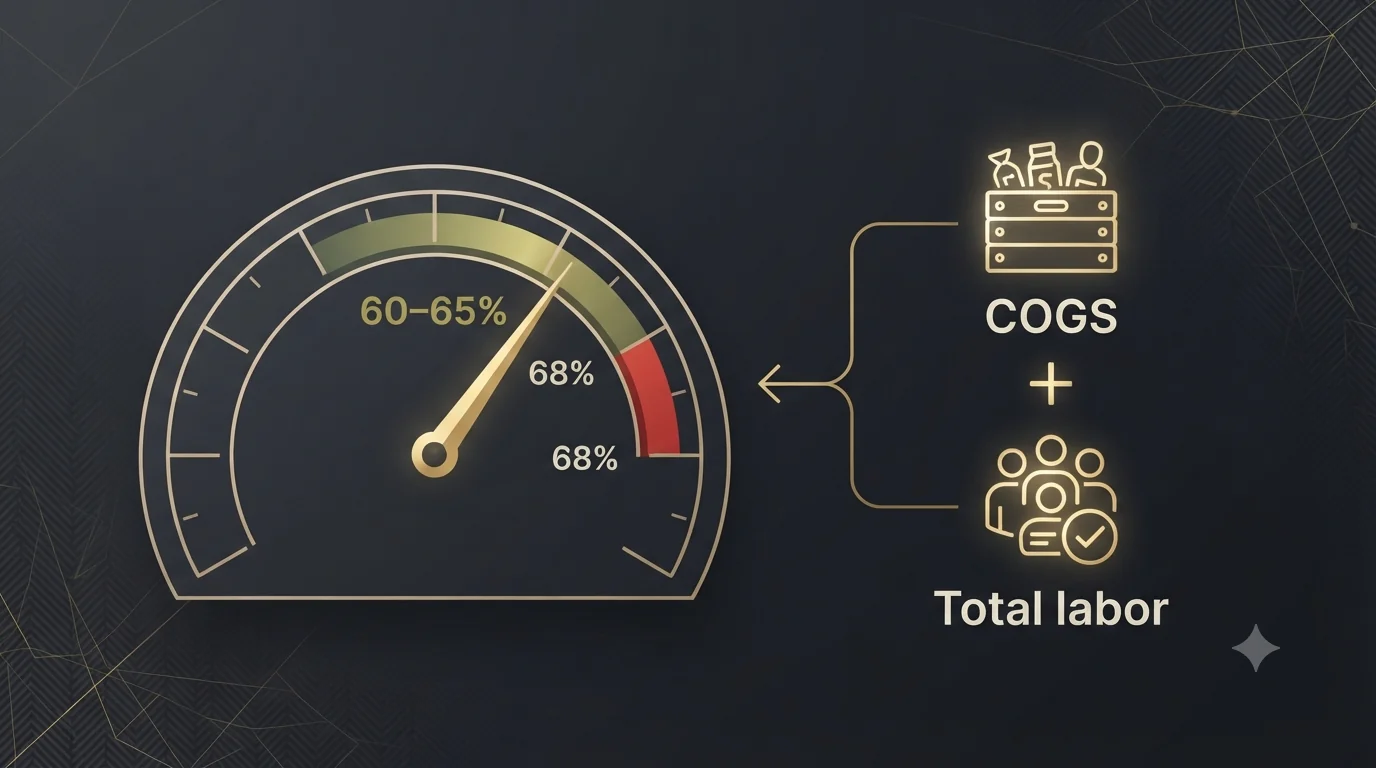
Healthy targets by concept:
| Restaurant type | Target prime cost | Danger zone |
|---|---|---|
| Full-service | 60–65% of sales | Above 68% |
| Fast-casual / QSR | 55–60% of sales | Above 65% |
| Bar-forward concepts | 50–58% of sales | Above 62% |
In California, labor pressure pushes many operators toward the top of these ranges. That makes the food-cost side of the equation even more important — it is the half you can still control week to week.
California-specific rules that change how you keep the books
This is where restaurant bookkeeping in California stops being generic advice and starts being survival.
1. Minimum wage is a moving target — and there is no tip credit
California’s statewide minimum wage increased from $16.50 to $16.90 per hour effective January 1, 2026, and California prohibits employers from taking a tip credit, so there is no separate lower rate for tipped workers. Your server earning $300 in tips on a Saturday still gets the full hourly wage. It gets more layered:
- Fast-food employees at chains covered by AB 1228 must be paid at least $20.00 per hour — a rule that applies to national chains with at least 60 locations.
- Dozens of cities run their own ordinances above the state rate. Los Angeles, Santa Monica, West Hollywood, and unincorporated LA County all adjust rates on July 1, while the state adjusts on January 1. Multi-city operators need location-based wage rules, verified twice a year.
- Exempt salaried employees (like some managers) must earn at least $70,304 per year in 2026 — double the state minimum for full-time work.
Bookkeeping impact: Wage changes mid-year mean your labor-cost percentage will drift even if hours stay flat. Track labor as a percentage of sales weekly so a July 1 city increase does not surprise you in September.
2. Sales tax is not one rate — it is a rulebook
The California Department of Tax and Fee Administration (CDTFA) governs restaurant sales tax, and the rules are genuinely tricky:
- Hot prepared food is taxable. Cold food sold to-go is generally not — but the 80/80 rule can pull cold to-go items into taxability if more than 80% of your sales are food and more than 80% are taxable.
- Mandatory service charges and auto-gratuities are taxable. Voluntary tips are not. If your POS adds an automatic 18% to parties of six, that charge is part of your taxable sales. Miscoding this is one of the most common audit findings we see.
- District taxes stack. The statewide base rate combines with county and city district taxes, so your effective rate depends on your exact address — and it changes when districts pass new measures.
- Delivery-platform sales (DoorDash, Uber Eats) are generally handled by the marketplace facilitator, but you still need to report them correctly and back them out so you do not pay tax twice.
Bookkeeping impact: Sales tax collected is a liability, never revenue. Book it to a liability account daily, reconcile it against your CDTFA filings quarterly, and keep POS tax settings reviewed whenever rates change.
3. Tip reporting has two masters
- Employees must report cash tips of $20 or more per month to you, and all tips flow through payroll for withholding.
- Large food and beverage establishments (more than 10 employees on a typical day) file IRS Form 8027 annually, reporting gross receipts and tips.
- California treats tips as the employee’s property. No deductions for card-processing fees on tips, no tip pooling that includes owners or most managers.
Bookkeeping impact: Credit-card tips paid out through payroll need a clearing account. Tips collected on cards sit as a liability until they hit paychecks. If your books show tip income or tip expense on the P&L, something is coded wrong.
4. Payroll compliance is where penalties live
Daily overtime after 8 hours (not just weekly after 40), meal and rest-break premiums, split-shift premiums, reporting-time pay — California wage law generates pay items that most out-of-state payroll setups do not handle. Under the reformed PAGA framework, documented compliance steps can cap penalties significantly, which makes accurate, provable payroll records a frontline defense, not just good hygiene. Your books should be able to show, for any pay period, exactly what was paid, at what rate, at which location.
The weekly rhythm: how well-run restaurant books actually work
Monthly bookkeeping is too slow for a restaurant. The operators who stay profitable run a weekly cycle:
- Daily: POS sales close out and post to the books — sales by category, sales tax liability, tips liability, comps and discounts, and cash deposits. Every day gets reconciled against the merchant deposit.
- Weekly: Enter or sync all vendor invoices. Run a flash report: sales, COGS from purchases, labor cost, and prime cost percentage. Count high-value inventory (proteins, liquor).
- Every 4 weeks: Close the period. Full inventory count, true up COGS (beginning inventory + purchases − ending inventory), reconcile all bank and credit-card accounts, review the P&L against the same period last year.
- Quarterly: File sales tax with CDTFA, reconcile payroll tax filings, review tip reporting.
Notice the “every 4 weeks” instead of monthly. Many restaurants close on thirteen 4-week periods instead of twelve calendar months, so every period contains the same number of Fridays and Saturdays and period-over-period comparisons actually mean something. February versus March is a distorted comparison; Period 2 versus Period 3 is clean.
DIY, in-house, or outsourced: comparing your options
| Factor | DIY (owner) | In-house bookkeeper | Outsourced restaurant bookkeeping |
|---|---|---|---|
| Typical monthly cost | Your time (10–20 hrs) | $4,500–$6,500 (salary + burden) | $400–$1,500 |
| Restaurant expertise | Usually limited | Varies widely | Specialized (if you choose right) |
| California compliance depth | Risky | Depends on hire | Built into the service |
| Weekly flash reporting | Rarely happens | Possible | Standard with good providers |
| Scales with multiple locations | Poorly | Needs more staff | Easily |
The honest math: an owner doing their own books at 15 hours a month is spending prime-cost-review time on data entry. An owner paying for outsourced bookkeeping services built for restaurants usually recovers the fee in caught errors alone — duplicate vendor charges, miscoded sales tax, and payroll misclassifications add up fast.
Benefits of getting restaurant bookkeeping right
- You see problems in days, not quarters. A prime cost that jumps from 62% to 66% shows up in the next weekly flash report, while you can still fix the schedule or reprice the menu.
- Audit protection. CDTFA audits restaurants at a higher rate than most industries because of cash handling. Clean daily sales records, documented comps, and reconciled tax liabilities turn an audit from a crisis into paperwork.
- Real menu engineering. Category-level COGS lets you price from data. If wine cost is running 32% and your target is 28%, you know exactly where to look.
- Lending and growth readiness. Banks and landlords want clean financials. A second-location deal moves faster when your P&L is credible.
- Lower tax bill, legally. Accurate books capture every deductible expense and set your CPA up to actually plan, not just file.
Common restaurant bookkeeping mistakes we clean up constantly
- Recording POS deposits as sales. The bank deposit is sales minus tips paid out, minus processing fees, plus sales tax collected, shifted by settlement timing. Booking deposits as revenue understates sales and buries your tax liability.
- Mixing sales tax into revenue. Then the “revenue” gets spent, and the quarterly CDTFA bill becomes a cash crisis.
- One giant “supplies” or “food” account. No category split means no cost percentages, which means no control.
- Ignoring inventory in COGS. Purchases alone are not COGS. Without counts, a big stock-up week looks like a terrible cost week and a run-down-the-shelves week looks great. Both are lies.
- Comps and voids vanishing. Untracked comps distort food cost and are a classic audit red flag.
- Personal expenses through the business. Common, understandable, and toxic to your books and your tax position.
- Falling months behind. Restaurant books decay fast. If you are more than a quarter behind, catch-up bookkeeping that reconstructs POS data, merchant statements, and vendor records is worth every dollar — guessing at prior periods poisons every comparison going forward.
Best practices that separate profitable operators
- Integrate your POS with your accounting system. Toast, Square, or Clover data should flow into QuickBooks daily via a proper sales mapping — not a lump-sum deposit entry. If you are moving off an older platform, a clean QuickBooks migration with a restaurant-specific chart of accounts is the right moment to fix structural problems.
- Reconcile every account, every period. Bank, credit cards, merchant processor, tip clearing, sales tax liability, gift card liability. All of them.
- Track gift cards as liabilities. Selling a gift card is not revenue yet. Redemption is.
- Watch the delivery apps separately. Third-party platforms take 15–30% and settle on their own schedule. Book their fees as an expense against gross sales so your food-cost percentage stays honest.
- Document your comp policy. Manager meals, marketing comps, and mistakes each get their own treatment. Consistency is what survives an audit.
- Review a flash report every Monday. Sales, prime cost, labor percentage, and cash position. Fifteen minutes that will save your year.
Why choose Numerawise Solutions
Numerawise Solutions works with restaurants, bars, and hospitality businesses across California, and the difference shows in the details. We build USAR-based charts of accounts, run weekly prime cost reporting instead of stale monthly summaries, and keep your CDTFA sales tax, tip clearing, and payroll liability accounts reconciled to the dollar.
Our team handles daily POS-to-books integration for Toast, Square, and Clover, manages multi-location wage compliance across California’s patchwork of city ordinances, and specializes in cleanup and catch-up work when books have fallen behind. If you are switching accounting systems, we also handle full QuickBooks conversions from legacy platforms without losing your history. Many restaurants keep us on for full outsourced bookkeeping with payroll included — transparent pricing, no long-term contracts, and financials you can actually run a restaurant with.
The bottom line
Restaurant bookkeeping in California is not harder because the math is complicated. It is harder because the state layers no-tip-credit wage law, shifting city minimums, multi-rate sales tax, and aggressive audit exposure on top of an industry that already runs on 4% margins. The operators who win treat their books as an operating tool, not a tax-season chore: daily POS reconciliation, weekly prime cost reviews, four-week periods that compare cleanly, and liability accounts that never mix with revenue.
Whether you do it yourself, hire in-house, or bring in a specialist, the standard is the same — you should know your prime cost from last week, your sales tax liability today, and your true labor percentage at every location. If your current books cannot answer those three questions, that is the gap to close first.
Key takeaways
- Prime cost (COGS + total labor) is the number to watch weekly; keep full-service concepts in the 60–65% range.
- California has no tip credit — tipped staff earn the full minimum wage, which rose to $16.90 statewide in January 2026, with many cities higher and fast-food chains at $20+.
- Sales tax collected is a liability, not revenue; mandatory service charges are taxable, voluntary tips are not.
- Close books on thirteen 4-week periods for clean period-over-period comparisons.
- Reconcile POS-to-bank daily; deposits are not sales.
- Track gift cards, tips, and sales tax in dedicated liability accounts.
- If books are behind, invest in professional catch-up before making decisions on bad data.