Whether you run a Wynwood café, a Brickell steakhouse, or a Little Havana ventanita, the same money problems show up: tip reporting, sales tax, delivery-app fees, and payroll that never sits still. Good restaurant bookkeeping in Miami isn’t just recording what happened — it’s giving you numbers fast enough to act on them.
What makes restaurant bookkeeping in Miami different
Bookkeeping for a law firm or a boutique is fairly steady. Restaurants are not. You’re handling hundreds of small transactions a day, cash and cards, tips flowing to staff, inventory that spoils, and revenue that swings with the tourist calendar. Add Miami’s local flavor:
- Seasonality. Winter high season packs the dining rooms; late summer and hurricane season slow things down. Your books need to show the cycle so you can plan cash for the quiet stretch.
- A no-income-tax state. Florida has no state income tax, a real advantage for owners and staff — but it makes federal and payroll reporting the main compliance job.
- Heavy competition. With one of the densest restaurant scenes in the country, small percentage points on prime cost decide who survives.
The numbers that keep a Miami restaurant alive
If you only watch a few metrics, watch these.
Prime cost
Prime cost is the single most important number in a restaurant. It combines your two largest, most controllable expenses:
Prime cost = cost of goods sold (food + beverage) + total labor cost (wages, payroll taxes, and benefits)
Most full-service restaurants aim to keep prime cost around 55–65% of total sales. Once it drifts past that range, profit disappears fast. The catch is timing: if you only calculate prime cost once a month, you find out about a problem 30 days too late. Smart operators run a quick weekly flash report so a bad food-cost week gets fixed the next week.

Food and beverage cost percentages
Break your cost of goods into food and beverage so you can spot exactly where money leaks.
| Category | Formula | Typical target range |
|---|---|---|
| Food cost % | Cost of food sold ÷ food sales | 28–35% |
| Liquor cost % | Cost of liquor sold ÷ liquor sales | 18–24% |
| Beer / wine cost % | Cost sold ÷ related sales | 24–35% |
Ranges are general industry benchmarks published by groups like the National Restaurant Association. Your ideal target depends on your concept, menu, and pricing.
Daily sales reconciliation
Your POS (Toast, Square, Clover, and the like) produces a daily sales summary. That number has to tie out to what actually lands in your bank account. In between sit cash, credit card settlements, gift cards, comps, voids, discounts, and delivery-app payouts. Reconciling this daily or at least weekly is where a lot of small theft and simple errors get caught. It also keeps your sales tax accurate, because the tax you owe is based on real taxable sales, not a guess.
Sales tax rules every Miami restaurant must follow
This is where owners get burned most often, because sales tax money never actually belongs to you — you’re just holding it for the state. In Miami-Dade County, the combined sales tax rate is 7%: the 6% Florida state rate plus a 1% Miami-Dade discretionary surtax. Restaurant meals and prepared food are taxable, even though groceries for home consumption are exempt. So the plate of stone crabs, the mojito, and the takeout empanadas all get taxed; a bag of raw groceries from a market does not. A few practical points:
- You collect it, then remit it. The Florida Department of Revenue expects that 7% back. Most restaurants file monthly, with returns due on the 1st and late after the 20th.
- Set it aside. Keep collected sales tax in a separate bank account so it’s never accidentally spent on payroll or produce.
- A recent win for restaurants: Florida repealed the sales tax on commercial rent effective October 1, 2025. If your landlord is still adding that charge to your lease, flag it — you shouldn’t be paying it anymore.
Getting sales tax wrong triggers penalties and interest quickly. This is one area where accurate, current books pay for themselves.
Payroll, tips, and the new federal tip rules
Payroll is the messiest part of restaurant accounting, and 2026 added a fresh layer.
Florida wage rates for tipped staff
As of mid-2026, Florida’s minimum wage is $14.00 per hour, and it rises to $15.00 on September 30, 2026 — the final step of the Amendment 2 schedule voters approved in 2020. For tipped employees, the direct cash wage is $10.98 per hour right now, increasing to $11.98 on September 30, 2026. Employers may take a fixed tip credit of $3.02 per hour. The rule that matters most: if an employee’s cash wage plus tips doesn’t reach the full minimum wage for every hour worked, you must make up the difference. The U.S. Department of Labor enforces this, and shortfalls are a common source of wage claims.
Tip reporting and the 2026 W-2 changes
Tips are taxable income. Employees must report monthly tips of $20 or more to you, and you withhold income tax and FICA (Social Security and Medicare) on those reported tips. Larger establishments — generally more than 10 employees — also file IRS Form 8027. Don’t overlook the FICA tip credit (Form 8846): it lets you claim a credit for the employer share of Social Security and Medicare tax paid on tips above the minimum-wage level. Many restaurants leave real money on the table by ignoring it.
The big update: the federal “No Tax on Tips” provision (part of the law signed July 4, 2025) gives qualifying tipped workers a federal income-tax deduction of up to $25,000 on voluntary tips for tax years 2025 through 2028. What owners need to understand:
- Payroll doesn’t change. You still withhold and remit as usual. FICA and payroll taxes still apply — the deduction is claimed by the employee on their personal return.
- Your reporting does change. Beginning with tax year 2026 W-2s, employers must separately report qualified tips in Box 14a, plus the worker’s Treasury Tipped Occupation Code in Box 14b. Your payroll records need to capture occupation codes and keep clean tip totals.
- Service charges are not tips. Automatic gratuities (like an 18% charge on large parties) don’t qualify and must be tracked separately as wages. Blurring the two is one of the fastest ways tip reporting goes wrong.
Since Florida has no state income tax, this deduction is a pure federal benefit for your staff — no state complication to manage.
| Voluntary tip | Mandatory service charge | |
|---|---|---|
| Who decides the amount | The customer | The restaurant |
| Belongs to | The employee | The business (until distributed) |
| Counts as “qualified tip” | Yes | No |
| Treated in books as | Tip income / pass-through | Revenue, then wages if shared |
Third-party delivery apps and your books
Uber Eats, DoorDash, and Grubhub are now a huge slice of revenue — and a common bookkeeping trap. These platforms deposit money net of their commission, which often runs 15–30%. If you simply record the net deposit as your sales, two things break: you understate your true sales (throwing off your food-cost and sales-tax numbers) and you hide the commission expense you’re actually paying.
Why the gross-versus-net entry matters, with figures: restaurant bookkeeping, the five entries that break the books.
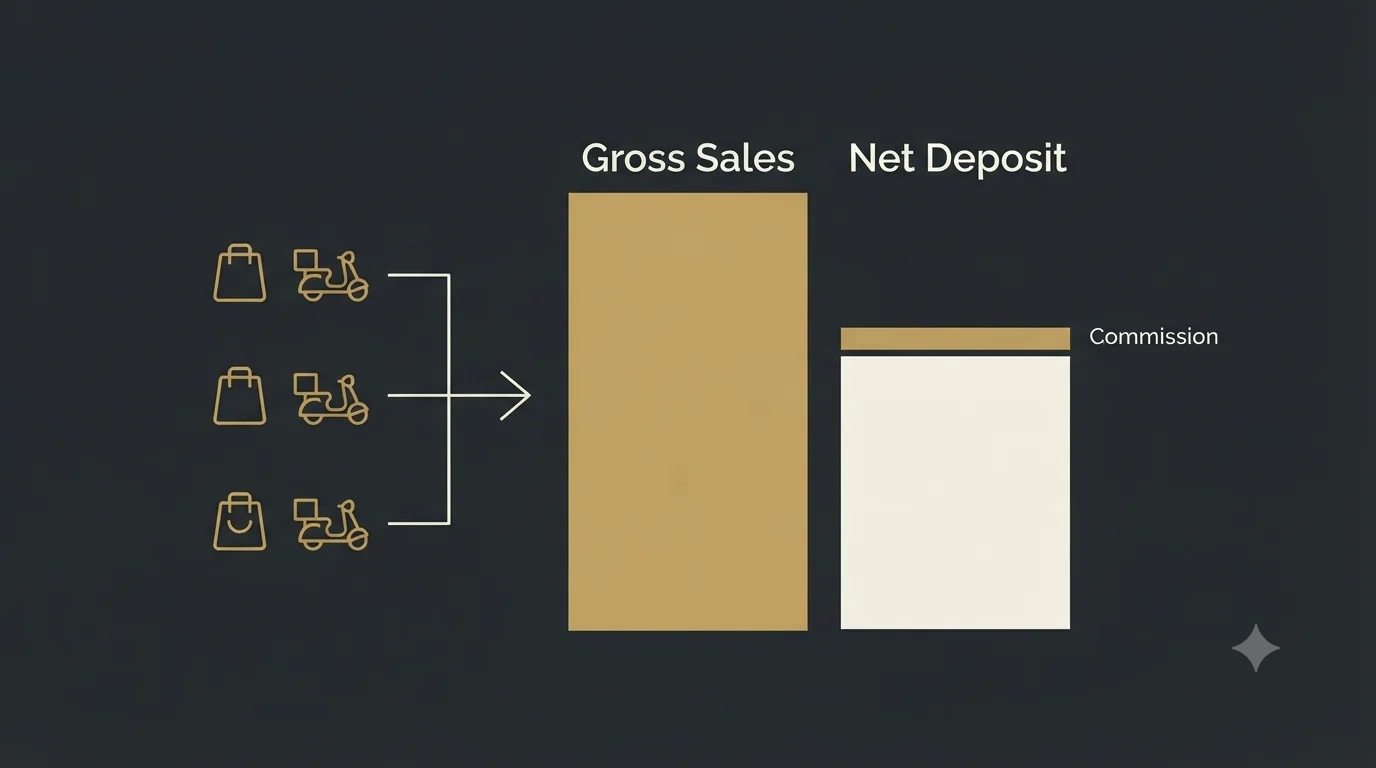
The correct approach is to record the gross sales, then book the commission and marketing fees as a separate expense, and reconcile each platform’s payout on its own. When you see the real cost of each app side by side, menu pricing and channel decisions get a lot clearer.
Benefits of strong restaurant bookkeeping in Miami
- Real-time visibility into prime cost, labor, and cash on hand.
- Accurate, on-time sales tax filings — no surprise penalties from the Department of Revenue.
- Audit-ready payroll and tip records, including the new 2026 W-2 details.
- Smarter pricing and scheduling based on numbers, not gut feel.
- Loan, insurance, and investor readiness — which matters in a hurricane-prone market where business-interruption claims demand clean records.
- More of your time on the floor, less buried in spreadsheets.
Common restaurant bookkeeping mistakes
- Recording only net delivery-app payouts instead of gross sales plus commission.
- Mixing personal and business spending — the “quick” personal charge on the restaurant card that muddies every report.
- Ignoring the FICA tip credit, and handing the IRS money you didn’t owe.
- Treating service charges as tips (or the reverse), a bigger compliance issue under the 2026 rules.
- Doing the books monthly, so problems surface far too late.
- Skipping POS-to-bank reconciliation, letting small losses go unnoticed.
- Booking gift cards as revenue when sold. A sold gift card is a liability until the guest redeems it.
- Falling behind entirely and scrambling for catch-up bookkeeping right before tax season.
Best practices for restaurant bookkeeping
- Use a restaurant-specific chart of accounts that separates food, beverage, and alcohol revenue and cost.
- Reconcile daily sales to deposits, and reconcile the bank monthly.
- Run a weekly flash P&L and prime cost report so you can adjust fast.
- Keep tips and service charges separate, and capture occupation codes for W-2 Box 14b.
- Integrate your systems. Connecting your POS and payroll services to accounting software cuts manual entry and errors — a clean QuickBooks setup and migration makes this far easier.
- Count inventory on a consistent schedule so cost of goods is real, not estimated.
- Park sales tax in its own account the moment you collect it.
- Close the books monthly on a checklist, and keep tip records for at least three years, as the IRS recommends.
Why choose Numerawise Solutions
Plenty of bookkeepers can enter transactions. Fewer understand a restaurant’s moving parts — tips, job-level costing, delivery-app reconciliation, and Florida sales tax — the way Numerawise Solutions does. Our focus is practical: accurate books delivered on a weekly cadence, so you’re never flying blind.
We handle full-service outsourced bookkeeping services, clean up months of neglected records with catch-up bookkeeping, and set up or migrate your accounting into QuickBooks so your POS, payroll, and reports finally talk to each other. If tip reporting, the new W-2 rules, or a stack of unreconciled statements are keeping you up at night, that’s exactly the work we take off your plate. You run the kitchen. We keep the numbers honest.
The bottom line
Restaurants live and die on small margins, and in a market this competitive, guessing isn’t a strategy. Strong restaurant bookkeeping in Miami gives you the one thing every owner needs and few have: a clear, current picture of where the money is going while there’s still time to fix it.
Nail the fundamentals — a weekly prime cost, honest sales reconciliation, correct 7% sales tax, clean tip and payroll records, and delivery-app income booked in full. Those habits protect your cash, keep you compliant with the IRS and the Florida Department of Revenue, and make every pricing and staffing decision sharper. Whether you handle it in-house or bring in a specialist like Numerawise Solutions, treat your books as a management tool, not an afterthought.
Key takeaways
- Prime cost (COGS + labor) is the number to watch — aim for roughly 55–65% of sales and check it weekly.
- Miami-Dade restaurants charge a 7% sales tax (6% state + 1% county surtax) on prepared food and must remit it to the Florida Department of Revenue.
- Florida’s tipped cash wage is $10.98/hour in mid-2026, rising to $11.98 on September 30, 2026; you must top up pay if tips fall short of the full minimum wage.
- “No Tax on Tips” is an employee federal income-tax deduction — payroll and FICA are unchanged, but 2026 W-2s require separate tip reporting (Box 14a and 14b).
- Record delivery-app income at gross sales plus a commission expense, never as the net payout.
- Falling behind is the costliest habit; consistent weekly books and a clean QuickBooks setup prevent panic at tax time.
Quick answers.
What is restaurant bookkeeping in Miami, and why does it matter?
Restaurant bookkeeping in Miami is the daily and weekly tracking of a restaurant’s money — sales, food and labor costs, tips, sales tax, and payroll. It matters because margins are thin and costs move fast. Clean, current books let you catch problems in real time, stay compliant, and make pricing and staffing decisions based on facts instead of guesswork.
How much sales tax do Miami restaurants charge?
Restaurants in Miami-Dade County charge a combined 7% sales tax on prepared food and drinks — the 6% Florida state rate plus a 1% county surtax. You collect it at the point of sale and remit it to the Florida Department of Revenue, usually monthly. Groceries for home consumption are exempt, but restaurant meals and takeout are fully taxable.
What is the minimum wage for tipped restaurant staff in Florida?
As of mid-2026, tipped employees earn a direct cash wage of $10.98 per hour, rising to $11.98 on September 30, 2026. Employers can take a fixed $3.02 tip credit, but the cash wage plus tips must reach the full state minimum wage ($14.00, going to $15.00 in late 2026). If tips fall short, you must pay the difference.
Does "No Tax on Tips" mean my staff's tips are tax-free?
No. Tips are still taxable, and Social Security and Medicare (FICA) still apply. “No Tax on Tips” is a federal income-tax deduction (up to $25,000 for 2025–2028) that qualifying workers claim on their own returns. For owners, the real change is reporting: starting with 2026 W-2s, you must separately list qualified tips and occupation codes in Box 14.
How often should a Miami restaurant do its books?
More often than most owners think. Reconcile daily sales to bank deposits, run a weekly flash report on prime cost, and complete a full monthly close. Restaurants move too fast for monthly-only bookkeeping — a food-cost or labor problem spotted a month late has already cost you real money. Weekly rhythm is the sweet spot for control.
What is prime cost, and what should it be?
Prime cost is your cost of goods sold (food and beverage) plus total labor cost, including payroll taxes and benefits. It’s the biggest chunk of a restaurant’s expenses and the most controllable. Most full-service restaurants target 55–65% of total sales. Track it weekly, because letting it creep past that range quietly wipes out your profit.
How do I record DoorDash or Uber Eats income correctly?
Record the gross sales, then book the platform’s commission and fees as a separate expense, and reconcile each payout individually. Delivery apps deposit money net of a 15–30% cut, so if you record only the net amount, you understate sales, distort your food-cost ratio, and hide what the apps really cost you. Track each platform on its own.
Should my restaurant use cash or accrual accounting?
Accrual accounting usually gives restaurants a clearer picture, because it matches revenue with the costs that produced it — food used, labor worked, and invoices owed in the same period. That accuracy matters for prime cost and menu decisions. Cash-basis is simpler, but it can hide unpaid bills and skew your numbers. A bookkeeper can help you choose based on your size and goals.
What is the FICA tip credit, and can I claim it?
The FICA tip credit (claimed on IRS Form 8846) lets employers recover the Social Security and Medicare tax paid on employee tips above the minimum-wage level. For a tip-heavy restaurant, it can add up to meaningful savings each year. Many owners simply never claim it. If your books track tips properly, capturing this credit is straightforward.
Do I need a local bookkeeper, or can software handle it?
Software like QuickBooks handles the mechanics well, especially when it connects to your POS and payroll. But restaurant-specific details — tip reporting, delivery-app reconciliation, Florida sales tax, and the 2026 W-2 rules — trip up generic setups. A bookkeeper who knows restaurants makes sure the numbers are right and useful, not just entered. Many owners use both: good software plus expert oversight.
Get a free scoping call.
Tell us what you’re working on. We respond same business day.

Ram · Founder & Principal
Founder of Numerawise Solutions, established MMXXIV in Atlanta. Intuit ProAdvisor Gold tier. Former Intuit Technical Support engineer. Has personally led two hundred accounting software conversions for US small businesses since founding the practice. Reachable directly at [email protected].
Free: The Clean-Cutover Checklist
The step-by-step checklist we use to migrate businesses to QuickBooks without losing data — bank rec, opening balances, payroll YTD, and the validation tie-out. Get it in your inbox.
No spam — just the checklist and the occasional QuickBooks tip.