Plenty of US accounting firms now send overflow tax-prep work to India, and the good ones treat it like an extension of their own team. The difference between a great experience and a painful one is almost always the vetting you do up front. Let’s make that easy.
What tax outsourcing to India actually is
Tax outsourcing means handing time-intensive tax-preparation work — individual, business, and partnership returns — to a trained team in India that works inside your process and software. You keep the client relationship, the review, and the final sign-off; they handle the heavy lifting so your season doesn’t break your staff.
India leads this space because of a deep pool of accountants trained in US tax rules, a big time-zone advantage, and mature service firms. It’s closely related to broader accounting outsourcing in India, just focused on returns instead of day-to-day books.
Why firms choose the best tax outsourcing companies in India
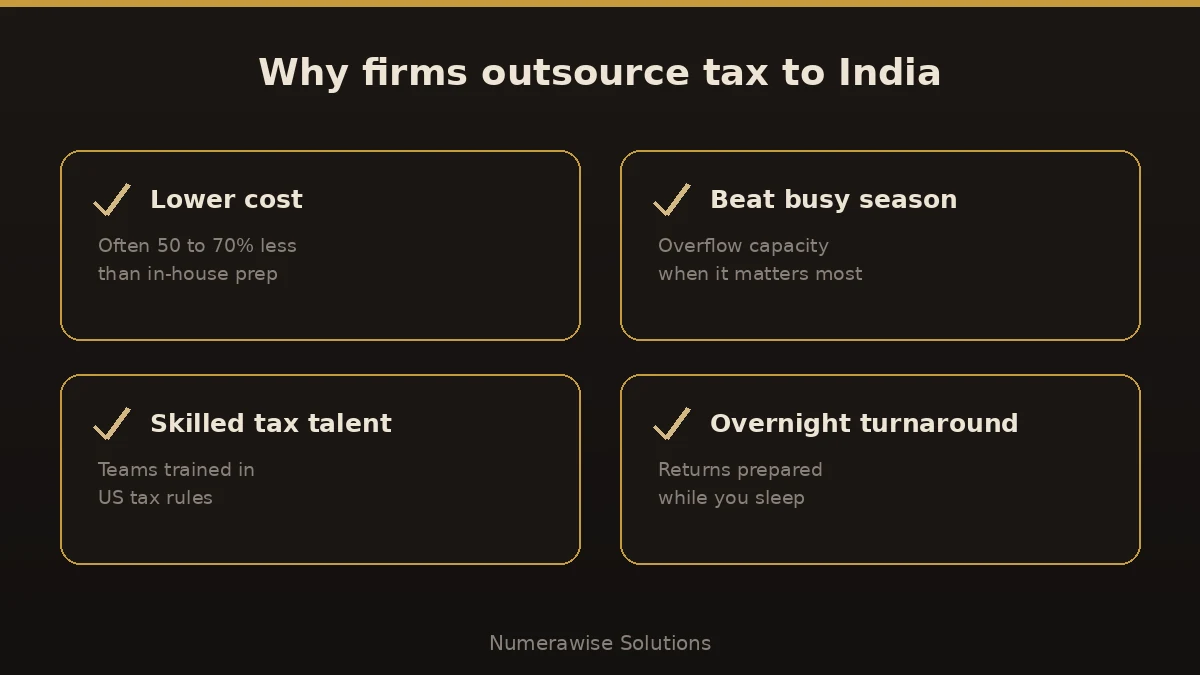
- Lower cost. Firms commonly cite savings of 50–70% versus in-house preparation.
- Busy-season capacity. Overflow help exactly when your team is buried.
- Skilled tax talent. Teams trained on 1040, 1120, 1065, and common tax software.
- Overnight turnaround. The time-zone gap means returns come back while you sleep.
How to judge the best tax outsourcing companies in India
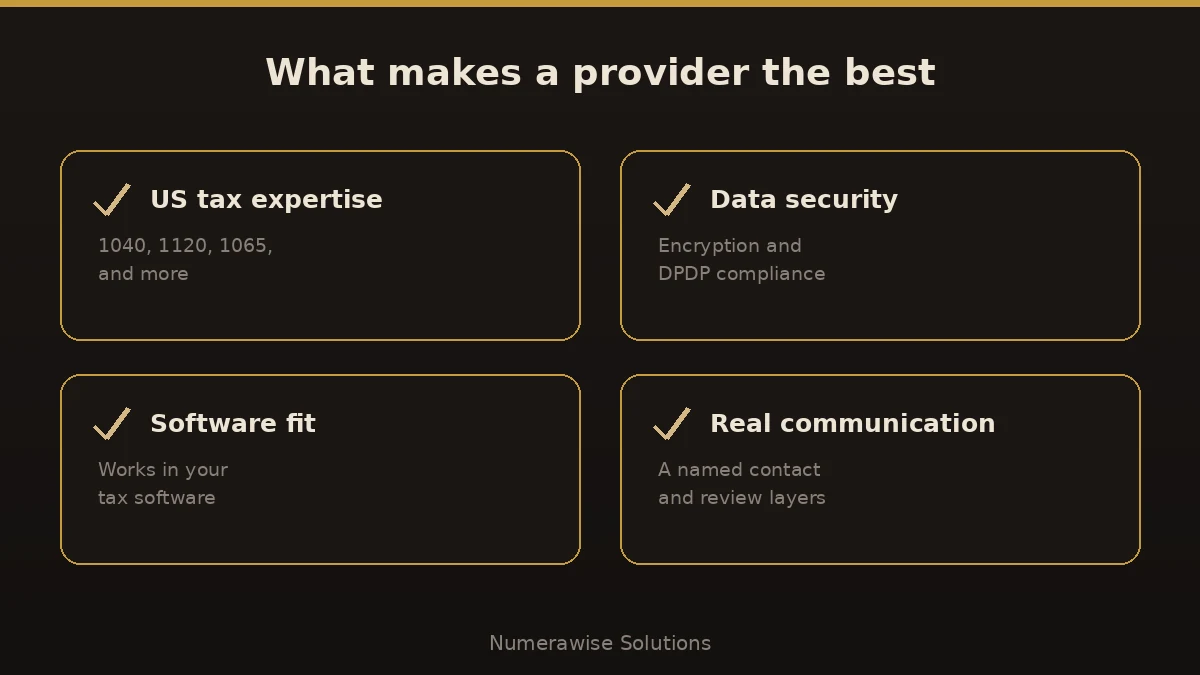
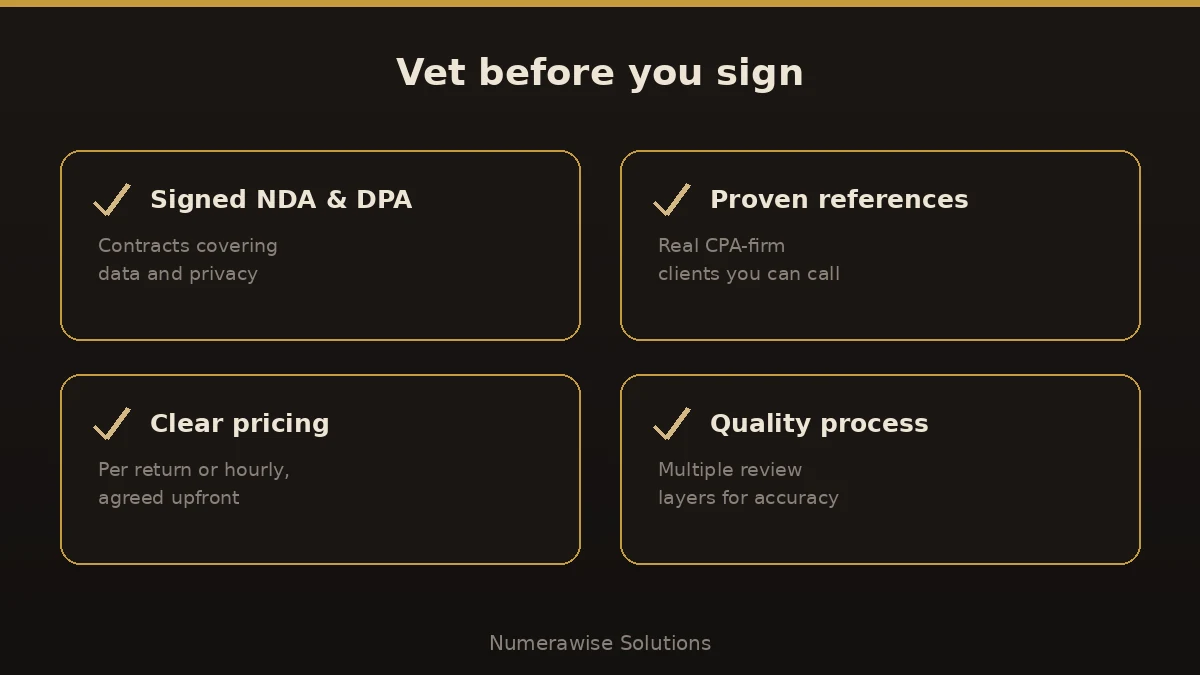
Score any provider against these before you sign. If they fall short on security or communication, keep looking.
| What to check | Why it matters |
|---|---|
| US tax expertise | Accurate returns across form types |
| Data security | Your clients’ data is highly sensitive |
| Software fit | They work in your tax stack, not against it |
| Communication | A named contact and clear review layers |
| Transparent pricing | Per-return or hourly, agreed upfront |
Notable providers in this space
To be clear, this isn’t a ranking or an endorsement — the “best” provider depends on your firm. But well-known names US firms often evaluate include QX Accounting Services (one of the largest by client count), KMK Associates (focused on US CPA firms), Datamatics (a long-established BPO), Unison Globus, Madras Accountancy, and TCB Accounting Services. Always run your own checks against the criteria above — reputation is a starting point, not a guarantee.
What does tax outsourcing cost?
Pricing is usually per return or hourly. Individual (1040) returns commonly start around $40–$60, with business and partnership returns higher, and hourly models running for complex or advisory work. The honest headline: it typically costs far less than hiring seasonal staff, but the cheapest quote is rarely the best value once you factor in quality and rework. Ask for pricing tied to your actual return mix.
Is your clients’ data safe?
This is the question that should make or break your choice. India’s Digital Personal Data Protection (DPDP) Act, 2023 now governs how personal data is handled, and serious providers back it with encryption, role-based access, and binding data-processing agreements. Look for:
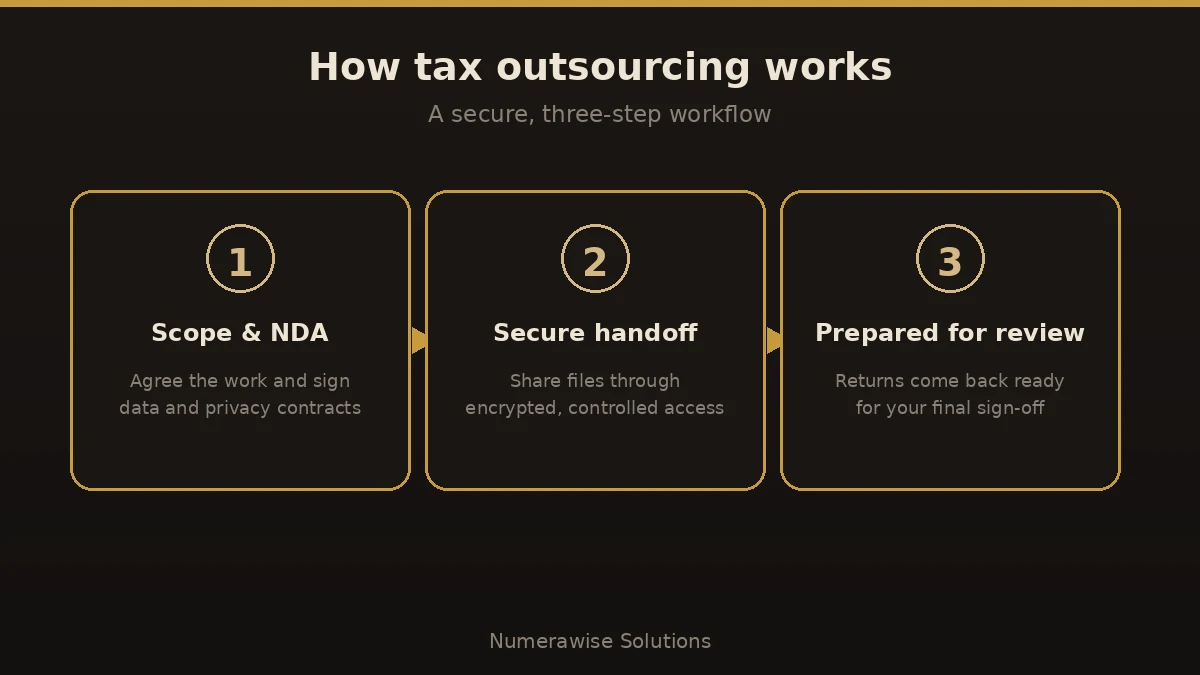
- Encrypted file transfer and secure, access-controlled portals — never data by email.
- Signed NDAs and data-processing agreements covering security, audits, and liability.
- Role-based permissions and logged access.
- Clear policies on where and how long data is stored.
Benefits of getting it right
- A survivable busy season without burning out your staff.
- Real cost savings versus seasonal hiring.
- Faster turnaround from overnight work.
- Scalable capacity that flexes with your volume.
- More time for review, advisory, and clients.
Common mistakes to avoid
- Choosing on price alone. The cheapest option often means rework and weak controls.
- Skipping the security check. No signed agreement or encryption? Walk away.
- No clear scope. Define exactly which returns and steps are outsourced.
- Ignoring quality process. Ask how many review layers stand between prep and your desk.
- No pilot. Test with a small batch before you hand over the season.
Best practices for a smooth partnership
- Sign an NDA and data-processing agreement before sharing anything.
- Start with a pilot batch, then scale as trust builds.
- Standardize your workpapers and review checklist so quality is consistent.
- Keep one named point of contact on each side.
- Confirm software fit — they should work in your tax and document tools.
- Keep final review and client sign-off in-house, always.
Why work with Numerawise Solutions
Great tax prep starts with clean books — and that’s our lane. At Numerawise Solutions, we deliver secure outsourced bookkeeping and keep your (or your clients’) bookkeeping services accurate and tax-ready all year, so returns are faster and cheaper to prepare. We work through encrypted, access-controlled tools with a real person who answers your emails. If you’re weighing the best tax outsourcing companies in India, talk to us first about getting the books tax-ready — it’s where most of the season’s pain actually comes from.
The bottom line
The best tax outsourcing companies in India aren’t found on a ranked list — they’re the ones that pass your own checks on US tax expertise, data security, software fit, and communication. Define your scope, insist on signed agreements and encryption, start with a pilot, and keep final review in-house. Do that, and outsourcing turns a brutal busy season into a manageable one, at a fraction of the cost of seasonal hiring — without putting your clients’ trust at risk.
Key takeaways
- The best tax outsourcing companies in India are the ones that fit your software, security, and quality standards — not a fixed ranking.
- Firms commonly save 50–70% versus in-house prep; individual returns often start around $40–$60.
- Vet for US tax expertise, DPDP-grade data security, software fit, and clear communication.
- Sign an NDA and data agreement, start with a pilot, and keep final review in-house.
- Clean, tax-ready books make any tax outsourcing faster and cheaper.
Quick answers.
What are the best tax outsourcing companies in India?
There’s no single best — it depends on your firm’s needs. Well-known providers US firms evaluate include QX Accounting Services, KMK Associates, Datamatics, Unison Globus, Madras Accountancy, and TCB Accounting Services. Score any provider on US tax expertise, data security, software fit, and communication before you commit, and start with a pilot.
How much does tax outsourcing to India cost?
Pricing is usually per return or hourly. Individual (1040) returns commonly start around $40 to $60, with business and partnership returns higher. Firms often report total savings of 50 to 70% versus in-house preparation. Ask for pricing tied to your actual return mix, and remember the cheapest quote rarely delivers the best value.
Is it safe to outsource tax preparation to India?
It can be very safe with the right controls. India’s Digital Personal Data Protection (DPDP) Act, 2023 governs personal data, and reputable providers use encryption, secure portals, role-based access, and signed data-processing agreements. Safety depends on the provider’s controls and contract, not the country. Never share client data without a signed NDA and secure transfer.
What tax work can I outsource to India?
Time-intensive preparation work: individual (1040), business (1120), and partnership (1065) returns, plus data entry, reconciliations, and workpaper prep. You keep client relationships, review, and final sign-off in-house. The provider works inside your software and process as an extended team, which is what makes the model efficient.
How do I choose the best tax outsourcing partner in India?
Check five things: proven US tax expertise, strong data security with signed agreements, fit with your tax software, clear communication with a named contact, and transparent pricing. Ask for references from real CPA-firm clients and run a small pilot batch before handing over your busy season.
Will I lose control of my clients or quality?
No, if you set it up well. You keep client relationships, review every return, and give the final sign-off. Good providers add review layers of their own and follow your workpapers and checklist. Starting with a pilot and standardizing your process keeps quality consistent as you scale.
What’s the difference between tax outsourcing and accounting outsourcing?
Tax outsourcing focuses on preparing returns, usually seasonally. Accounting outsourcing covers ongoing work like bookkeeping, reconciliations, and payroll year-round. Many firms use both — clean, outsourced bookkeeping all year makes tax season faster because the books arrive ready to prepare from.
Do the best tax outsourcing companies in India work with small firms?
Yes. Many providers serve solo CPAs and small firms as well as large ones, scaling capacity to your volume. Small firms often benefit most during busy season, gaining overflow help without hiring seasonal staff. Look for a provider comfortable with your size and willing to start with a pilot.
How do I start outsourcing tax preparation?
Define your scope, sign an NDA and data-processing agreement, and confirm the provider works in your software. Share a small pilot batch through a secure portal, review the results closely, then scale as trust builds. Keep final review and client sign-off in-house throughout.
Get a free scoping call.
Tell us what you’re working on. We respond same business day.

Ram · Founder & Principal
Founder of Numerawise Solutions, established MMXXIV in Atlanta. Intuit ProAdvisor Gold tier. Former Intuit Technical Support engineer. Has personally led two hundred accounting software conversions for US small businesses since founding the practice. Reachable directly at [email protected].
Free: The Clean-Cutover Checklist
The step-by-step checklist we use to migrate businesses to QuickBooks without losing data — bank rec, opening balances, payroll YTD, and the validation tie-out. Get it in your inbox.
No spam — just the checklist and the occasional QuickBooks tip.