Most owners start that search at a frustrating moment — the books are behind, a lender wants statements, or tax season is closing in. The instinct is to find someone local you can sit across from.
That instinct is reasonable, but it narrows your options to whoever happens to be nearby. This guide covers what good bookkeeping actually includes, what it costs, when local genuinely helps, and the questions worth asking before you sign anything.
What "bookkeeping near me for small business" should actually include
Bookkeeping is a repeating monthly cycle, not a once-a-year tidy-up. Any service worth paying for covers:
- Transaction categorization. Every bank and card transaction coded correctly, weekly rather than annually.
- Account reconciliation. Bank, credit card, and loan accounts tied out every month, so your balances are real.
- Accounts receivable and payable. Who owes you, what you owe, and what is overdue.
- Sales tax tracking. Recorded as a liability and prepared for filing — never as income.
- Payroll journals. Wages, taxes, and benefits posted correctly each run.
- Monthly reports. A profit and loss, balance sheet, and aging report that arrive on a schedule.
If a quote does not name these, ask. "Doing the books" means very different things to different providers.
Local vs virtual: does "near me" still matter?
Here is an honest answer, even though we work remotely. Local still helps in a few real situations: if your business is cash-heavy, if you handle a lot of paper that someone must physically sort, or if you simply think better sitting across a table.
For most small businesses in 2026, though, the work happens in cloud accounting software. Your bank feeds in automatically, receipts are photographed, and reviews happen on a video call. At that point, hiring within driving distance mostly limits your choice.
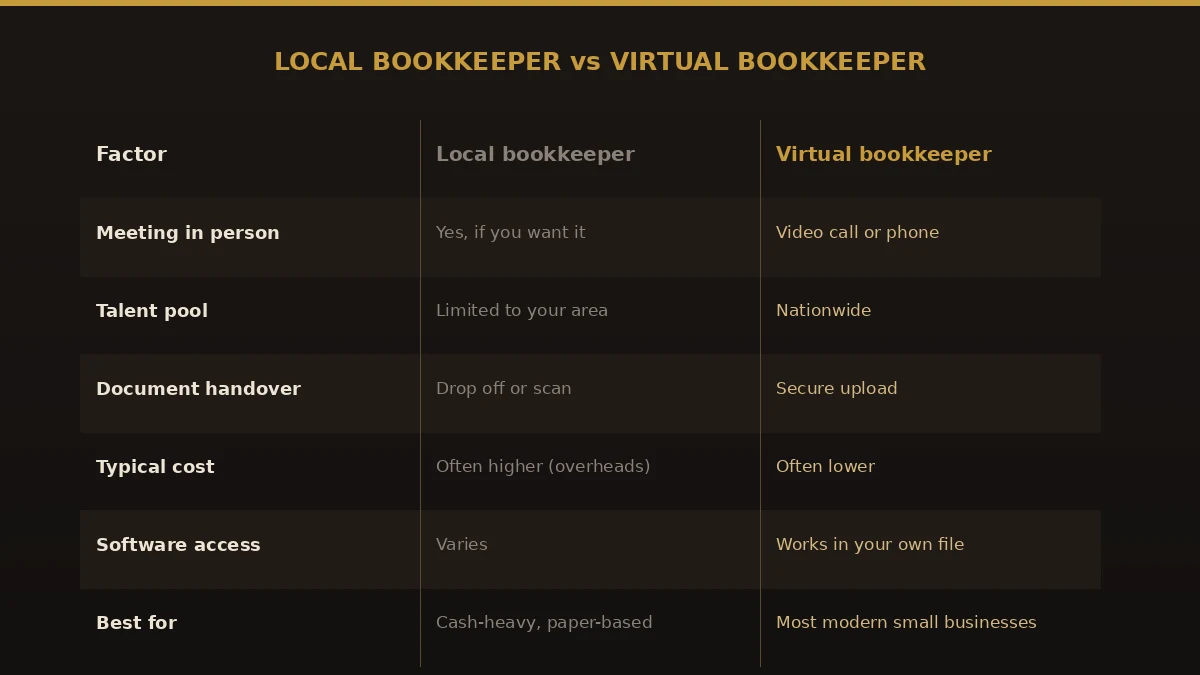
| Factor | Local bookkeeper | Virtual bookkeeper |
|---|---|---|
| In-person meetings | Yes, if you want them | Video call or phone |
| Choice of talent | Limited to your area | Nationwide |
| Documents | Drop off or scan | Secure upload |
| Typical cost | Often higher (overheads) | Often lower |
| Best suited to | Cash-heavy, paper-based | Most modern small businesses |
One practical note on searching: Google personalises "near me" results to your location and leans heavily on Google Business Profiles. So the local map results you see are not a ranking of quality — they are a ranking of proximity. Judge providers on process, not placement.
What small business bookkeeping costs
Pricing follows volume and complexity, not the size of anyone’s office. Typical flat monthly fees:
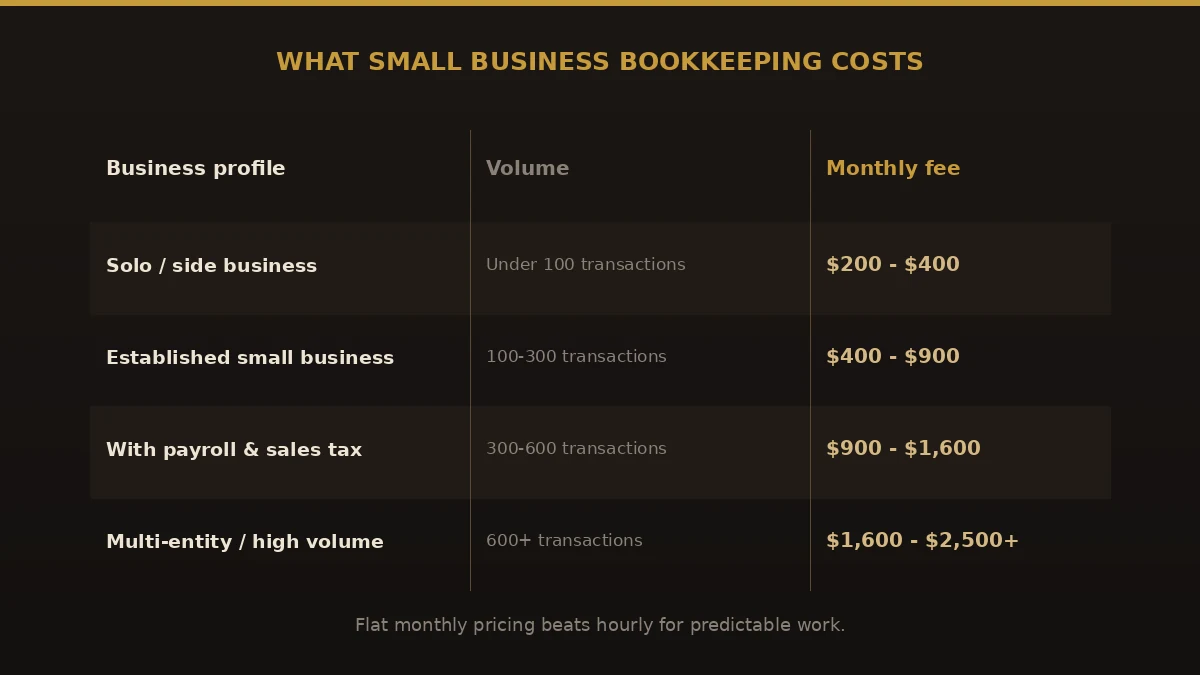
| Business profile | Monthly volume | Typical monthly fee |
|---|---|---|
| Solo or side business | Under 100 transactions | $200 – $400 |
| Established small business | 100 – 300 transactions | $400 – $900 |
| With payroll and sales tax | 300 – 600 transactions | $900 – $1,600 |
| Multi-entity or high volume | 600+ transactions | $1,600 – $2,500+ |
Prefer a flat monthly fee to an hourly rate for recurring work — it is predictable, and it does not punish you for asking questions. Catch-up work should be quoted separately.
Questions to ask before you hire a bookkeeper
These seven questions surface almost everything that matters:
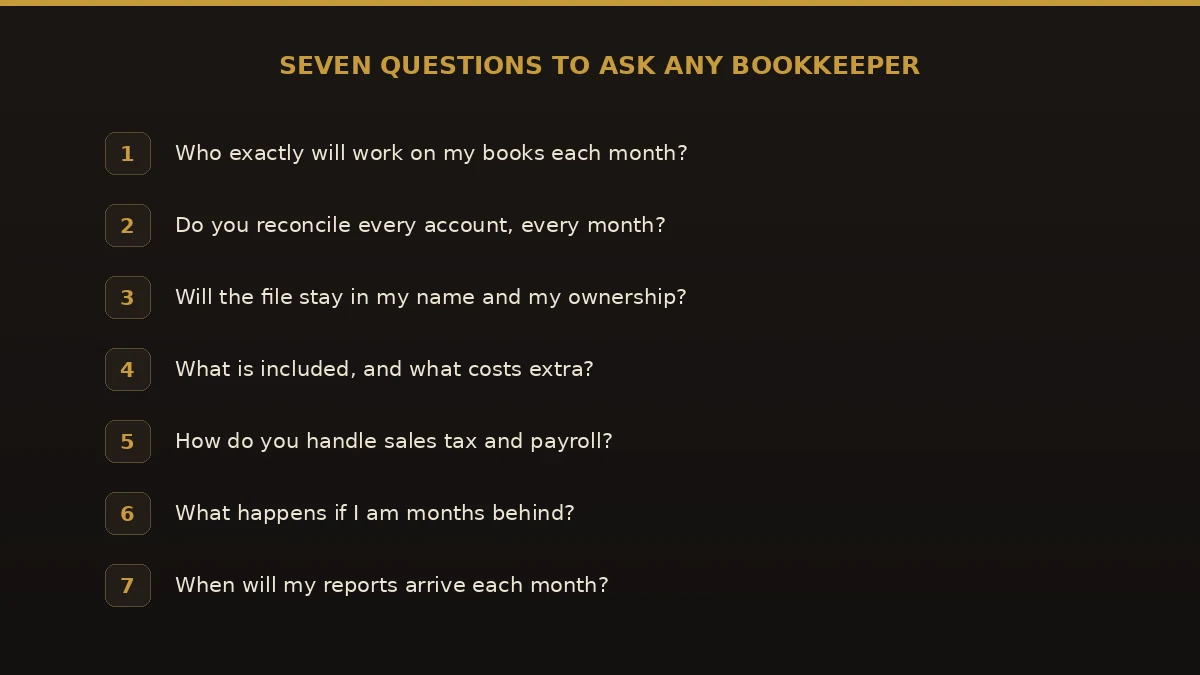
- Who exactly will work on my books? You want a named person, not a rotating queue.
- Do you reconcile every account, every month? If the answer is vague, keep looking.
- Does the file stay in my name? You should own your accounting file and retain admin access. Always.
- What is included, and what costs extra? Payroll, sales tax, and catch-up are common add-ons.
- How do you handle sales tax and payroll? Rules vary by state; you want specifics.
- What if I am months behind? A good answer is a scoped quote, not a flinch.
- When will my reports arrive? "Within X days of month end" beats "when they are ready."
Benefits of hiring a bookkeeper
- You price with confidence. Real margins, not guesswork.
- Tax season stops being a crisis. Your CPA gets a clean file and can focus on planning.
- Financing gets easier. Lenders and the SBA want current statements.
- Problems surface early. A customer drifting to 90 days shows up in an aging report, not a cash shortfall.
- You get your evenings back. Most owners are not slow at bookkeeping — they just should not be doing it.
Common mistakes to avoid
- Choosing on price alone. The cheapest quote often excludes reconciliation, which is the actual work.
- Letting someone own your file. If you cannot access your own books, you are stuck.
- Mixing personal and business accounts. It muddies every report and weakens liability protection.
- Assuming software is enough. QuickBooks records what it is told; judgment is still human.
- Waiting until March. Twelve months of catch-up always costs more than twelve monthly closes.
Best practices that keep books clean
- Separate accounts from day one. A dedicated business checking account and card.
- Reconcile monthly, without exception. Short monthly closes beat annual reconstruction.
- Capture receipts as you go. Photograph them; do not rely on a glovebox.
- Set sales tax aside. Move it out of operating cash so it is there when the return is due.
- Review your numbers monthly. Fifteen minutes with a P&L beats an April surprise.
Why choose Numerawise Solutions
We are an accounting firm built around QuickBooks and clean monthly books. We work remotely inside your own file, so you keep full ownership and access at all times. You get a flat monthly fee scoped after a real review, a named person who knows your business, and reports that arrive on schedule. If you are behind, we quote the catch-up separately and tell you plainly what it will take. Alongside monthly bookkeeping services, we handle payroll, QuickBooks setup and cleanup, and outsourced accounting.
The bottom line
If you are searching for bookkeeping near me for small business, widen the question. Proximity is easy to measure and tells you very little. What actually protects you is a bookkeeper who reconciles every account monthly, keeps sales tax as a liability, leaves the file in your name, and delivers reports on a predictable schedule. Local is genuinely better for cash-heavy or paper-heavy businesses. For everyone else, hire on process and fit rather than distance — then hold whoever you choose to the seven questions above.
Key takeaways
- When searching bookkeeping near me for small business, judge on process, not proximity — "near me" results rank by location, not quality.
- Proper monthly bookkeeping covers categorization, reconciliation, AR/AP, sales tax, payroll, and reports.
- Most small businesses pay $200–$2,500 a month; prefer a flat fee over hourly for recurring work.
- Always keep your accounting file in your own name, with admin access.
Quick answers.
How do I find good bookkeeping near me for small business?
Start with the work, not the map. Ask whether they reconcile every account monthly, what is included in the fee, who will handle your books, and whether the file stays in your name. Local matters most if your business is cash-heavy or paper-based. Otherwise, hiring remotely widens your choice and often lowers your cost.
How much does a small business bookkeeper cost?
Most small businesses pay a flat monthly fee between $200 and $2,500, depending on transaction volume, number of accounts, and whether payroll and sales tax are included. Solo owners sit at the low end. Be cautious of quotes given before anyone has looked at your books, because those are estimates rather than real prices.
Is a local bookkeeper better than a virtual one?
Not usually, but sometimes. A local bookkeeper helps if you handle lots of cash or paper, or if you strongly prefer meeting in person. For most modern small businesses, the work happens in cloud software, so a virtual bookkeeper gives you a wider choice of specialists and often costs less for the same monthly service.
What does a bookkeeper do each month?
They categorize your transactions, reconcile bank, credit card, and loan accounts, update accounts receivable and payable, track sales tax as a liability, post payroll journals, and deliver a profit and loss, balance sheet, and aging reports. The point is a repeating monthly rhythm so nothing piles up before tax season.
Do I need a bookkeeper if I already use QuickBooks?
Usually yes. QuickBooks records what it is told, but it will not catch a miscoded expense, an unreconciled account, or sales tax booked as income. A bookkeeper brings judgment and monthly discipline. Think of the software as the tool and the bookkeeper as the person making sure that tool is telling the truth.
What is the difference between a bookkeeper and an accountant?
A bookkeeper maintains day-to-day records: categorizing, reconciling, and producing monthly reports. An accountant or CPA handles tax strategy, filings, and formal statements. They work best together, because clean books let your accountant spend time on planning instead of reconstructing a year of records in April.
Can a bookkeeper help if I am months behind?
Yes. Catch-up bookkeeping is common and fixable. A good provider scopes it by how many months are open and how far off the reconciliations are, then quotes it separately from the monthly fee. Once the backlog is cleared, you move onto a monthly schedule so the same thing does not happen again.
Is it safe to share my financial data with a remote bookkeeper?
Yes, when it is handled properly. Look for named user access to your own accounting file rather than shared logins, secure document upload instead of email attachments, and a clear answer on who can see your data. You should keep ownership of the file and be able to see exactly what changed and when.
When should a small business hire a bookkeeper?
The usual triggers are time and uncertainty. If bookkeeping eats your evenings, you cannot confidently say whether last month was profitable, or you are behind on sales tax, it is time. Many owners start with monthly bookkeeping long before they need a full-time hire, because the cost is a fraction of a salary.
Get a free scoping call.
Tell us what you’re working on. We respond same business day.

Ram · Founder & Principal
Founder of Numerawise Solutions, established MMXXIV in Atlanta. Intuit ProAdvisor Gold tier. Former Intuit Technical Support engineer. Has personally led two hundred accounting software conversions for US small businesses since founding the practice. Reachable directly at [email protected].
Free: The Clean-Cutover Checklist
The step-by-step checklist we use to migrate businesses to QuickBooks without losing data — bank rec, opening balances, payroll YTD, and the validation tie-out. Get it in your inbox.
No spam — just the checklist and the occasional QuickBooks tip.