California spans Bay Area tech and finance, Los Angeles entertainment, Central Valley agriculture, and coastal trade — alongside the heaviest compliance load in the country. Loose books get expensive here faster than almost anywhere.
California is home to small businesses in every industry, and clean books are what let those businesses price work correctly, borrow when they need to, and walk into tax season calm. Dependable bookkeeping services in California quietly prevent the fire drills before they start.
Bookkeeping built for California businesses
California spans tech and finance in the Bay Area, entertainment in Los Angeles, agriculture in the Central Valley, and trade along the coast. It also carries the country’s heaviest compliance load.
We tailor the chart of accounts and the monthly workflow to your industry, so your reports answer real questions instead of just balancing. Who we keep books for in California:
- Tech and startups
- Entertainment and media
- Agriculture
- Retail and e-commerce
- Professional services
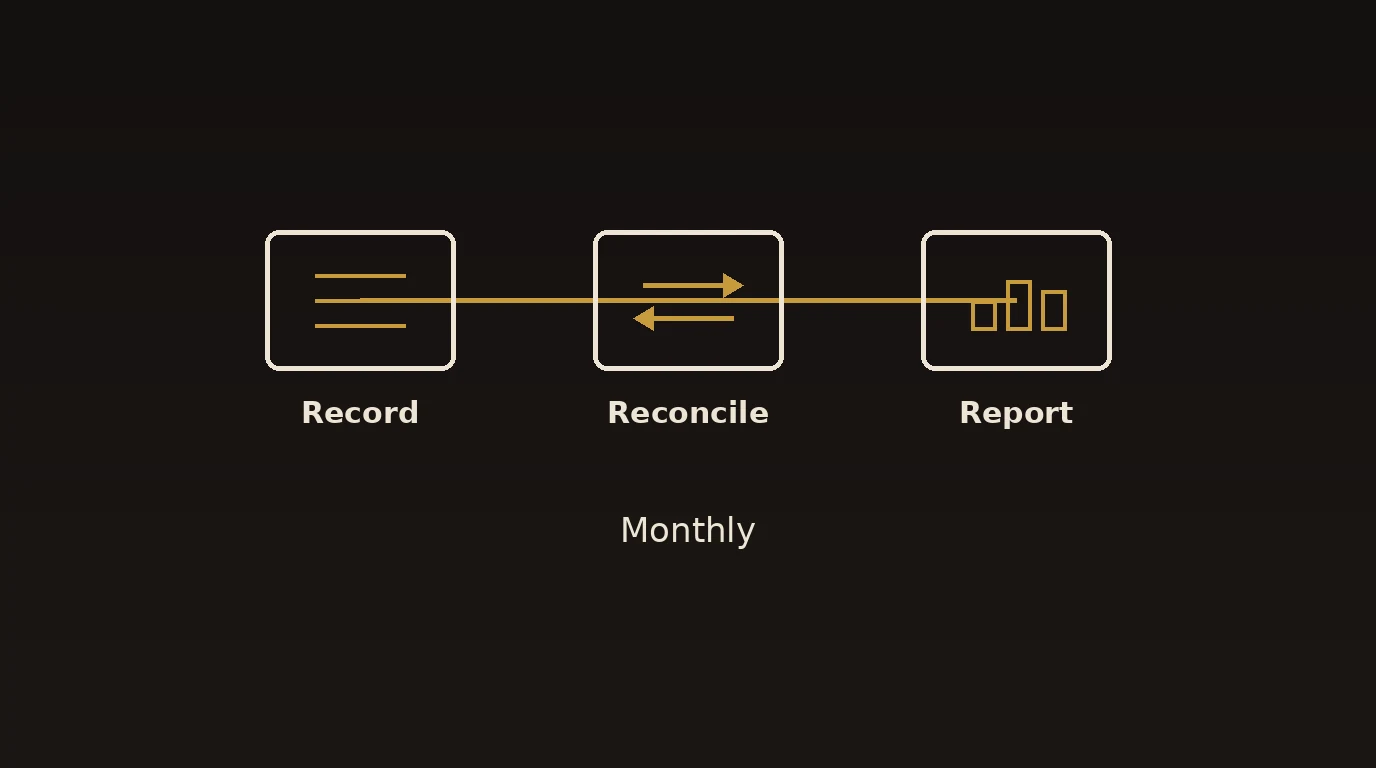
What bookkeeping services in California cover
Bookkeeping is the day-to-day recording, categorizing, and reconciling of every dollar your business handles. A full-service engagement usually includes:
- Recording and categorizing income and expenses
- Reconciling every bank and credit card account monthly
- Accounts payable and receivable — paying bills, chasing invoices
- Payroll support and filings that go out on time
- Sales tax tracking and remittance
- Monthly reports: profit and loss, balance sheet, cash flow
- Catch-up work when you’ve fallen behind
A bookkeeper handles the day-to-day; a CPA uses those clean records to file and advise. You want both, and strong bookkeeping is the foundation.
DIY vs. professional bookkeeping
| Factor | DIY | Professional |
|---|---|---|
| Time required | 5–20+ hours/month | A quick monthly check-in |
| Accuracy | Depends on your experience | Consistent, reconciled monthly |
| Tax readiness | Often a year-end scramble | Books ready to file anytime |
| Cost | “Free” (but your time isn’t) | Predictable monthly fee |
| Best for | Brand-new, simple businesses | Growing or busy businesses |
California carries some of the country’s highest income-tax rates, an $800 minimum LLC franchise tax, and a 7.25% base sales tax before local add-ons. A local bookkeeper keeps your filings lined up with what the state expects.
Benefits of professional bookkeeping
- You get your time back — owners reclaim 5–15 hours a month.
- Your numbers become decisions — accurate reports show what actually makes money.
- Tax season stops being scary — clean books mean a handoff, not a scramble.
- Cash flow gets predictable — you see crunches coming.
- You look ready for anyone — lenders and investors want clean financials.
A California retailer we support finally tracked the $800 franchise tax and city business tax inside its books, so nothing showed up as a surprise at filing time.
Common bookkeeping mistakes
- Mixing personal and business spending in one account.
- Falling behind on monthly reconciliations.
- Miscategorizing transactions, which buries deductions.
- Ignoring accounts receivable and letting invoices age.
- Waiting until tax time to look at the books.
- DIY-ing well past the point the business outgrew a spreadsheet.
The mistake that stings most is ignoring the layered taxes — state income, franchise, and local business tax — until a deadline forces a rushed, error-prone catch-up.
Best practices to keep books clean
- Separate business and personal finances from day one.
- Reconcile every account monthly — bank, card, and loans.
- Use QuickBooks Online instead of manual spreadsheets.
- Review your profit and loss monthly to catch trends.
- Set money aside for taxes every month.
- Get a second set of eyes annually.
Why choose Numerawise Solutions
At Numerawise Solutions, bookkeeping is the core of what we do. We serve businesses in California with hands-on financial support built for real small businesses. We’re QuickBooks specialists — setup, cleanup, and full QuickBooks conversions — and we pair the books with payroll services and outsourced bookkeeping so one team covers the whole back office. Behind on records? We catch you up and keep you there.
The bottom line
Your books are the scoreboard for your business. Clean, current bookkeeping services in California keep your records straight, your taxes ready, and your cash flow in plain view. Separate your accounts, reconcile monthly, and hand off the busywork the day it starts eating hours you should spend on customers.
California asks a lot. Accurate, current books are how businesses across the state keep the franchise tax, local levies, and sales tax from becoming year-end shocks.
Key takeaways
- Bookkeeping services in California cover recording, reconciliation, reporting, and often payroll and sales tax.
- A bookkeeper keeps books clean year-round; a CPA files and advises — you want both.
- Reconcile monthly and never mix personal and business accounts.
- Outsourcing usually costs less than the hours and mistakes it replaces.
- Choose a partner who knows your industry and your software.
Quick answers.
How does California’s tax load affect my bookkeeping?
Significantly. California has high income-tax rates, an $800 minimum LLC franchise tax, and local business taxes on top of a 7.25% base sales tax before local add-ons. We build your books to track all of it, so your filings are accurate and the franchise tax and local levies never catch you off guard.
How much do bookkeeping services in California cost?
Most small businesses pay a predictable monthly fee based on transaction volume, number of accounts, and whether payroll and sales tax are included — commonly a few hundred dollars a month, more for higher volume or multiple entities. Ask for a quick review of your books so the quote fits your actual needs, not a one-size-fits-all number.
What's the difference between a bookkeeper and an accountant?
A bookkeeper handles the day-to-day: recording transactions, reconciling accounts, and producing monthly reports. An accountant or CPA uses those records to file taxes, advise on strategy, and handle planning. Most healthy businesses use both, and clean bookkeeping actually lowers your CPA bill because they aren’t fixing your file first.
Do I still need a bookkeeper if I use QuickBooks?
Yes. QuickBooks is a tool, not a bookkeeper — it records what you tell it, including mistakes. It still needs someone to categorize transactions correctly, reconcile accounts, and catch errors before they snowball. Great software plus a skilled hand equals clean books; one without the other leaves gaps.
How often should my books be updated?
At a minimum, reconcile monthly so your records match your bank and card statements. Busy or high-volume businesses often benefit from weekly updates. Staying current is the key — waiting until year-end almost always means more errors, more stress, and higher cleanup costs than a steady monthly rhythm.
Can you help if I'm several months behind?
Absolutely. Catch-up bookkeeping is one of the most common reasons owners reach out. We reconstruct past months, reconcile the accounts, and get you current and tax-ready. Once you’re caught up, an ongoing monthly plan keeps you from landing back in that spot.
Is my financial information kept secure?
Yes. Reputable bookkeeping services use encrypted, cloud-based platforms and strict access controls. Look for a provider that limits who can see your data and backs everything up. Your financial records are sensitive, and any serious bookkeeper treats them that way and will put the safeguards in writing.
Do you handle payroll and sales tax in California?
We do. We record payroll, wages, withholdings, and filings that go out on time, and we keep sales tax straight so you collect the right amount and stay square with the state. Running these next to your books keeps everything consistent and helps you dodge penalties from a missed filing.
Can bookkeeping be done remotely?
Yes, and most modern bookkeeping is. With cloud accounting and secure bank feeds, your bookkeeper manages everything without setting foot in your office. You get the same accuracy and communication, often faster, with digital access to your reports anytime — and you’re not limited to bookkeepers in your immediate area.
How do I switch bookkeepers without losing data?
Easier than most owners expect. A good provider reviews your existing file, cleans up any errors, and picks up where the last one left off. Your QuickBooks or accounting data stays intact and moves with you. The main thing is choosing a partner who understands your setup before making changes.
Get a free scoping call.
Tell us what you’re working on. We respond same business day.

Ram · Founder & Principal
Founder of Numerawise Solutions, established MMXXIV in Atlanta. Intuit ProAdvisor Gold tier. Former Intuit Technical Support engineer. Has personally led two hundred accounting software conversions for US small businesses since founding the practice. Reachable directly at [email protected].
Free: The Clean-Cutover Checklist
The step-by-step checklist we use to migrate businesses to QuickBooks without losing data — bank rec, opening balances, payroll YTD, and the validation tie-out. Get it in your inbox.
No spam — just the checklist and the occasional QuickBooks tip.