I’ve cleaned up plenty of end-of-year messes on the Space Coast, and they tend to start the same way. A busy season hits — a big contract, tourist months, the holidays — receipts scatter, and by spring nobody can say where the cash went. This guide covers what good bookkeeping looks like in Melbourne, what it should cost, the Florida tax details that trip owners up, and how to keep records that stay ready for your accountant all year.
What small business bookkeeping Melbourne, FL owners should expect
Bookkeeping is the day-to-day work of recording, categorizing, and reconciling every dollar your business handles. It’s not the same as tax prep — bookkeeping is the steady record you keep all year, and your accountant uses it to file. Get the first part right and the second gets faster and cheaper.
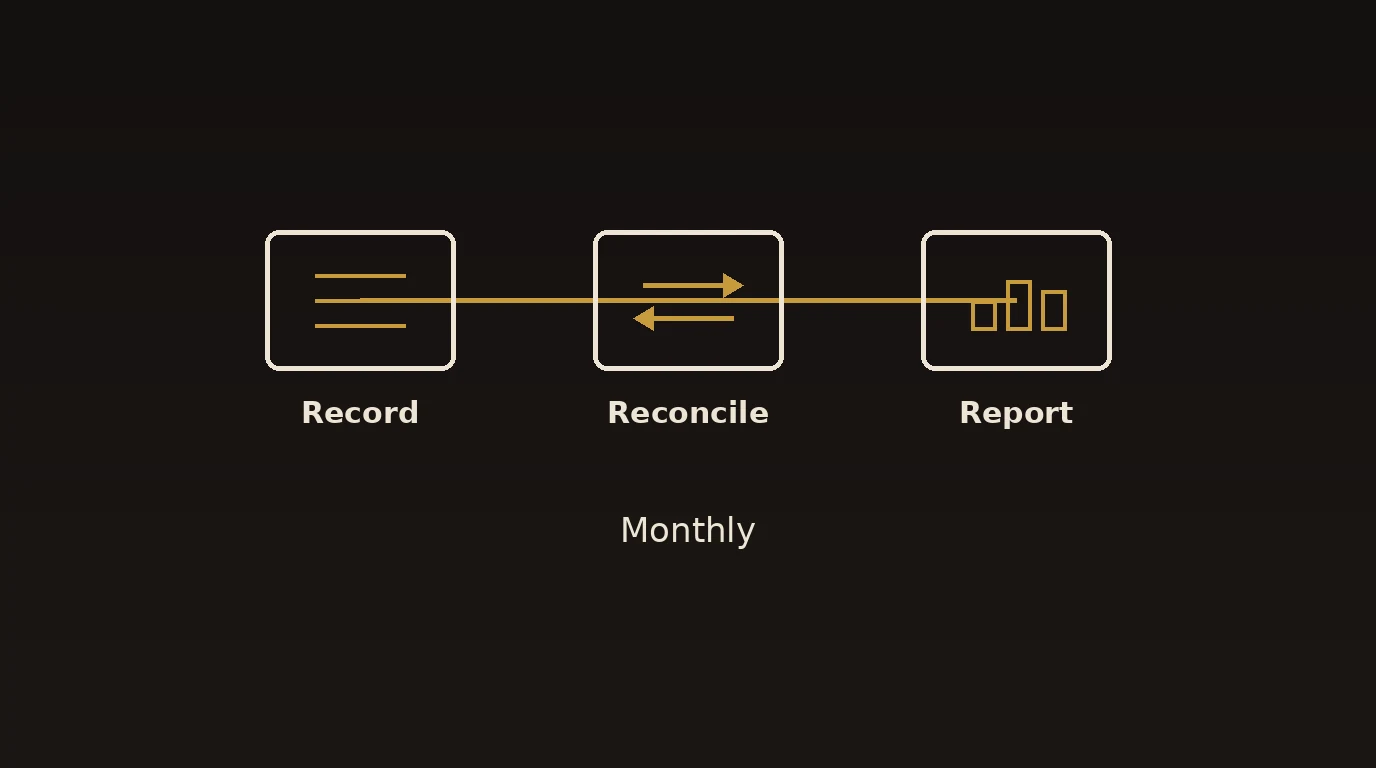
A full monthly engagement in Melbourne usually covers:
- Recording and categorizing income and expenses
- Reconciling every bank and credit card account each month
- Tracking receivables (who owes you) and payables (what you owe)
- Keeping Florida sales tax organized and filed on time
- Supporting payroll so filings hit their deadlines
- Monthly profit & loss, balance sheet, and cash-flow reports
- Catch-up work when you’ve slipped a few months behind
Already on QuickBooks? Most of this plugs right in. Not yet? Getting onto a clean setup through our QuickBooks setup and cleanup is usually step one. When the routine outgrows your evenings, our bookkeeping services take it off your plate entirely.
What bookkeeping costs in Melbourne
There’s no single price, and anyone quoting one before seeing your file is guessing. Cost tracks three things: how many transactions you run, how many accounts you have, and whether payroll and sales tax are in the mix. Here’s the range most Melbourne businesses land in:
| Business profile | Typical monthly fee | What drives it |
|---|---|---|
| Solo / very small | $200–$500 | Low volume, one or two accounts |
| Growing small business | $500–$1,200 | Payroll, A/R and A/P, multiple accounts |
| Established operation | $1,000–$2,500+ | High volume, job costing, multiple entities |
| Catch-up / cleanup | Quoted per project | Months behind or messy data |
Now weigh that against hiring in-house. A full-time bookkeeper on the Space Coast market means salary plus payroll taxes, benefits, and software before a single account is reconciled. For most small businesses, outsourced bookkeeping delivers a whole team for a fraction of that cost.
The Florida tax details that trip Melbourne owners up
Florida is friendlier than most states, but “no income tax” makes some owners sloppy. A few things to watch in 2026:
- No state income tax on individuals — a real advantage for owners who report business profit on a personal return. It does not, however, mean you can skip clean books.
- Sales tax is 7% in Melbourne. That’s 6% state plus Brevard County’s 1% surtax. Collect it correctly, track it as a liability — not income — and file on time. Note the county surtax only applies to the first $5,000 of a single taxable item.
- The Brevard surtax is set to expire December 31, 2026 unless voters renew it. If it lapses or changes, your point-of-sale and invoices need to follow — another reason to keep books current.
You can confirm current figures with the Florida Department of Revenue. The goal isn’t to memorize rates — it’s to keep books current enough that a sales-tax filing or a surtax change never becomes a penalty.
DIY vs. professional bookkeeping
Plenty of Melbourne owners start by doing their own books, and for a brand-new, simple business that’s reasonable. The real question is when the trade-off stops being worth it.
| Factor | Doing it yourself | Professional |
|---|---|---|
| Your time | 5–20+ hours a month | A short monthly review |
| Accuracy | Depends on your experience | Reconciled and consistent |
| Tax readiness | A year-end scramble | Ready to file anytime |
| Real cost | “Free,” minus your time | A predictable monthly fee |
Benefits of professional bookkeeping
- You get your evenings back. Owners routinely reclaim 5–15 hours a month.
- Your numbers turn into decisions. Accurate reports show which jobs and services actually earn.
- Tax season stops being scary. Clean books mean a handoff, not a fire drill.
- Cash flow gets predictable. You see a slow season coming instead of feeling it.
- You look ready for lenders. A bank or the SBA wants reconciled financials, not a shoebox.
Common mistakes to avoid
- Assuming no income tax means no bookkeeping. Florida skips the income tax, but you still owe sales tax, payroll filings, and a federal return — all of which need clean books.
- Mixing personal and business money. One shared card muddies every report and weakens your LLC protection. Open a dedicated business account on day one.
- Skipping monthly reconciliation. If the books don’t match the bank, they’re fiction. I once caught a Melbourne marine shop paying a vendor twice for two months — a routine reconciliation would have flagged it right away.
- Booking sales tax as income. That 7% you collect belongs to Florida, not your P&L.
- Ignoring receivables. Unpaid invoices are interest-free loans to your customers. Chase them.
- Waiting until April. A year of catch-up always costs more than staying current.
Best practices that keep books clean
- Separate business and personal finances from the start.
- Reconcile every account monthly — bank, credit card, and loans.
- Use QuickBooks Online with connected bank feeds instead of manual spreadsheets.
- Track sales tax as a liability and set the money aside as you collect it.
- Snap and attach receipts to transactions so nothing is a mystery later. The IRS accepts digital copies.
- Review your P&L and balance sheet monthly, and close each period on a simple checklist.
Why choose Numerawise Solutions
At Numerawise Solutions, bookkeeping is the core of what we do — not a bolt-on. We’re QuickBooks specialists who handle setup, cleanup, and ongoing QuickBooks setup and cleanup, and we pair the books with payroll services and outsourced bookkeeping so one team covers your whole back office. You get accurate monthly reports, a real person who answers when you email, and records that stay filing-ready all year. We support Melbourne and Space Coast businesses remotely through secure cloud tools, so “local” means someone who understands Florida sales tax and the Brevard surtax — not someone you have to drive up US-1 to see.
The bottom line on small business bookkeeping Melbourne, FL
Good books aren’t complicated — they’re consistent. Separate your accounts, reconcile every month, keep an eye on the Brevard surtax, and hand off the busywork the day it starts eating hours you owe your customers. Done right, small business bookkeeping Melbourne FL owners can rely on becomes the quiet system that shows you what’s working, what isn’t, and what you can afford next — instead of a shoebox you dread every spring.
Key takeaways
- Bookkeeping covers recording, reconciliation, reporting, and often payroll and sales tax.
- Most Melbourne small businesses pay $200–$2,500 a month depending on volume and complexity.
- Florida has no state income tax; Melbourne’s combined sales tax is 7% (with a Brevard surtax set to expire end of 2026).
- Never book sales tax as income, reconcile monthly, and keep personal and business separate.
- No income tax still doesn’t mean no bookkeeping — sales tax, payroll, and federal filings all need clean records.
Quick answers.
How much does small business bookkeeping in Melbourne, FL cost?
Most Melbourne small businesses pay a flat monthly fee between $200 and $2,500, based on transaction volume, number of accounts, and whether payroll and sales tax are included. Solo owners sit at the low end; higher-volume or multi-entity businesses pay more. A quick review of your books gives you a real number instead of a ballpark.
What is the sales tax rate in Melbourne, FL?
The combined sales tax rate in Melbourne is 7% — 6% Florida state plus Brevard County’s 1% discretionary surtax. The county surtax applies only to the first $5,000 of a single taxable item, and it’s scheduled to expire at the end of 2026 unless renewed. Confirm the current rate with the Florida Department of Revenue.
Does Florida have a state income tax for small businesses?
Florida has no personal state income tax, which benefits owners who report business profit on their personal return. You still owe federal income tax, payroll taxes, and sales tax, though. “No income tax” is a real advantage, but it doesn’t reduce the need for accurate, current books.
What’s the difference between a bookkeeper and a CPA?
A bookkeeper handles the day-to-day: recording transactions, reconciling accounts, and producing monthly reports. A CPA uses those records to file taxes and advise on strategy. Most businesses use both. Clean bookkeeping lowers your CPA bill, because your accountant advises instead of fixing your file first.
Do I still need a bookkeeper if I use QuickBooks?
Yes. QuickBooks is a tool, not a bookkeeper — it records what you tell it, mistakes included. It still needs someone to categorize transactions, reconcile accounts, and catch errors before they snowball. Good software plus a skilled hand is what produces books you can actually make decisions from.
How often should my books be reconciled?
Monthly, at a minimum, so your records match every bank and card statement. Busy or high-volume businesses often benefit from weekly updates. Staying current beats a year-end catch-up, which almost always means more errors, more stress, and a bigger cleanup bill.
Can you help if I’m several months behind?
Absolutely — catch-up work is one of the most common requests we get. We rebuild the missing months, reconcile the accounts, and get you current and tax-ready, then set an ongoing routine so you don’t fall behind again. Cleanup is quoted by scope, based on how far behind and how messy the file is.
Is remote bookkeeping safe for a Melbourne business?
Yes, and most modern bookkeeping works this way. With cloud accounting and secure, read-only bank feeds, your bookkeeper manages everything without setting foot in your office. Look for encrypted platforms, limited access, and a signed confidentiality agreement, and you get in-house accuracy without the overhead.
When should a small business hire a bookkeeper?
Bring one in when the books consistently fall behind, when your profit and loss doesn’t match your bank balance, when tax season is a scramble, or when data entry is eating hours you should spend selling. If two of those sound familiar, a bookkeeper usually pays for itself.
Get a free scoping call.
Tell us what you’re working on. We respond same business day.

Ram · Founder & Principal
Founder of Numerawise Solutions, established MMXXIV in Atlanta. Intuit ProAdvisor Gold tier. Former Intuit Technical Support engineer. Has personally led two hundred accounting software conversions for US small businesses since founding the practice. Reachable directly at [email protected].
Free: The Clean-Cutover Checklist
The step-by-step checklist we use to migrate businesses to QuickBooks without losing data — bank rec, opening balances, payroll YTD, and the validation tie-out. Get it in your inbox.
No spam — just the checklist and the occasional QuickBooks tip.