I have reviewed plenty of Buffalo businesses whose books looked fine until someone tried to reconcile them. Reconciliation is where the truth comes out, which is exactly why it matters.
What account reconciliation actually means

Account reconciliation is matching two sets of records and resolving the differences. The most common is the bank reconciliation — comparing your books to the bank statement. But a full service covers more:
- Bank reconciliation — every deposit and payment matched to the statement
- Credit card reconciliation — card charges tied out and categorized
- Loan and line-of-credit — balances and interest confirmed
- General ledger (GL) reconciliation — balance sheet accounts proven against support
- Clearing accounts — Undeposited Funds and payroll clearing cleared out
Why reconciliation matters for Buffalo businesses
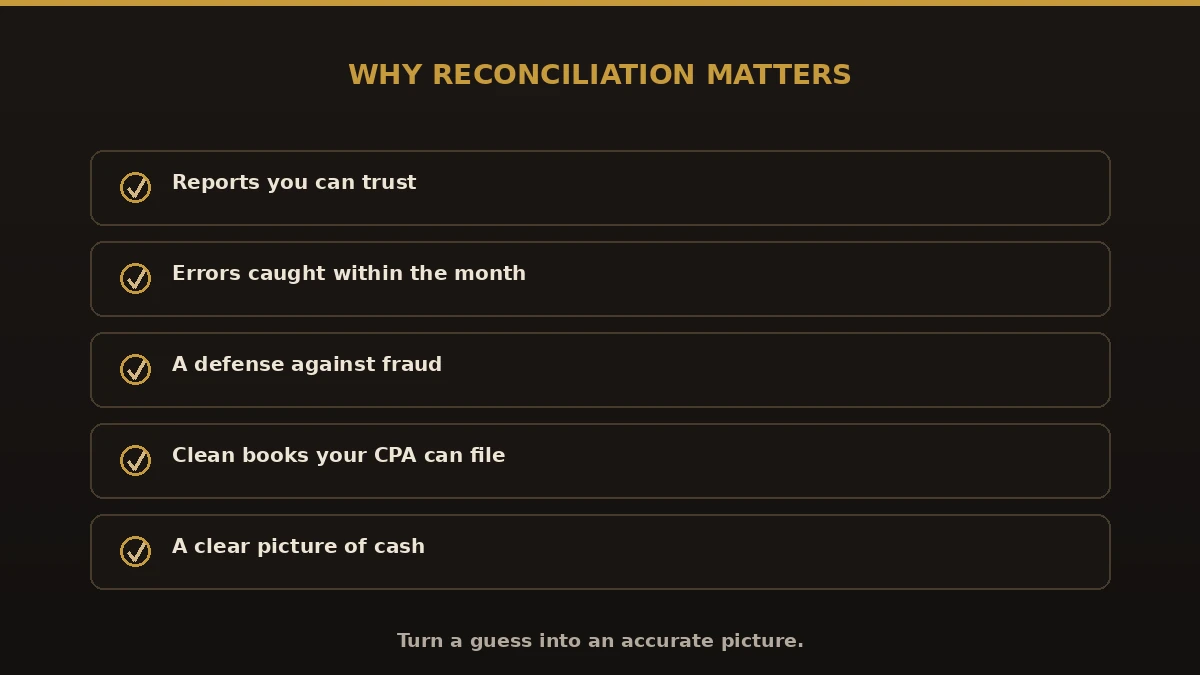
- Reports you can trust for taxes, loans, and decisions
- Errors and duplicates caught within the month, not at year-end
- A defense against fraud and unauthorized charges
- Clean books your CPA can file from without cleanup fees
- A clear, current picture of cash
Reconciled vs. unreconciled books
| Unreconciled | Reconciled | |
|---|---|---|
| Reports match bank? | Maybe not | Yes, proven |
| Errors caught | At year-end | Every month |
| Tax time | Cleanup fees | Ready to file |
Common reconciliation mistakes
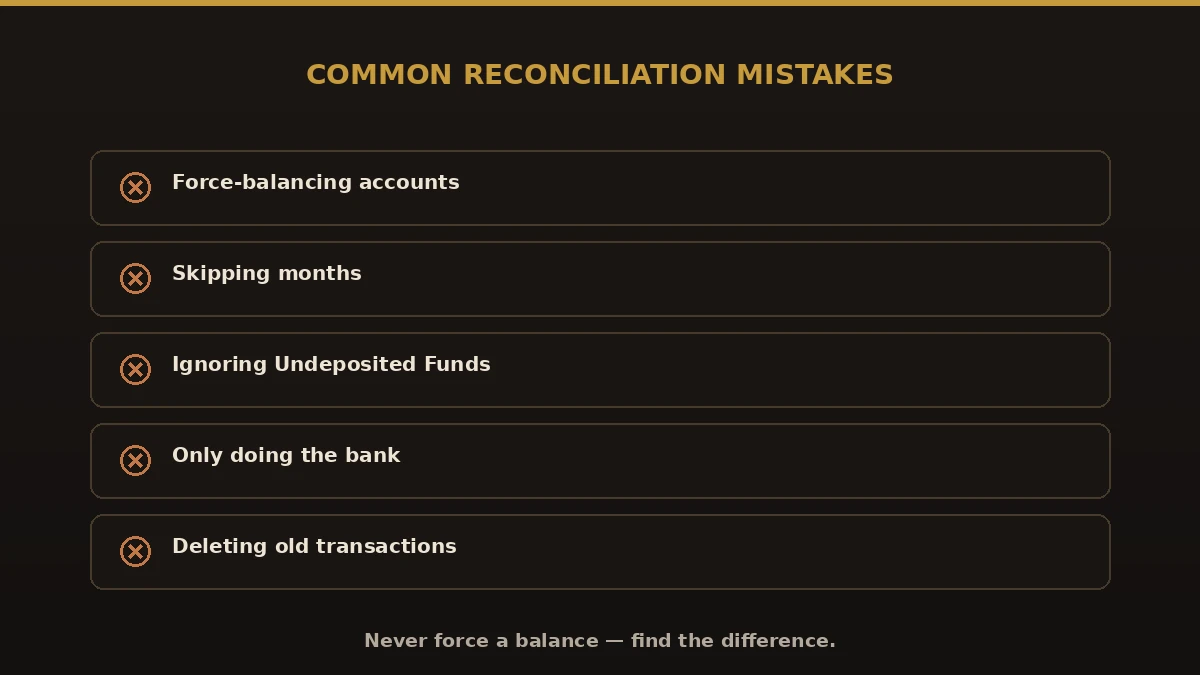
- Force-balancing. Making an account “match” without finding the real difference hides the problem.
- Skipping months. Errors compound and get harder to trace.
- Ignoring Undeposited Funds. This clearing account quietly inflates income if left alone.
- Not reconciling credit cards or loans. Only doing the bank leaves gaps.
- Deleting old transactions. This throws prior periods out of balance.
Best practices for monthly reconciliation

- Reconcile every account, every month — not just the main checking.
- Match to the statement, and investigate any difference rather than plugging it.
- Clear Undeposited Funds and clearing accounts each month.
- Keep statements and support organized by month.
- Pair reconciliation with steady monthly bookkeeping so nothing drifts.
The account reconciliation process, step by step
A reconciliation is not just ticking boxes. It is a repeatable process that ends with your books proven against an outside source. Here is how we run it each month.
- Gather the statements. Bank, credit card, loan, and merchant statements for the period.
- Match transactions. Every item in your books is matched to the statement, one by one.
- List the differences. Outstanding checks, deposits in transit, fees, and timing gaps are identified.
- Investigate. Anything unexplained is researched — a duplicate, a missing entry, a bank error.
- Adjust and record. Real corrections are posted; nothing is forced to balance.
- Confirm the balance. The adjusted book balance equals the statement balance.
- Document and sign off. The reconciliation is saved as support for your CPA and any audit.
Done this way, the reconciliation itself becomes proof — not just a checkmark.
Reconciling items: the differences you will see
When your books and the bank do not match, the gap is almost always one of a handful of reconciling items. Knowing them makes reconciliation faster:
- Outstanding checks. Written and recorded, but not yet cashed.
- Deposits in transit. Recorded in your books but not yet cleared by the bank.
- Bank fees and interest. Charged by the bank but not yet in your books.
- Timing differences. A payment recorded on a different day than it cleared.
- Errors. A duplicate, a transposed number, or a bank mistake.
The goal is not to erase these differences but to explain each one. A reconciliation with unexplained items is not finished.
Types of account reconciliation explained
"Reconciliation" covers more than the bank. A complete monthly service ties out every account that has an outside record or a control balance.
Bank and cash
The core reconciliation — checking, savings, and any cash accounts matched to the statement. This is the foundation everything else rests on.
Credit cards
Every card charge tied out and categorized, so expenses are complete and accurate. Missed card reconciliations are a common source of understated costs.
Loans and lines of credit
Principal and interest confirmed against the lender statement, so your liabilities are right on the balance sheet.
General ledger and balance sheet
GL reconciliation proves balance-sheet accounts — prepaid expenses, accrued liabilities, fixed assets — against supporting detail. This is where deeper errors hide.
Clearing and merchant accounts
Undeposited Funds, payroll clearing, and merchant or POS deposits (Stripe, Square, Toast) are cleared each month so they do not quietly distort income.
How reconciliation works in QuickBooks
Most Buffalo businesses reconcile inside QuickBooks Online or Desktop. The reconcile tool compares your recorded transactions to the statement, and the difference should end at zero. When it does not, QuickBooks flags a discrepancy.
The trap is the "reconcile discrepancy" or a forced adjustment that makes the number zero without fixing the cause. We investigate the discrepancy instead, using the reconciliation and audit reports to trace changed or deleted transactions. If your file will not reconcile at all, that usually signals a deeper problem best solved with a QuickBooks cleanup first.
Reconciliation by industry in Buffalo
Different Buffalo businesses feel reconciliation in different ways:
- Restaurants and food service. Heavy card volume and delivery-app payouts (net of fees) make reconciliation essential to see true net sales.
- Contractors and trades. Job deposits, retainage, and equipment loans all need tying out for accurate job costing.
- Retail. Merchant deposits and inventory purchases must reconcile to keep margins honest.
- Nonprofits. Grant and restricted funds require clean reconciliations for reporting and audits.
- Professional services. Client trust or retainer accounts often carry strict reconciliation rules.
Signs your accounts are not reconciled
- Your bank balance and QuickBooks balance never seem to match.
- Undeposited Funds keeps growing and never clears.
- Your accountant keeps asking questions about the balance sheet.
- You have found duplicate or missing transactions.
- You are not sure your profit and loss is accurate.
If two or three of these sound familiar, your books are likely running on numbers you cannot fully trust.
Why reconciliation matters for loans, taxes, and audits
Reconciled books are not just tidy — they are what lenders, the IRS, and auditors expect. A bank or the SBA reviewing a loan wants financials that tie to statements. A tax preparer files from reconciled numbers, and unreconciled books usually mean cleanup fees before your return can be filed. In an audit, a documented reconciliation is your first line of defense, showing the numbers were checked against independent records. For guidance on record-keeping expectations, the IRS and the AICPA both point to regular, documented reconciliation as a core control.
DIY vs. professional reconciliation
You can reconcile your own books, and for a single account with light volume, that is fine. The trouble starts with multiple cards, loans, merchant payouts, and clearing accounts — and with the temptation to force a balance when something does not tie. A professional reconciles every account, investigates each difference, and documents the result, so your reports actually hold up. The time you save, and the errors and fraud you catch, usually more than cover the cost.
Your monthly reconciliation checklist
A tight monthly routine keeps everything reconciled without a year-end scramble. This is the checklist we run for Buffalo clients:
- Download every bank, card, loan, and merchant statement for the month.
- Reconcile each bank and cash account to the statement.
- Reconcile every credit card and categorize new charges.
- Confirm loan principal and interest against the lender.
- Clear Undeposited Funds and payroll or merchant clearing accounts.
- Reconcile key balance-sheet accounts to their support.
- Investigate and resolve every reconciling item.
- Produce a profit and loss and balance sheet you can trust.
How often should you reconcile each account?
| Account | How often |
|---|---|
| Bank & cash | Monthly, when the statement posts |
| Credit cards | Monthly |
| Loans & lines | Monthly or quarterly |
| Merchant / POS | Monthly, or weekly at high volume |
| Balance-sheet GL | Monthly, with a fuller review at year-end |
The pattern is simple: reconcile as soon as the statement is available, and never let an account go more than a month without a check.
What you get from us each month
Reconciliation is only useful if it lands as something you can act on. Each month you receive:
- Every account reconciled to the statement, to the penny
- A short note on anything unusual we found and fixed
- A clean profit and loss and balance sheet
- Books that are ready for your CPA at any time
- A quick channel to ask questions about your numbers
How reconciliation protects your cash flow
Reconciled books tell you how much cash you truly have, not just what an unmatched screen shows. That matters for a Buffalo business making payroll, paying vendors, or deciding whether to invest. When accounts are reconciled, the cash figure you plan from is real. When they are not, you are guessing — and guessing about cash is how good businesses get caught short. Pair reconciliation with monthly bookkeeping and you always know where you stand.
The real cost of skipping reconciliation
Skipping reconciliation feels harmless until it is not. Small errors compound quietly — a duplicate here, a miscoded charge there — until the books no longer reflect the business. By year-end, the cost shows up in three ways: a bigger cleanup bill before taxes can be filed, decisions made on numbers that were never true, and fraud or bank errors that went unnoticed for months. None of that is dramatic in any single month, which is exactly why it is easy to put off. Reconciling monthly keeps all three risks small.
Reconciliation as your business grows
A one-person Buffalo business with a single bank account can often reconcile in an afternoon. Add a couple of credit cards, a loan, payroll, and merchant deposits, and the work grows fast — and so does the cost of getting it wrong. Growing businesses also draw more outside attention: lenders, investors, and auditors all expect reconciled books. Building a steady monthly reconciliation habit early means you never have to scramble to make your numbers presentable when it counts.
Getting started with account reconciliation in Buffalo, NY
Getting started is simple. We review your accounts and current state, tell you honestly whether you need a one-time catch-up first, and quote a clear monthly price. From there, we reconcile every account each month and hand you clean, trustworthy financials. Whether you are a Buffalo restaurant drowning in card payouts, a contractor tracking job costs, or an office that just wants books it can rely on, the outcome is the same: numbers you can finally trust.
Reconciliation and your year-end tax filing
Every number on your tax return traces back to your books, and reconciled books are the difference between a smooth filing and a stressful one. When your accounts are reconciled through December, your CPA can start immediately instead of untangling a year of unmatched transactions first. Reconciled records also stand up if the return is ever questioned: you can show that income, expenses, and balances were verified against outside statements, not just typed in. For Buffalo businesses, that means filing on time, claiming every legitimate deduction with confidence, and avoiding the last-minute cleanup fees that come from handing an accountant a messy file in March. Reconciliation done monthly turns tax season from a scramble into a formality.
Buffalo businesses that reconcile every month share one trait: they are never surprised by their own numbers. They know what they can spend, what they owe, and what they are worth at any point in the year — not just after a stressful year-end cleanup. That confidence is the real product of reconciliation, and it is what we deliver to every client we work with.
Why choose Numerawise for account reconciliation in Buffalo, NY
We are an Intuit QuickBooks ProAdvisor firm serving Buffalo, Kenmore, Tonawanda, and the wider Erie County area. We reconcile every account to the penny each month, research reconciling items instead of forcing a balance, and hand you reports you can act on. If your books are already behind, we start with QuickBooks cleanup or historical cleanup, then keep them reconciled going forward. New to QuickBooks? See our Buffalo setup page.
Keeping your Buffalo books reconciled
Reliable account reconciliation in Buffalo, NY is what turns a set of books into numbers you can actually trust. Reconcile every account monthly, match to the statement, chase down every difference, and never force a balance. Do that, and your reports stop being a guess — they become an accurate picture of your business that holds up for your CPA, your bank, and your own decisions all year long.