Done right, local vs virtual bookkeeping services for small businesses hands your day-to-day financial work to a dedicated team — recording, reconciliation, AP/AR, and monthly reports — so you save time and keep your books accurate and tax-ready.
Cash-flow surprises sink more small businesses than slow sales ever do, and they almost always trace back to books that were a step behind. Current, reconciled records give you the early warning a bank balance alone never will.
Our approach is deliberately simple: fix whatever’s behind, set a monthly rhythm you can count on, and give you a real person who answers when you email. The result is books that stay tax-ready all year and reports that actually mean something when you open them.
local vs virtual bookkeeping services for small businesses: how it works
- Onboarding. We review your current books and securely connect your bank feeds and accounting software.
- Cleanup, if needed. We fix past months before layering on the routine.
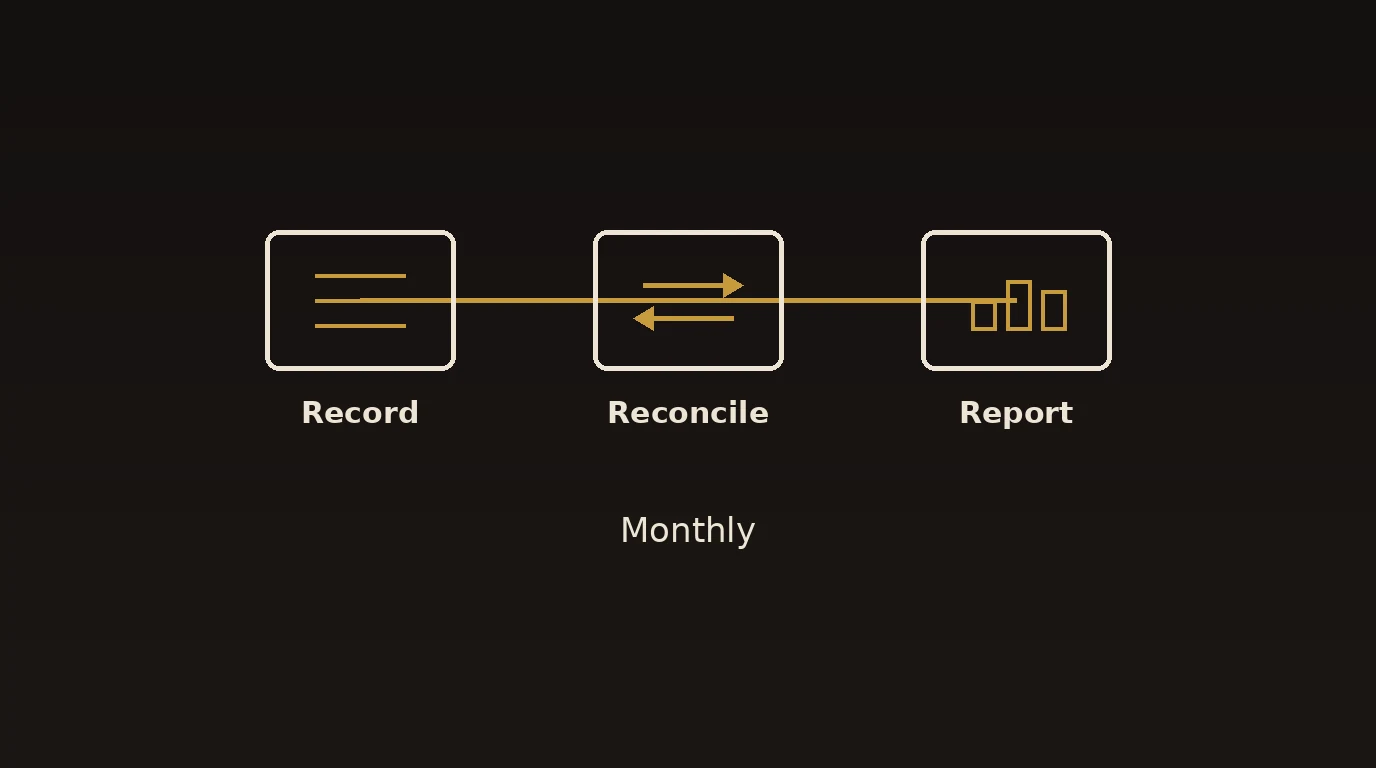
- Ongoing work. Each month we record, categorize, and reconcile.
- Reporting. You get a clear monthly package and a plain-English note on anything worth a look.
Local vs. virtual bookkeeping
| Factor | Local in-person | Virtual / outsourced |
|---|---|---|
| Access | Office hours | Your reports anytime, from anywhere |
| Cost | Often higher | Flat monthly fee, no overhead |
| Coverage | One person | A team, no gaps for PTO |
| Software | Varies | Cloud, real-time |
Benefits
- Lower cost than a full-time hire.
- A whole team instead of one person.
- More time back for the business.
- Fewer errors and cleaner compliance.
- Books that scale as you grow.
Common mistakes to avoid
- Mixing personal and business spending. It muddies every report and weakens your LLC protection.
- Skipping monthly reconciliation. If the books don’t match the bank, they’re fiction.
- Guessing at expense categories. Wrong category, wrong tax — and buried deductions.
- Ignoring accounts receivable. Unpaid invoices are interest-free loans to your customers.
- Waiting until tax season. A year of catch-up costs far more than staying current.
- DIY-ing past your capacity. The mistake is white-knuckling it long after the business outgrew a spreadsheet.

Best practices that keep books clean
- Separate business and personal finances from day one.
- Reconcile every account monthly — bank, credit card, and loans.
- Use QuickBooks Online instead of manual spreadsheets, and connect your bank feeds.
- Review your profit and loss and balance sheet monthly, not just at tax time.
- Attach receipts to transactions so nothing is a mystery six months later.
- Set aside money for taxes every month, and close each period on a checklist.
Why choose Numerawise Solutions
At Numerawise Solutions, bookkeeping is the core of what we do — not a side service. We’re QuickBooks specialists who handle setup, cleanup, and full QuickBooks setup and migration, and we pair the books with payroll services and outsourced bookkeeping so one team covers your whole back office. You get accurate monthly reports, a real person who answers when you email, and books that stay ready for your CPA all year.
Whether you want fully outsourced bookkeeping or just a steady monthly hand, we size the engagement to fit — and keep everything in QuickBooks so you always own your data.
The bottom line
local vs virtual bookkeeping services for small businesses gives small businesses professional, reliable financial support without the cost of a full-time hire. Pick a partner who communicates well, knows your software, and treats your numbers with care.
Key takeaways
- Outsourced/virtual bookkeeping delivers a team for a flat monthly fee.
- It usually costs less than hiring in-house.
- Cloud software means real-time access from anywhere.
- Choose a provider fluent in your platform.
Quick answers.
What is local vs virtual bookkeeping services for small businesses?
It means handing your day-to-day financial recordkeeping to an outside team instead of an in-house employee. The provider records transactions, reconciles accounts, and produces monthly reports, usually through cloud software. You keep ownership of your accounts and data while skipping the hiring, training, and management.
Is outsourced bookkeeping cheaper than hiring in-house?
For most small businesses, yes. A full-time bookkeeper costs salary, payroll taxes, benefits, and software. Outsourcing replaces that with one predictable monthly fee and gives you a whole team plus coverage when someone’s out.
Is virtual bookkeeping secure?
Yes, with the right team. Reputable providers use encrypted cloud platforms, restricted access, and signed confidentiality agreements. Ask how they store files and who can see your accounts. Done well, outsourcing is often safer than one in-house person because duties are separated.
What software do outsourced bookkeepers use?
Most use QuickBooks Online or Desktop, and some use Xero, paired with tools for receipts and bill pay. Cloud software lets you and your bookkeeper see the same real-time numbers. If you already run a platform, pick a provider fluent in it or one that can migrate you cleanly.
Can outsourced bookkeeping handle payroll and sales tax?
Yes. Many providers record payroll and keep sales tax organized and filed on time alongside your books. Running these together keeps everything consistent and helps you avoid the penalties that come from a missed or late filing.
How do I switch to outsourced bookkeeping?
Choose a provider, grant secure access to your accounting software and bank feeds, and they review your books, catch up any backlog, and set a monthly routine. A solid onboarding usually takes a few weeks, especially if cleanup is needed.
Local or virtual bookkeeping — which is better?
For most businesses, virtual wins on cost and coverage, and cloud software makes distance irrelevant. Some owners still prefer a local face for the occasional in-person meeting, which many virtual firms happily accommodate. It comes down to how you like to work.
Can startups and very small businesses use outsourced bookkeeping?
Absolutely. Startups gain clean, tax-ready books and financial clarity without a full-time hire, and the service scales as they grow. Getting the finances right early also helps with funding, loans, and smart decisions before small problems get expensive.
Get a free scoping call.
Tell us what you’re working on. We respond same business day.

Ram · Founder & Principal
Founder of Numerawise Solutions, established MMXXIV in Atlanta. Intuit ProAdvisor Gold tier. Former Intuit Technical Support engineer. Has personally led two hundred accounting software conversions for US small businesses since founding the practice. Reachable directly at [email protected].
Free: The Clean-Cutover Checklist
The step-by-step checklist we use to migrate businesses to QuickBooks without losing data — bank rec, opening balances, payroll YTD, and the validation tie-out. Get it in your inbox.
No spam — just the checklist and the occasional QuickBooks tip.