Professional Odoo Migration Services
Moving to Odoo? Our ERP specialists deliver secure, accurate Odoo migration services — from QuickBooks, Sage, NetSuite, or a legacy system — with your data reconciled and your business running throughout.
Moving to a new ERP is one of the most consequential technology decisions a business makes, and the data migration is where those projects succeed or fail. Done well, professional Odoo migration services deliver a unified platform with your history intact and your operations uninterrupted. Done poorly, a migration leaves you with duplicated records, broken inventory, and balances that will not reconcile — at the worst possible time. Numerawise Solutions exists to make sure it is done well.
ERP migrations are complex because they touch everything: accounting, inventory, sales, purchasing, manufacturing, and the connections between them. Data has to be cleansed, mapped to Odoo’s structure, migrated in the right order, and verified before go-live. That is expert work, not a weekend project. This page explains what we migrate, how our proven framework works, the challenges we solve, and why businesses trust us with the move to Odoo.
Ready to Migrate to Odoo?
Our ERP migration experts ensure secure, accurate, hassle-free Odoo migrations with minimal downtime. Contact Numerawise Solutions for a free migration assessment.
Get a Free Migration AssessmentWhat are Odoo migration services?
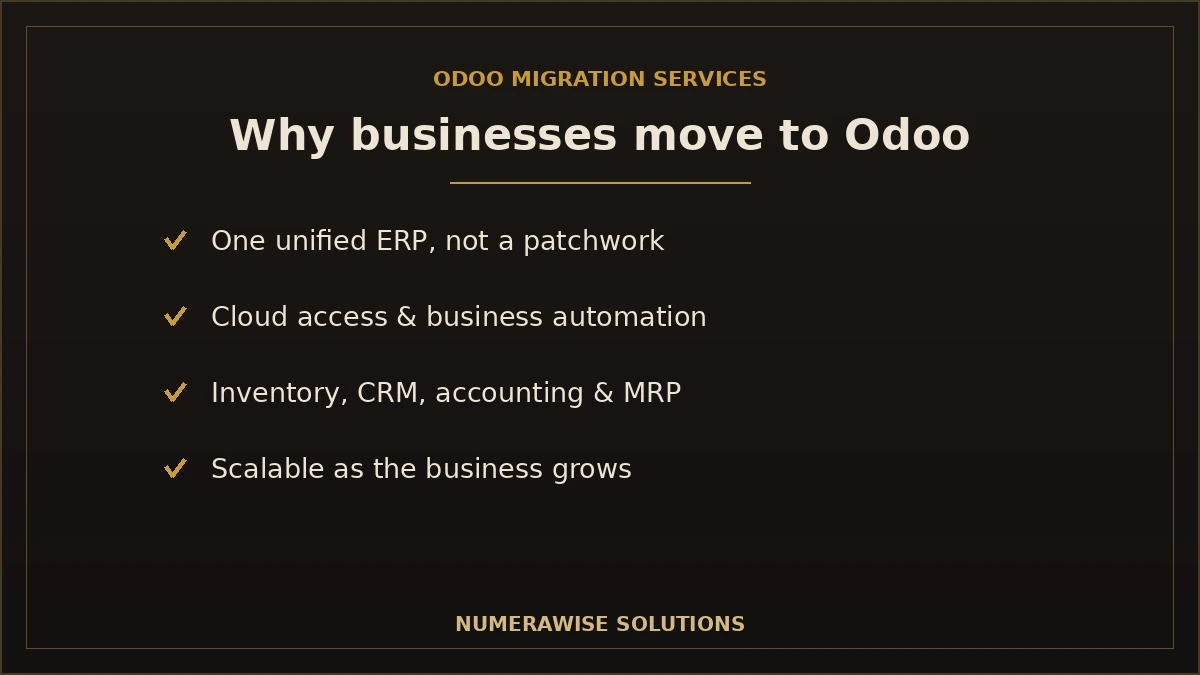
Odoo migration services are professional services that move your business from an existing system into Odoo — or from an older version of Odoo to a newer one. Odoo is an integrated, modular ERP that runs accounting, inventory, CRM, sales, purchasing, manufacturing, and more on one platform, so a migration into it often means bringing several separate systems together.
A complete migration covers several distinct pieces of work:
- ERP migration process: the overall project of moving from your current system to Odoo, planned and controlled end to end.
- Data migration: moving your records — accounts, contacts, transactions, inventory — into Odoo accurately.
- System migration: replacing your existing platform with Odoo as your operational system.
- Business process migration: mapping how you work today into Odoo’s modules and workflows.
- Module migration: setting up the specific Odoo apps your business needs — Accounting, Inventory, Sales, and others.
- Version upgrades: moving from an older Odoo release to a current one, including custom modules and the database.
In plain terms: we take everything your business runs on today and move it into Odoo so it works — not just the data, but the processes and connections around it. That combination of technical data work and business-process understanding is what separates a professional migration from a risky do-it-yourself attempt.
Why businesses migrate to Odoo
Companies choose Odoo for practical, operational reasons. The most common drivers:
- A unified ERP platform that replaces a patchwork of disconnected tools with one system.
- Cloud accessibility so teams work from anywhere with real-time data.
- Business automation across workflows that used to be manual.
- Inventory management with real-time stock, warehouses, and reordering.
- CRM integration that ties sales and customer data to the rest of the business.
- Accounting built into the same platform as operations.
- Manufacturing with bills of materials, work orders, and production planning.
- Sales from quotation to invoice in one flow.
- Purchasing tied directly to inventory and accounting.
- HR for employees, time off, and recruitment where needed.
- Reporting across the whole business from a single source of truth.
- Scalability to add modules and users as the business grows.
The appeal is consolidation: instead of accounting in one app, inventory in another, and CRM in a third, Odoo brings them together. But that same integration is why migration must be handled carefully — everything is connected, so the data has to move as a coherent whole, not in disconnected pieces.
Systems we migrate to Odoo
We migrate businesses to Odoo from a wide range of accounting platforms, ERPs, and data sources. If your system is not listed, ask — we handle custom and legacy sources too.
| Source system | Type | Migration to Odoo |
|---|---|---|
| QuickBooks (Online & Desktop) | Accounting | Fully supported |
| Xero | Accounting | Fully supported |
| Sage 50 | Accounting | Fully supported |
| Sage 100 | ERP / accounting | Supported |
| Sage 300 | ERP | Supported |
| NetSuite / Oracle NetSuite | Cloud ERP | Supported |
| Microsoft Dynamics GP | ERP | Supported |
| Microsoft Dynamics 365 | ERP | Supported |
| SAP Business One | ERP | Supported |
| Zoho Books | Accounting | Fully supported |
| FreshBooks | Accounting | Fully supported |
| AccountEdge | Accounting | Supported |
| MYOB | Accounting | Supported |
| Reckon | Accounting | Supported |
| Odoo (older versions) | ERP | Version upgrade migration |
| Legacy / custom ERP systems | ERP | Assessed case by case |
| Custom accounting software | Various | Assessed case by case |
| Excel / CSV files | Data files | Structured import |
| Access / custom SQL databases | Databases | Extracted and mapped |
Because we also handle QuickBooks conversion services and Sage migration services, businesses consolidating multiple systems into Odoo can rely on one partner for the whole move — including sources like NetSuite migration.
What data can we migrate?
A complete Odoo migration brings across the records that keep your business running and reporting accurately. What moves depends on your source system and Odoo modules, but our scope typically includes:
| Data | Migrates to Odoo? | Notes |
|---|---|---|
| Chart of accounts | Yes | Mapped to Odoo’s accounting structure |
| Customers | Yes | With balances and contact details |
| Vendors | Yes | With balances and contact details |
| Products | Yes | Product catalog and variants |
| Inventory | Yes | Stock levels and valuations |
| Invoices | Yes | Open and historical as needed |
| Bills | Yes | Open and historical as needed |
| Purchase orders | Yes | Open and reference history |
| Sales orders | Yes | Open and reference history |
| Payments | Yes | Applied to the right documents |
| Bank transactions | Yes | With reconciliation handled carefully |
| Employees | Yes | Where the HR module is in scope |
| Payroll history | Where supported | Often re-established going forward |
| Tax codes | Yes | Mapped to Odoo’s tax setup |
| Opening balances | Yes | Reconciled to your source system |
| Attachments | Where supported | Depends on type and volume |
| Journal entries | Yes | Manual and adjusting entries |
| Fixed assets | Yes | Where the asset module is in scope |
| Contacts | Yes | Full contact records |
| Projects | Yes | Where the Projects module is used |
| CRM data | Yes | Leads, opportunities, and pipeline |
| Manufacturing data | Yes | Bills of materials and routings |
| Warehouse data | Yes | Locations and stock moves |
| Custom fields | Yes | Mapped or recreated as needed |
Migration methods vary with the complexity of your source system and your Odoo configuration, which is why every project begins with an assessment rather than a generic import. We scope exactly what will move, what needs recreation, and how far back your history should go.
Expert tip
More data is not always better. We help you decide which history is worth migrating for reporting, tax, and audit — and what is better left archived. Bringing over years of clutter slows the project and imports old problems into a clean new system.
Our Odoo migration process
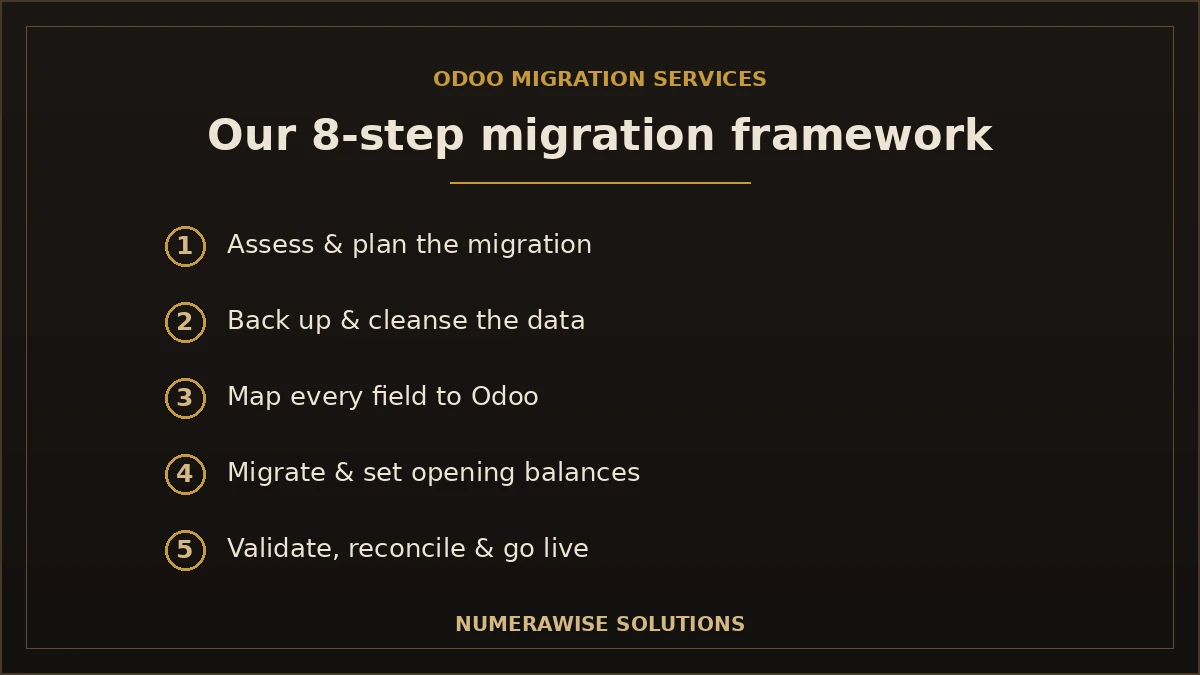
We run every migration as a controlled, eight-step framework. You get a clear plan, a dedicated point of contact, and verification at every stage — nothing goes live until the numbers are proven.
Step 1: Business assessment
We learn your operations, current systems, data volume, and the Odoo modules you need — the foundation for a realistic plan.
Step 2: Migration planning
We build a detailed migration plan: scope, cutover date, responsibilities, and a timeline you can schedule around.
Step 3: Data backup
We take full backups of your source data before anything changes, so your originals are always safe.
Step 4: Data cleansing
We fix duplicates, errors, and inconsistencies before the move — migrating clean data is far cheaper than fixing it after.
Step 5: Field mapping
We map every field — accounts, tax codes, products, contacts, custom fields — to its correct Odoo equivalent.
Step 6: Migration execution
We migrate the data into Odoo in the right order, set opening balances, and configure the modules.
Step 7: Validation & reconciliation
We verify every balance and record against the source — trial balance, A/R, A/P, inventory — until they tie out.
Step 8: Go-live support
We support your team through launch and the first close, so the switch is smooth and confident.
Risk mitigation built in
Backups before changes, cleansing before mapping, validation before go-live, and a parallel-run option where you keep the old system available until Odoo is proven. These safeguards are how we protect business continuity through the move.
Talk to an ERP Migration Specialist
From assessment to go-live, we manage the entire Odoo migration so your data lands clean and your operations keep running. Reach out today.
Get a Free Migration AssessmentOdoo version upgrade services
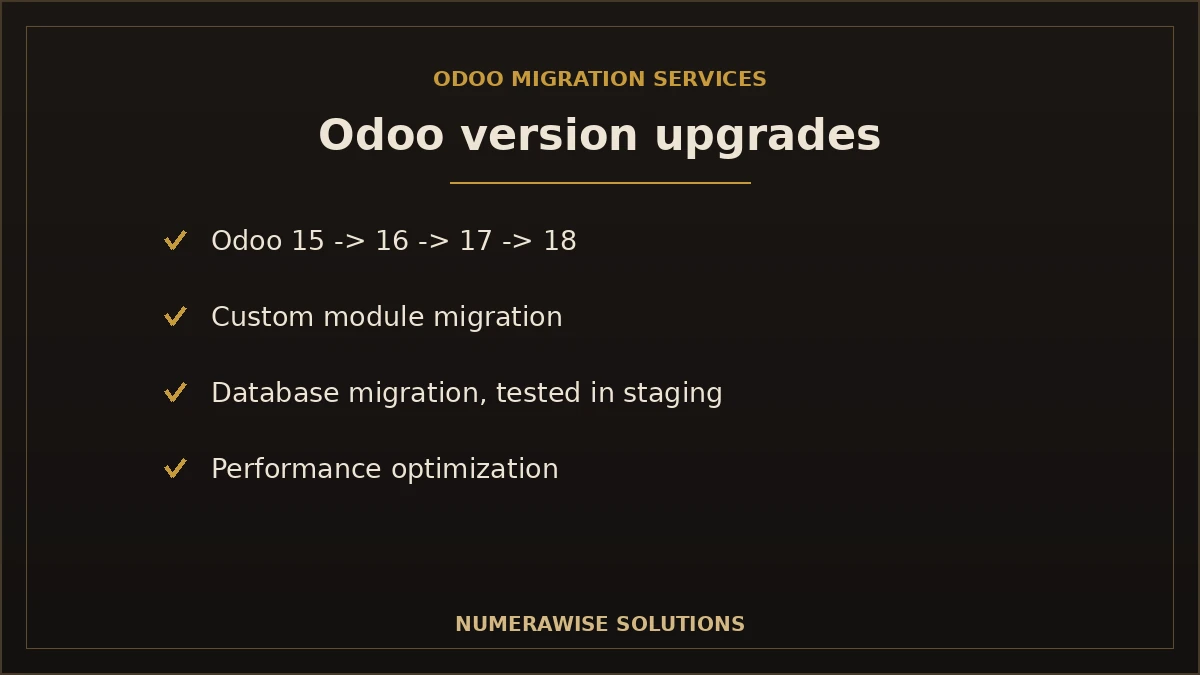
Already on Odoo? Moving to a newer version is its own kind of migration, because Odoo does not simply auto-upgrade — your database and custom modules have to be migrated to work with the new release. We handle version upgrades end to end:
- Odoo 15 to 16 — database and module migration to the newer release.
- Odoo 16 to 17 — upgrade with testing and validation.
- Odoo 17 to 18 — moving to the current generation.
- Custom module migration — adapting your custom apps to the new version’s framework.
- Database migration — upgrading your data structure safely.
- Performance optimization — tuning the upgraded system so it runs well.
Version upgrades are where many in-house teams get stuck, because custom modules built for an older release often break on the new one. We test in a staging environment first, so your live system is never the experiment.
Migration challenges we solve
Complex migrations hit predictable problems. We handle each as part of the engagement:
| Challenge | How we solve it |
|---|---|
| Duplicate records | Identified and removed before migration so nothing is doubled |
| Corrupt databases | Worked through carefully to extract your data safely |
| Large datasets | Migrated in a structured, tested way that handles volume |
| Custom modules | Assessed and migrated or rebuilt for the target Odoo version |
| Data inconsistencies | Cleansed and standardized before mapping |
| Inventory mismatch | Stock levels and valuations reconciled to the source |
| Accounting errors | Corrected so opening balances tie out exactly |
| Multi-company setup | Structured correctly in Odoo’s multi-company framework |
| Multi-currency | Mapped and configured with the right rates and handling |
| Custom workflows | Recreated in Odoo so your processes carry over |
| Broken integrations | Reconnected or rebuilt so connected systems keep working |
The common thread is that these problems are far cheaper to solve before go-live than after. Our assessment surfaces them early, and our cleansing and validation steps resolve them — so they never become a live-system emergency.
Industries we serve
We migrate businesses of every type to Odoo, tuning modules and mapping to each industry’s needs:
- Manufacturing — bills of materials, work orders, and production data.
- Retail — point of sale, inventory, and multi-location stock.
- Construction — project costing and job tracking.
- Healthcare — compliant, accurate records through the transition.
- Professional services — projects, timesheets, and billing.
- Wholesale — pricing, purchasing, and warehouse management.
- Ecommerce — high-volume orders and online-store integration.
- Hospitality — sales, inventory, and point of sale.
- Education — operations and back-office consolidation.
- Distribution — multi-warehouse logistics and inventory.
- Real estate — property, contacts, and accounting.
- Automotive — parts inventory, service, and sales.
DIY vs. professional Odoo migration
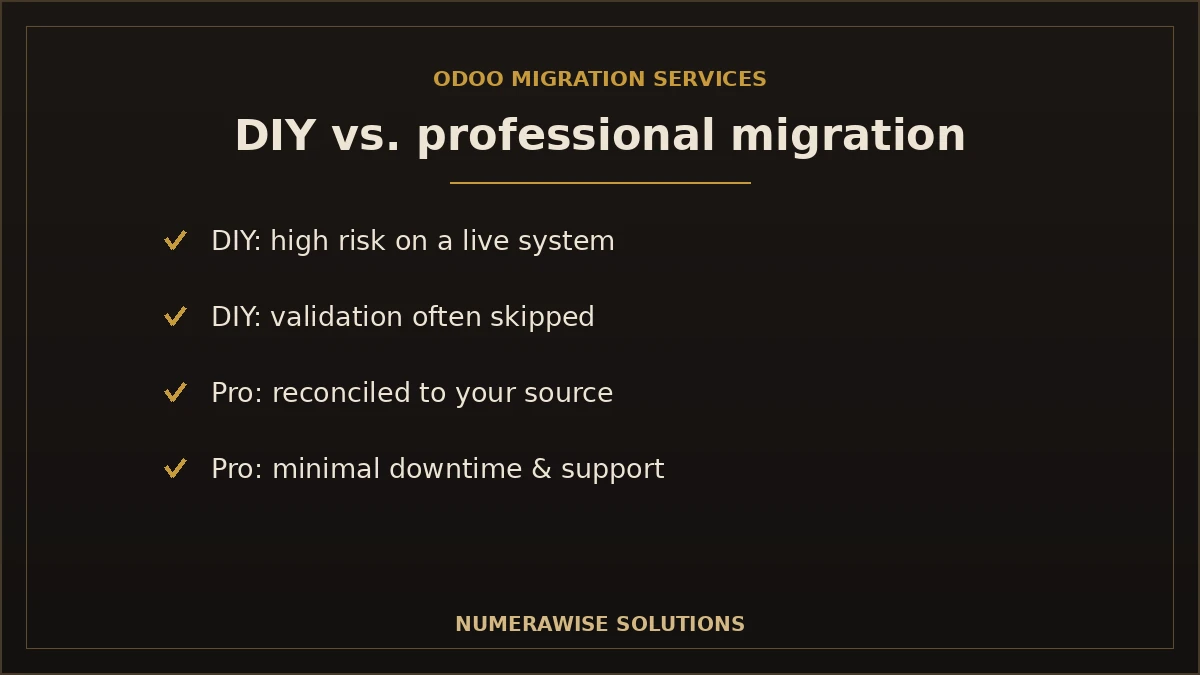
Odoo is powerful and open-source, which tempts some teams to migrate themselves. For anything beyond the simplest data, that is a costly gamble. The honest comparison:
| Factor | DIY migration | Numerawise Solutions |
|---|---|---|
| Risk | High — live-system errors | Managed and mitigated |
| Accuracy | Depends on in-house skill | Verified balance by balance |
| Downtime | Often significant | Minimized with a planned cutover |
| Data validation | Frequently skipped | Full reconciliation to the source |
| Testing | Limited | Staging environment and test runs |
| Support | You are on your own | Dedicated project manager |
| Customization | Hard to get right | Custom modules and integrations handled |
| Security | Ad hoc | Secure, controlled process |
| Training | None | Go-live training for your team |
The real risk of DIY is not that the migration fails outright — it is that it appears to succeed while the data is subtly wrong, surfacing as reconciliation errors, inventory mismatches, or reporting gaps weeks later. Professional migration removes that risk, and for an ERP that runs your whole business, that certainty is worth far more than the cost.
How long does an Odoo migration take?
ERP migrations take longer than a single-app conversion because more systems and data are involved. A rough guide:
| Project | Typical timeline | What drives it |
|---|---|---|
| Small business, few modules | Two to four weeks | Accounting plus one or two modules, clean data |
| Mid-sized, multi-module | One to three months | Inventory, manufacturing, CRM, more history |
| Complex / multi-company | Three months or more | Custom modules, integrations, multi-entity, heavy data |
The timeline is driven far more by data quality, custom modules, and the number of Odoo modules in scope than by raw record count. Most of the schedule goes to planning, cleansing, mapping, and testing — the work that makes go-live safe. We give you a realistic timeline in the assessment so you can plan the transition around your business calendar.
How much does an Odoo migration cost?
There is no flat rate for ERP migration, because scope varies enormously. Cost tracks the number of source systems, the Odoo modules in scope, data volume and quality, custom modules and integrations, and how much history you migrate. A small business moving accounting and inventory is a defined project; a mid-sized manufacturer consolidating several systems with custom workflows is a larger one. We assess your systems and data first, then quote based on what the work actually requires — never a guess. Weighed against the cost of a failed migration, lost data, or operational downtime, professional migration is the lower-risk and usually lower-total-cost path.
Pre-migration preparation and post-migration validation
Two phases decide whether a migration succeeds, and both deserve attention. Before the move, we prepare: reconcile your source accounts to the cutover date, decide how much history to bring, standardize and cleanse the data, document your current workflows, and agree on a cutover date that minimizes disruption. Skipping preparation is the most common reason migrations go wrong.
After the move, validation proves it worked. We reconcile Odoo against your source system — trial balance, receivables, payables, bank balances, and inventory — confirm that transactions and documents landed correctly, test key workflows, and check that reports reflect reality. A migration is not finished when data lands in Odoo; it is finished when the numbers and processes are verified. This discipline is the difference between a migration you can trust and one that quietly hides errors.
Keeping your business running during migration
Business continuity is a first-class concern in any ERP migration, because you cannot stop operating while you switch systems. We protect continuity in several ways: a planned cutover scheduled for a low-impact window, a parallel-run option where your old system stays available until Odoo is proven, phased migration for complex environments so you move in manageable stages, and go-live support on hand for the first critical days. The goal is simple — you keep serving customers, invoicing, and shipping throughout, and the switch to Odoo happens without a gap in your operations. Minimizing downtime is not a bonus in our process; it is a design requirement.
Why choose Numerawise Solutions
- ERP specialists who understand both the data and the business processes behind it.
- Migration experts with a proven, repeatable framework — not a first attempt on your live system.
- Secure migration with encrypted transfer, backups, and restricted access throughout.
- Business continuity — we plan cutover to keep you operating with minimal disruption.
- Affordable pricing with clear, assessment-based quotes and no surprises.
- Minimal downtime through careful scheduling and parallel-run options.
- A dedicated project manager who owns your migration end to end.
- Post-launch support through go-live and beyond.
- Custom integrations to connect Odoo with the tools you keep.
- Training so your team is confident on day one.
Once you are live on Odoo, our bookkeeping services and outsourced accounting services can keep your books accurate and your back office running, so the migration is the start of a cleaner operation, not a one-time project. We also handle cloud migration services for businesses moving on-premise systems to the cloud.
Migrate to Odoo with a partner you can trust
An ERP migration is too important to improvise. Your accounting, inventory, sales, and operations all depend on the data arriving in Odoo complete, accurate, and reconciled — and on your business continuing to run while it happens. That is what professional Odoo migration services deliver: a controlled framework, expert data mapping, thorough validation, and support through go-live. Numerawise Solutions brings ERP and accounting expertise together, so your migration is handled by specialists who understand both the numbers and the business behind them. Whether you are moving from QuickBooks, Sage, NetSuite, a legacy ERP, or upgrading an older Odoo version, we make the transition secure, accurate, and smooth. Migrate to Odoo with confidence — and with a partner who treats your data with the care it deserves.
Ready to Migrate to Odoo?
Get a secure, accurate, hassle-free Odoo migration with minimal downtime. Contact Numerawise Solutions for your free migration assessment today.
Get a Free Migration AssessmentKey takeaways
- Odoo migration services move your data and processes into Odoo — securely, accurately, and with minimal downtime.
- We migrate from QuickBooks, Sage, NetSuite, Dynamics, spreadsheets, and more, plus Odoo version upgrades.
- Our eight-step framework validates and reconciles every balance before go-live.
- We solve the hard problems: duplicates, custom modules, multi-company, multi-currency, and broken integrations.
- Professional migration removes the real risk — data that moves subtly wrong and fails later.
Quick answers.
How long does an Odoo migration take?
It depends on scope. A small business moving accounting and one or two modules with clean data can take two to four weeks; a mid-sized, multi-module project takes one to three months; and complex or multi-company migrations with custom modules can take three months or more. The timeline is driven by data quality, custom modules, and the number of Odoo modules in scope. We provide a realistic timeline in the assessment.
Can all historical data be migrated to Odoo?
Most historical data can migrate — accounts, contacts, transactions, inventory, and balances — but you rarely need all of it. We help you decide how much history to bring for reporting, tax, and audit rather than importing years of clutter. Some data, like detailed payroll history, may be re-established going forward. We scope exactly what moves during the assessment.
Can custom modules be migrated to Odoo?
Yes. Custom modules are one of the trickiest parts of any Odoo migration or version upgrade, because modules built for an older release often break on a newer one. We assess your custom modules and migrate or rebuild them to work with your target Odoo version, testing in a staging environment first so your live system is never the experiment.
Can QuickBooks migrate to Odoo?
Yes. QuickBooks — both Online and Desktop — is one of the most common sources we migrate to Odoo. We move your chart of accounts, customers, vendors, transactions, inventory, and balances into Odoo's accounting and operational modules, reconcile opening balances to QuickBooks, and verify everything before go-live. If you are consolidating QuickBooks with other systems into Odoo, we handle the whole move.
Can Sage migrate to Odoo?
Yes. We migrate Sage 50, Sage 100, and Sage 300 to Odoo. Sage ERP data includes accounting, inventory, and often manufacturing or distribution modules, all of which we assess, cleanse, map, and migrate into Odoo. Because Sage systems vary in complexity, we scope each migration individually and reconcile every balance against Sage before your Odoo system goes live.
How much does an Odoo migration cost?
There is no flat rate, because scope varies widely. Cost depends on the number of source systems, the Odoo modules in scope, data volume and quality, custom modules and integrations, and how much history you migrate. We assess your systems first and quote based on what the work requires, never a guess. Against the cost of a failed migration or downtime, professional migration is the lower-risk, usually lower-total-cost path.
Will my business operations stop during migration?
No. Business continuity is a core part of our process. We schedule cutover for a low-impact window, offer a parallel-run option where your old system stays available until Odoo is proven, and can migrate complex environments in phases. You keep serving customers, invoicing, and shipping throughout, and the switch to Odoo happens with minimal downtime rather than a shutdown.
Can you migrate inventory to Odoo?
Yes. Inventory is one of Odoo's strengths, and we migrate stock levels, valuations, product catalogs, warehouses, and stock locations. Because inventory ties directly to accounting and purchasing, we reconcile stock values against your source system so your balance sheet and inventory match after the move. Complex or multi-warehouse setups are reviewed and mapped carefully during the assessment.
Can users continue working during the migration?
In most cases, yes. With a parallel-run or phased approach, your team keeps using the existing system until Odoo is validated and ready. We plan the cutover so the actual switch happens with minimal disruption, often over a weekend or low-activity period. The goal is a smooth transition where users move to Odoo on go-live day, not a long freeze on operations.
Do you provide training after migration?
Yes. Go-live training is part of our process. We help your team learn the Odoo modules they use day to day, so they are confident from launch. We also provide post-launch support through the first close and beyond, so questions get answered as your team settles in. Training is what turns a technically successful migration into one your people actually adopt.
Can you migrate to a newer version of Odoo?
Yes. Odoo version upgrades — such as 15 to 16, 16 to 17, or 17 to 18 — are a form of migration, because Odoo does not simply auto-upgrade; the database and custom modules must be migrated to the new release. We handle the database migration, adapt custom modules, test in staging, and optimize performance, so your upgraded system works correctly and your live environment is never at risk.
Is my data secure during the migration?
Yes. We use secure, encrypted transfer, take full backups before anything changes, and restrict access to the specialists on your project. Your original systems stay intact as a fallback until Odoo is verified and complete, and you retain ownership throughout. For an ERP migration touching your entire business, this controlled, secure process is essential — and it is built into every step.
What systems can you migrate to Odoo?
We migrate from QuickBooks, Xero, Sage 50/100/300, NetSuite, Microsoft Dynamics GP and 365, SAP Business One, Zoho Books, FreshBooks, AccountEdge, MYOB, Reckon, older Odoo versions, legacy and custom ERPs, and data sources like Excel, CSV, Access, and SQL databases. If your system is not listed, we assess it case by case — custom and legacy sources are part of what we handle.
Can you handle multi-company or multi-currency setups?
Yes. Multi-company and multi-currency are common in ERP migrations and are fully supported in Odoo. We structure your entities correctly in Odoo's multi-company framework and configure currencies with the right rates and handling. These setups need careful planning so consolidation and reporting work after the move, which is exactly what our assessment and mapping steps address.
What happens to my integrations after migrating to Odoo?
Connected systems — ecommerce platforms, payment processors, shipping tools — are reconnected or rebuilt as part of the migration. Broken integrations are a common pain point, so we identify every connection during the assessment and plan how each will work with Odoo. Where a native Odoo module or app replaces an old integration, we set that up so your workflows keep running smoothly.
Do I need to clean up my data before migrating?
Cleansing is part of our process, so you do not have to do it alone. We fix duplicates, errors, and inconsistencies before mapping, because migrating clean data is far cheaper than fixing it in the live Odoo system afterward. If your source data is significantly messy, cleansing is a defined phase of the project. Moving clean data is what makes the difference between a smooth launch and inherited problems.
How do you make sure the migration is accurate?
We validate and reconcile. After migrating, we compare Odoo against your source system — trial balance, receivables, payables, bank balances, and inventory — until they tie out exactly, and we test key workflows and reports. A migration is not finished when data lands in Odoo; it is finished when the numbers and processes are verified. This reconciliation is what proves your new system is accurate and safe to rely on.
Can you migrate manufacturing data to Odoo?
Yes. Odoo's manufacturing module handles bills of materials, work orders, and production planning, and we migrate the underlying data — BOMs, routings, and product structures — so your manufacturing operations run in Odoo from day one. Manufacturing data ties to inventory and accounting, so we reconcile it across modules to keep everything consistent after the move.
What if my current system is a legacy or custom database?
We handle legacy ERPs, custom accounting software, and custom SQL or Access databases by extracting and mapping the data case by case. These sources require more assessment because their structure is unique, but the goal is the same: get your records into Odoo accurately and reconciled. Many businesses migrate to Odoo precisely to escape an aging custom system, and we make that move safely.
Do you offer a free migration assessment?
Yes. Every engagement starts with a free migration assessment, where we review your current systems, data, and requirements, and scope the project. This lets us give you an accurate timeline and quote — and gives you a clear picture of what the migration involves — before any commitment. It is the right first step for any business considering a move to Odoo.
Why should I use a professional Odoo migration company?
Because an ERP runs your whole business, and a subtly wrong migration surfaces as reconciliation errors, inventory mismatches, and reporting gaps weeks after go-live. A professional migration company brings a proven framework, expert data mapping, thorough validation, and business-continuity planning that a DIY effort cannot match. The certainty of a correct, reconciled migration is worth far more than the cost, especially for a system this central to operations.
Get a free scoping call.
Tell us what you’re working on. We respond same business day.

Ram · Founder & Principal
Founder of Numerawise Solutions, established MMXXIV in Atlanta. Intuit ProAdvisor Gold tier. Former Intuit Technical Support engineer. Has personally led two hundred accounting software conversions for US small businesses since founding the practice. Reachable directly at [email protected].
Free: The Clean-Cutover Checklist
The step-by-step checklist we use to migrate businesses to QuickBooks without losing data — bank rec, opening balances, payroll YTD, and the validation tie-out. Get it in your inbox.
No spam — just the checklist and the occasional QuickBooks tip.