Most halls start simple. One shared POS, a handshake revenue split, a spreadsheet. It works until you have twelve vendors, three payment processors, a shared bar, and a landlord asking for percentage-rent figures by the 10th.
Then food hall accounting stops being data entry and becomes the thing that decides whether vendors trust you. Every payout is a statement about your books. If they cannot be explained, vendors leave. This guide covers how bookkeeping for food halls actually works and where it breaks.
Why food hall bookkeeping is harder than restaurant bookkeeping
A single restaurant reconciles one set of sales to one bank account. A food hall has to answer a harder question: whose money is this?
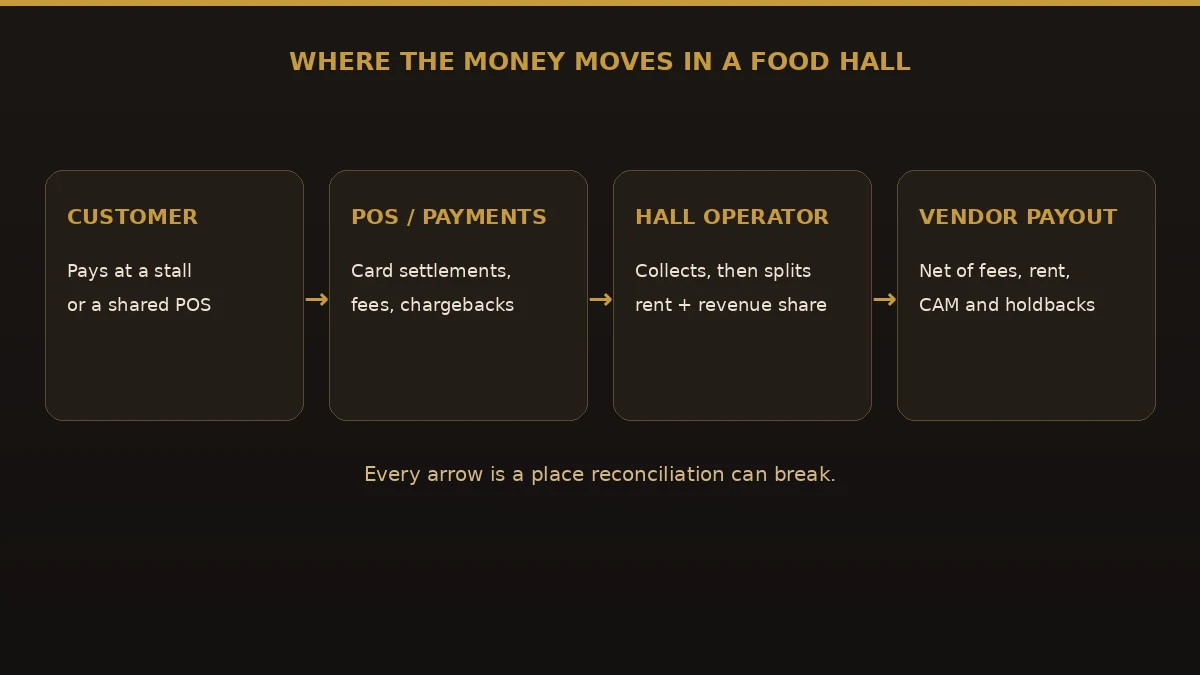
- Money lands in one place and belongs to many. If the hall collects on a shared POS, most of that deposit is not your revenue — it is a payable to vendors.
- Payouts are net of several things. Processing fees, base rent, percentage rent, CAM, utilities, marketing levies, sometimes a holdback.
- Sales tax responsibility varies. Depending on the agreement and your state, the operator or the vendor may be the party that remits. Getting this wrong is expensive.
- Tips may pool across stalls. Shared bars and runners complicate allocation, and 2026 brought new reporting requirements.
- Everyone needs different reports. Vendors want their own P&L, the operator wants the consolidated view, the landlord wants sales for percentage rent.
What our food hall bookkeeping services cover
Whether you run the hall or a stall inside it, food hall accounting services should cover this monthly cycle:
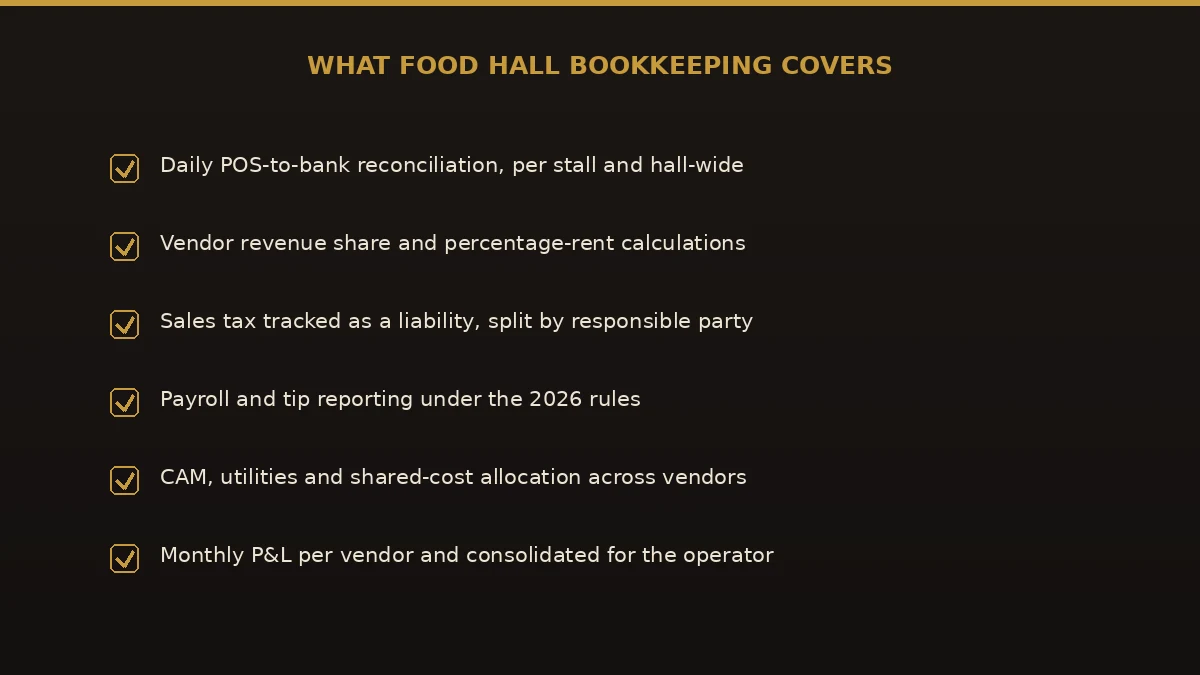
- Daily POS-to-bank reconciliation. Per stall and hall-wide, so settlements, fees, and chargebacks are matched, not assumed.
- Revenue share and percentage rent. Calculated from reconciled sales, not raw POS totals.
- Vendor payout statements. Clear enough that a vendor can check them without calling you.
- Sales tax as a liability. Tracked and split by whichever party is responsible for remitting.
- Payroll and tip reporting. Including the 2026 requirements below.
- Shared cost allocation. CAM, utilities, and marketing spread on a consistent, defensible basis.
- Monthly reporting. A P&L per vendor and a consolidated set for the operator.
Tip reporting: what changed for 2026
This matters to every tipped venue, and food halls with shared bars or service staff are squarely in scope. Any food hall accountant should be raising it with you now:
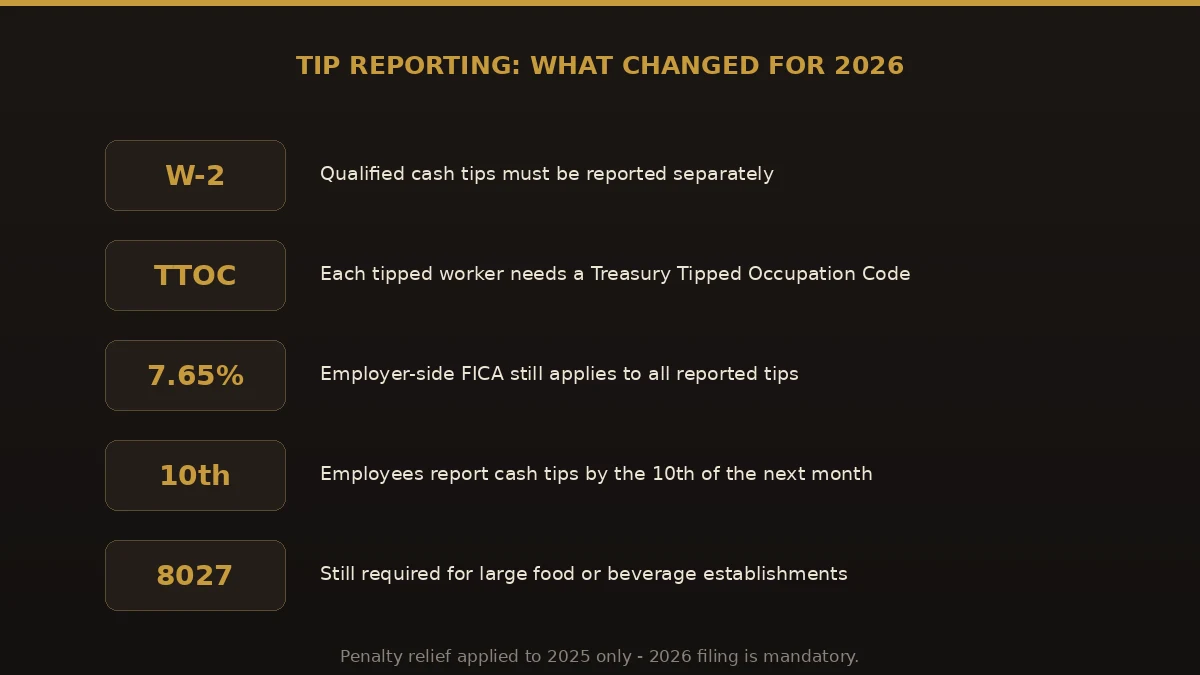
- Qualified cash tips are reported separately. From tax year 2026, employers must separately report qualified cash tips on the updated Form W-2 and applicable 1099 forms.
- Treasury Tipped Occupation Codes (TTOC). Each tipped worker must be assigned a code from the IRS list of qualifying occupations, so your payroll setup needs updating.
- FICA has not gone away. The deduction applies to employees’ federal income tax. Employers still owe the employer-side FICA of 7.65% on reported tips.
- Employees still report by the 10th. Cash tips must be reported to the employer by the 10th of the following month.
- Form 8027 still applies. Large food or beverage establishments still file it — generally by the last day of February on paper, or 31 March electronically.
One caution worth stating plainly: the IRS waived penalties for 2025 only. For 2026 onward, this reporting is mandatory. Most states have not conformed to the federal treatment either, so state withholding may still apply. Confirm your position with the IRS and your CPA rather than assuming.
Operator or vendor: who needs what
| Need | Hall operator | Food vendor |
|---|---|---|
| POS reconciliation | Hall-wide, all stalls | Own stall only |
| Key calculation | Revenue share, CAM, rent | True margin after fees and rent |
| Sales tax | Often remits centrally | Depends on the agreement |
| Payroll | Shared staff, bar, security | Own kitchen team |
| Reporting | Consolidated plus per vendor | Single P&L |
We work with both sides, but never on opposite sides of the same payout dispute. If we keep the hall’s books, we will tell a vendor that plainly before taking them on.
Benefits of outsourced food hall bookkeeping
- Payouts vendors trust. Reconciled statements end most disputes before they start.
- You see real margins. Per stall, per day-part, not just gross sales.
- Sales tax and tips stay compliant. Tracked as they happen, not reconstructed later.
- Faster month-end. Percentage-rent figures ready when the landlord asks.
- Lower cost than in-house. Outsourced food hall bookkeeping costs a fraction of a full-time controller.
- Works remotely. Virtual food hall bookkeeping means your books are current wherever your hall is.
Common mistakes to avoid
- Treating vendor collections as revenue. If you collect on their behalf, it is a liability until paid out. This single error inflates revenue and distorts every ratio.
- Calculating rent from gross POS sales. Percentage rent should come off reconciled net sales, after refunds and voids.
- Booking sales tax as income. It is collected for the state, not earned.
- Ignoring processing fees in payouts. Vendors notice, and unexplained deductions destroy trust quickly.
- Allocating CAM inconsistently. Pick a defensible basis, document it, and apply it the same way every month.
- Leaving tip codes until year end. The 2026 TTOC requirement is a payroll setup task, not a January problem.
Best practices for clean food hall books
- Use a clearing account for vendor money. Collections in, payouts out, so it never touches your revenue.
- Reconcile POS to bank daily. Card settlements lag; catching a gap after a month is far harder.
- Set up classes or locations per vendor in QuickBooks. This is what makes per-stall reporting possible without a second system.
- Write the allocation rules down. CAM, utilities, and marketing splits should be in the agreement and mirrored in the books.
- Issue payout statements on a fixed schedule. Predictability is most of what vendors want.
- Review margins per stall monthly. A struggling vendor is visible in the numbers months before they give notice.
Why choose Numerawise Solutions
We are an accounting firm built around QuickBooks and clean monthly books, and hospitality is a core part of what we do. Our food hall bookkeeping work runs inside your own QuickBooks file, using classes or locations per vendor so per-stall reporting comes out of one system rather than a pile of spreadsheets. You get a flat monthly fee scoped after a real review, a named person who knows your hall, and payout statements that arrive on schedule. If your books are behind, we quote the catch-up separately and say plainly what it will take. We also handle restaurant bookkeeping, payroll, QuickBooks setup and cleanup, and outsourced accounting.
The bottom line
A food hall succeeds when vendors trust the numbers. That is really what food hall bookkeeping services buy you: reconciled sales, defensible allocations, and payout statements nobody has to argue about. Keep vendor collections in a clearing account, reconcile POS to bank daily, allocate shared costs on a written basis, and get your tip reporting set up for the 2026 rules now rather than in January. Whether you need a food hall accountant for the whole venue or food vendor bookkeeping for a single stall, the standard is the same — and it is the difference between a hall vendors renew in and one they quietly leave.
Key takeaways
- Food hall bookkeeping services differ from restaurant work because one deposit belongs to many businesses.
- Keep vendor collections in a clearing account — never treat them as your own revenue.
- Calculate percentage rent from reconciled net sales, not raw POS gross.
- From 2026, qualified cash tips need separate W-2 reporting and a Treasury Tipped Occupation Code per worker; employer FICA still applies.
Quick answers.
What are food hall bookkeeping services?
They are bookkeeping built for a multi-vendor venue. Food hall bookkeeping services cover POS reconciliation across stalls, vendor revenue share and percentage rent, shared cost allocation, sales tax tracking, payroll and tip reporting, and monthly reporting both per vendor and consolidated for the operator. Ordinary restaurant bookkeeping does not handle the split-money problem.
How is food hall accounting different from restaurant accounting?
A restaurant reconciles one set of sales to one bank account. Food hall accounting has to determine whose money each deposit belongs to, then calculate payouts net of processing fees, rent, CAM, and other deductions. It also requires reporting in several directions at once: to vendors, the operator, and often a landlord.
Who remits sales tax in a food hall, the operator or the vendor?
It depends on your agreements and your state. In some structures the operator collects and remits centrally; in others each vendor is the seller of record and remits its own. Getting this wrong creates real liability, so confirm the position in writing and mirror it in the books before the first filing.
How should vendor collections be recorded?
Through a clearing or liability account, not revenue. If the hall collects on a vendor’s behalf, that money is a payable until it is paid out. Recording it as revenue inflates your top line and distorts every margin and ratio you rely on. This is the single most common error in bookkeeping for food halls.
What changed for tip reporting in 2026?
From tax year 2026, employers must separately report qualified cash tips on the updated Form W-2 and applicable 1099 forms, and assign each tipped worker a Treasury Tipped Occupation Code. Employer-side FICA of 7.65% still applies, employees still report cash tips by the 10th of the following month, and Form 8027 still applies to large food or beverage establishments.
Can I use QuickBooks for a food hall?
Yes, and it is usually the right tool. QuickBooks for food halls works well when you set up classes or locations per vendor, so per-stall reporting comes from one system instead of spreadsheets. It needs configuring properly at the start, because retrofitting a vendor structure onto months of untagged transactions is slow work.
How much do food hall bookkeeping services cost?
Pricing depends on the number of vendors, transaction volume, how many POS and payment systems are in play, and whether payroll and sales tax are included. Outsourced food hall bookkeeping costs a fraction of a full-time controller, but insist on a scoped quote after someone has actually reviewed your setup rather than a number given upfront.
Do you work with individual vendors as well as operators?
Yes. Food vendor bookkeeping for a single stall focuses on true margin after processing fees, rent, and shared costs, which many vendors never see clearly. We do not act for both sides of the same payout dispute, though, and we will say so plainly before taking on work that could conflict.
Can food hall bookkeeping be done remotely?
Yes. Virtual food hall bookkeeping is standard now, because POS systems, payment processors, and bank feeds are all cloud-based. We work inside your own QuickBooks file with named user access, so you keep ownership and can see exactly what changed and when, wherever your hall is located.
Get a free scoping call.
Tell us what you’re working on. We respond same business day.

Ram · Founder & Principal
Founder of Numerawise Solutions, established MMXXIV in Atlanta. Intuit ProAdvisor Gold tier. Former Intuit Technical Support engineer. Has personally led two hundred accounting software conversions for US small businesses since founding the practice. Reachable directly at [email protected].
Free: The Clean-Cutover Checklist
The step-by-step checklist we use to migrate businesses to QuickBooks without losing data — bank rec, opening balances, payroll YTD, and the validation tie-out. Get it in your inbox.
No spam — just the checklist and the occasional QuickBooks tip.