Foundation Software has served contractors well for years. It is a dedicated construction platform with mature job costing, certified payroll, and WIP. So why move? Usually it comes down to three things: owners want browser-based access instead of a server in the back office, a group of entities that needs real consolidation, and the pull of the wider Intuit product family. That is where a Foundation Software to Intuit Enterprise Suite move starts to make sense.
Before we go further, one honest point from doing this work: Intuit Enterprise Suite (IES) is a capable, modern platform, but Foundation is a deep construction tool. A Foundation to Intuit Enterprise Suite conversion is worth doing when IES’s strengths — cloud, multi-entity, and AI-driven reporting — matter more to you than the niche construction features Foundation has spent decades refining. We will be straight with you about that fit before anyone touches your data.
You may also see this called a Foundation software conversion or a Foundation data conversion to Intuit Enterprise Suite — the labels differ, but the work is the same.
What is Intuit Enterprise Suite, and why contractors look at it
Intuit Enterprise Suite is Intuit’s cloud platform for mid-market businesses that have outgrown QuickBooks Online but do not want a heavy ERP. It adds native multi-entity management, dimensional reporting, deeper automation, and built-in payroll and HR. In 2026 Intuit shipped a construction-focused edition with real-time job cost visibility and financial reporting built for construction sub-industries.
For a contractor, that combination is the draw: keep job-level detail, gain a cloud system the whole team can reach, and consolidate several companies without the month-end spreadsheet gymnastics. That is the case for a Foundation to Intuit Enterprise Suite migration — and it is why you should plan it carefully rather than treat it as a simple export and import.
What data moves in a Foundation to Intuit Enterprise Suite migration
The value of your Foundation system is the history inside it. A real Foundation to Intuit Enterprise Suite data migration is about mapping that history to how IES organizes information — using dimensions and projects instead of Foundation’s structure. Some teams call this a Foundation ERP to Intuit Enterprise Suite project, a Foundation to IES migration, or simply a decision to convert Foundation to Intuit Enterprise Suite; the work is the same.
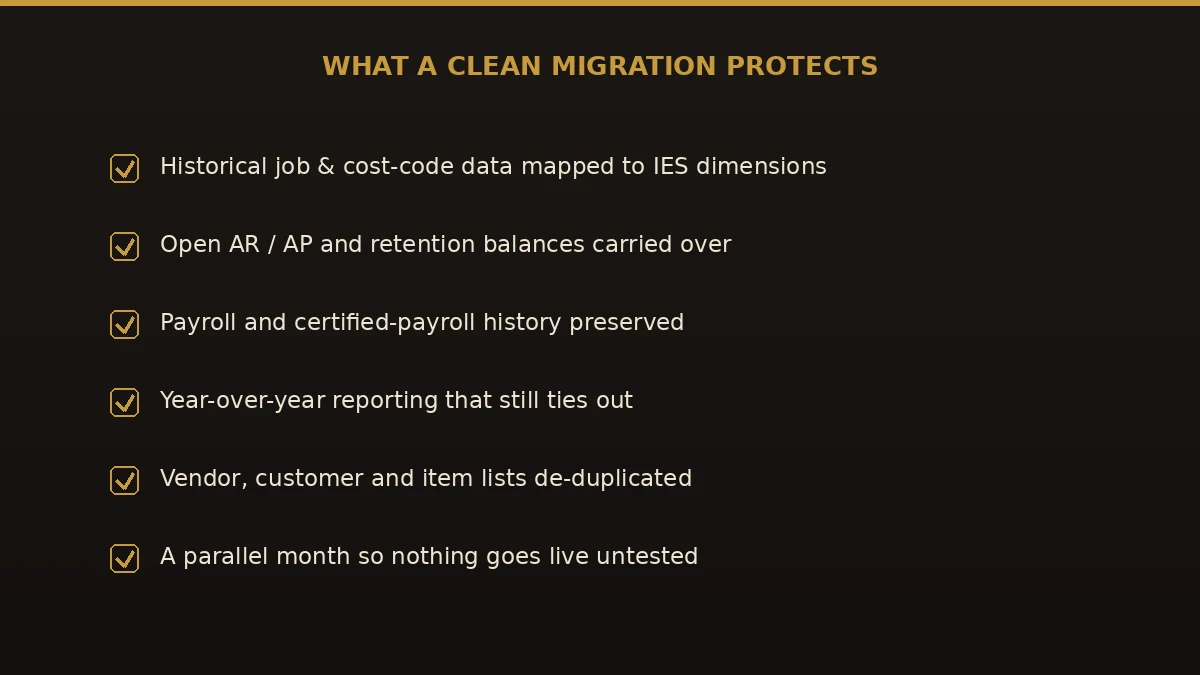
- Chart of accounts — rebuilt and, usually, cleaned up along the way.
- Jobs and cost codes — mapped to IES projects and dimension values.
- Customers, vendors, and items — de-duplicated as they come across.
- Open AR, AP, and retention — carried as open items so nothing is lost at cutover.
- Trial balance and historical activity — brought over so prior years still report.
- Payroll and certified-payroll history — preserved for reporting and compliance.
Not everything transfers cleanly. Some Foundation-specific reports and workflows have no exact match in IES and get rebuilt as dimensional reports. Knowing that in advance is the difference between a smooth cutover and a surprise in your first month-end.
How to migrate Foundation Software to Intuit Enterprise Suite, step by step
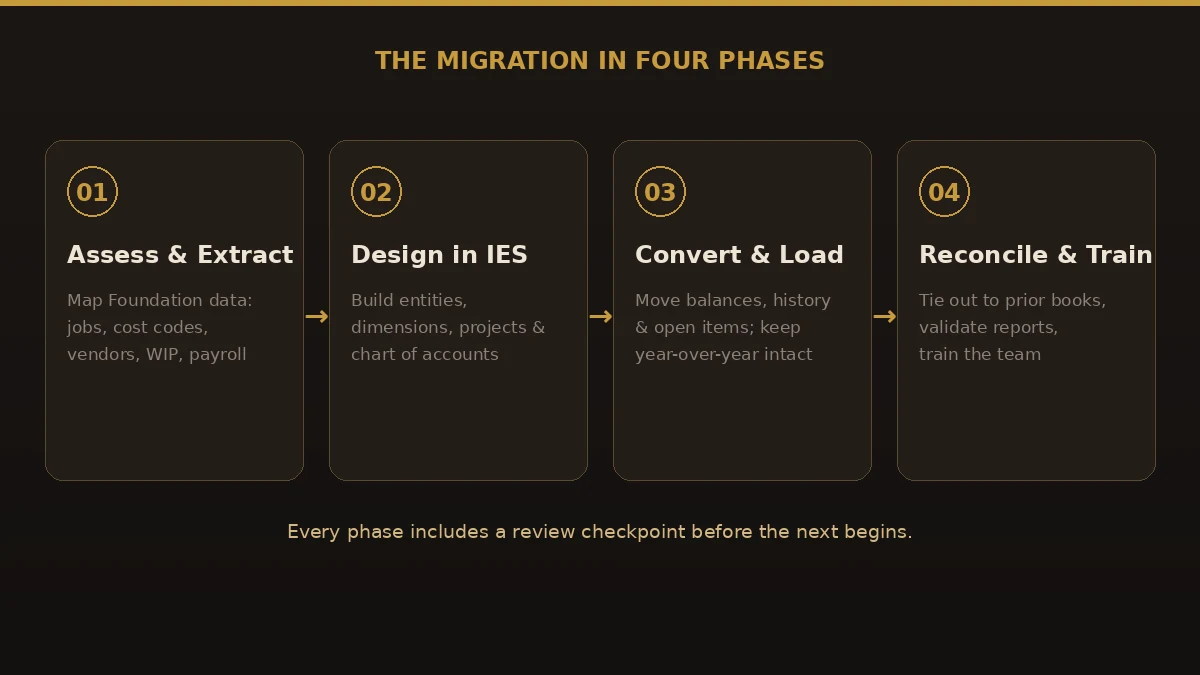
When we migrate Foundation Software to Intuit Enterprise Suite, we run it in four phases. Each ends in a review before the next starts, so problems surface early — not after go-live.
- Assess and extract. Inventory your Foundation setup: entities, jobs, cost-code structure, open balances, payroll items, and the reports you cannot live without. Export the underlying data.
- Design in IES. Build the target: entity hierarchy, dimensions, projects, and a chart of accounts. This is where a clean structure is designed in, rather than old clutter carried forward.
- Convert and load. Map and import balances, history, and open items. Year-over-year figures are validated so comparisons still hold after the move.
- Reconcile, run parallel, and train. Tie IES back to your last Foundation reports to the dollar, run a parallel period, then train the team before the old system is retired.
Foundation vs Intuit Enterprise Suite for construction: an honest comparison
Neither system is simply "better." They are built for different priorities. This is the trade-off at the heart of any Foundation to Intuit Enterprise Suite conversion:
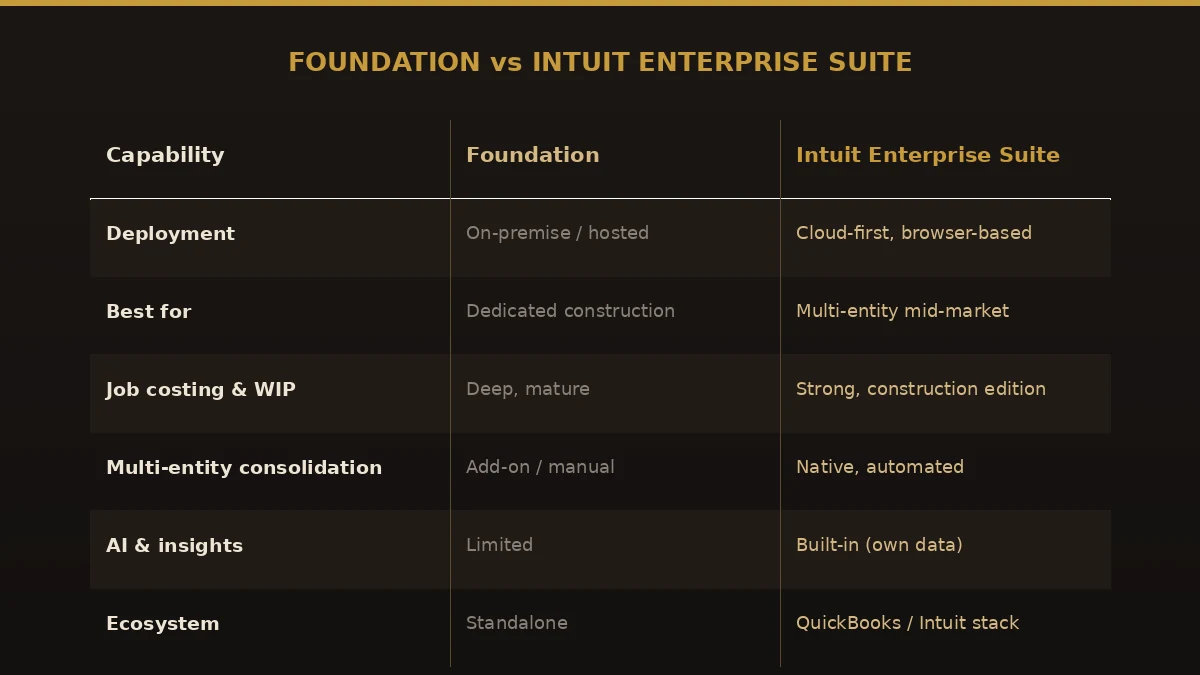
| Capability | Foundation Software | Intuit Enterprise Suite |
|---|---|---|
| Deployment | On-premise or hosted | Cloud-first, browser-based |
| Built for | Dedicated construction accounting | Multi-entity mid-market, incl. construction |
| Job costing & WIP | Deep and mature | Strong; newer construction edition |
| Multi-entity consolidation | Add-on or manual | Native and automated |
| AI & insights | Limited | Built in, from your own data |
| Ecosystem | Standalone | QuickBooks / Intuit stack |
Benefits of moving to Intuit Enterprise Suite
When the fit is right, contractors who complete a Foundation software to Intuit Enterprise Suite move tend to gain:
- Anywhere access. A cloud system reachable from the office, the field, or a phone — no VPN into a server.
- Real multi-entity reporting. Consolidate related companies natively, with automated intercompany handling.
- Dimensional insight. Slice results by job, division, project manager, or region without exporting to spreadsheets.
- Built-in AI. Trend and variance signals drawn from your own transaction history.
- One ecosystem. Payroll, payments, and reporting living inside the Intuit family.
Common mistakes to avoid
The failures we get called in to fix usually trace back to the same handful of shortcuts:
- Treating it as an export/import. Foundation and IES organize data differently; a raw dump lands your job costs in the wrong place.
- Skipping the design phase. Copying an old chart of accounts forward carries every problem with it.
- Migrating mid-period. Cutting over inside a job or a payroll quarter creates reconciliation headaches. Pick a clean break.
- No parallel run. Going live without a test period means finding errors in real reports, in front of your CPA or bank.
- Ignoring certified payroll. If you run prevailing-wage jobs, confirm how IES handles certified payroll before you commit.
Best practices for a clean migration
- Start from a clean Foundation period. Reconcile and close cleanly before extracting anything.
- Design the target first. Agree the entity, dimension, and project structure before loading a single balance.
- Map cost codes deliberately. Your job-costing history is the crown jewel — map it, do not guess it.
- Run parallel for at least one period. Compare IES output to Foundation side by side until they match.
- Train before you retire the old system. Keep Foundation read-only until the team is confident in IES.
Why work with Numerawise Solutions
We are a QuickBooks and Intuit-focused accounting firm that moves businesses onto the Intuit platform for a living. A Foundation to Intuit Enterprise Suite migration sits squarely in what we do: we assess the fit honestly, design the IES structure around how you actually run jobs, convert the data, and reconcile it back to your last Foundation reports before anything goes live. You keep ownership of your data throughout, and you get a fixed scope before we begin. If IES is not the right destination for your construction business, we will tell you that too — and point you at a better path. If you run construction accounting on another platform, see our Sage 100 Contractor to Intuit Enterprise Suite and Sage 300 CRE to Intuit Enterprise Suite guides, or our Foundation to QuickBooks Enterprise and other conversion services.
The bottom line
A Foundation to Intuit Enterprise Suite migration is a genuine upgrade for the right contractor: cloud access, native multi-entity reporting, and the Intuit ecosystem, with your job-costing history carried across intact. The risk is never the software — it is a rushed, undesigned data move. Plan the target, map your cost codes, run a parallel period, and the conversion becomes a non-event. Get that wrong and you spend your first quarter untangling reports. If you are weighing the move, talk to a specialist who does Foundation to Intuit Enterprise Suite data migration work every week before you commit to a date.
Key takeaways
- A Foundation to Intuit Enterprise Suite migration suits contractors who want cloud access and multi-entity reporting inside the Intuit ecosystem.
- IES is modern and multi-entity; Foundation has deeper niche construction features — fit matters, so assess it honestly first.
- The real work is a Foundation to Intuit Enterprise Suite data migration: mapping jobs, cost codes, balances, and payroll history to IES dimensions.
- Run it in four phases with a parallel period, and cut over on a clean break, never mid-job or mid-quarter.
Quick answers.
What is a Foundation to Intuit Enterprise Suite migration?
It is the process of moving a construction company off Foundation Software and onto Intuit Enterprise Suite (IES). A proper Foundation to Intuit Enterprise Suite migration transfers your chart of accounts, jobs, cost codes, open balances, and payroll history, mapping them to how IES organizes data so your reporting still ties out after the move.
How long does a Foundation to Intuit Enterprise Suite conversion take?
Most small-to-mid construction firms complete a Foundation to Intuit Enterprise Suite conversion in a few weeks to a couple of months. Timing depends on how many entities and years of history are involved, how clean the Foundation data is, and how much certified-payroll and job-costing detail must carry across. A parallel period adds time but sharply reduces risk.
Will I lose my job costing and WIP history when I migrate Foundation Software to Intuit Enterprise Suite?
Not if it is planned. When we migrate Foundation Software to Intuit Enterprise Suite, job and cost-code history is mapped to IES projects and dimensions so year-over-year comparisons hold. The danger is a raw export/import that dumps data in the wrong structure. Deliberate mapping is what keeps your job costing intact.
Is Intuit Enterprise Suite good for construction companies?
Yes, increasingly so. Intuit shipped a construction-focused edition of IES in 2026 with real-time job cost visibility and construction sub-industry reporting. It is strong for multi-entity contractors who want the cloud and the Intuit ecosystem. Dedicated platforms like Foundation still have deeper niche features, so the right choice depends on your priorities.
How much does a Foundation to Intuit Enterprise Suite data migration cost?
There are two costs: the IES subscription and the migration project. Independent analysts estimate IES runs roughly $8,000 a year for a single entity and $12,000 to $15,000 or more for multi-entity setups; Intuit sells it through a sales team rather than list pricing. The Foundation to Intuit Enterprise Suite data migration is scoped separately based on entities, history, and complexity.
Should I move from Foundation to Intuit Enterprise Suite or to QuickBooks Enterprise?
It depends on size and structure. Intuit Enterprise Suite fits multi-entity, mid-market contractors who want cloud and consolidation. QuickBooks Enterprise can be a better fit for a single-entity business that wants a familiar, lower-cost desktop-style tool. We assess both honestly before recommending a Foundation to Intuit Enterprise Suite migration.
Can certified payroll data come across in the migration?
Certified-payroll and payroll history can be preserved during a Foundation to Intuit Enterprise Suite migration, which matters if you run prevailing-wage or government jobs. Because payroll and compliance handling differ between the two systems, confirm exactly how IES will manage certified payroll for your job types before you set a cutover date.
Do I have to migrate all my historical data?
No. Many contractors bring over open items plus one to five years of history for reporting, and archive the rest as read-only exports from Foundation. Bringing across less data can speed up a Foundation to Intuit Enterprise Suite conversion, but keep enough history for year-over-year reporting, tax, and any bonding or lending requirements.
What is the biggest risk in a Foundation to Intuit Enterprise Suite migration?
Skipping the design and parallel-run steps. Foundation and IES structure data differently, so a rushed conversion misplaces job costs and breaks WIP. The fix is simple discipline: design the IES structure first, map cost codes deliberately, and run a parallel period until IES matches Foundation to the dollar.
Get a free scoping call.
Tell us what you’re working on. We respond same business day.

Ram · Founder & Principal
Founder of Numerawise Solutions, established MMXXIV in Atlanta. Intuit ProAdvisor Gold tier. Former Intuit Technical Support engineer. Has personally led two hundred accounting software conversions for US small businesses since founding the practice. Reachable directly at [email protected].
Free: The Clean-Cutover Checklist
The step-by-step checklist we use to migrate businesses to QuickBooks without losing data — bank rec, opening balances, payroll YTD, and the validation tie-out. Get it in your inbox.
No spam — just the checklist and the occasional QuickBooks tip.
Other Intuit Enterprise Suite migrations
Viewpoint Vista · Sage 300 CRE · Sage 100 Contractor · Sage Intacct (construction)
Related: QuickBooks Online Advanced vs Intuit Enterprise Suite