I have watched small US firms go from turning clients away to comfortably doubling their return volume, all because they stopped trying to do every 1040 in-house. The talent gap in US accounting is real, and India has become the go-to answer. But it only works when the process is set up properly.
What is outsourcing tax return preparation to India?
At its simplest, outsourcing tax return preparation to India means a US firm hands the data-entry and preparation stage of a return to an offshore team. The firm still owns the client relationship, signs the return, and does the final review. The India team does the heavy lifting in between.
This is not the same as sending clients overseas. Your clients stay yours. What changes is who keys in the W-2s, reconciles the numbers, and builds the draft return before your CPA reviews and files it.
What a typical engagement looks like
- You upload source documents to a secure portal
- The India team prepares the return in your tax software
- They flag questions and missing items
- Your CPA reviews, finalizes, and files
- You keep all client contact and sign-off
Why US firms are outsourcing tax preparation to India
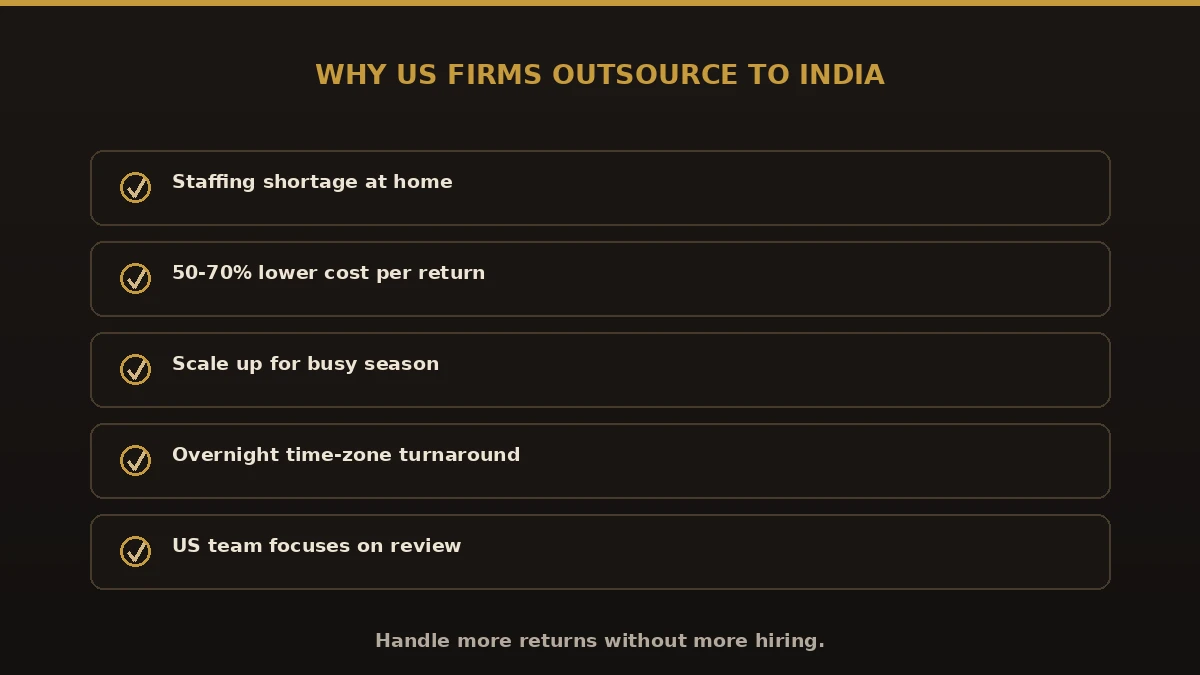
The reasons come up again and again when firms explain why they made the move:
- The staffing shortage. Fewer accounting graduates and high turnover make US hiring hard and expensive.
- Cost. Offshore preparation often costs 50–70% less than a US in-house preparer.
- Scale during busy season. You can add capacity for January–April without hiring year-round.
- Time zones. Work sent at end of day in the US comes back prepared the next morning.
- Focus. Your US team spends time on review, advisory, and clients instead of data entry.
India in particular has a deep pool of accountants, many trained in US tax through the enrolled agent path or accounting degrees, plus strong English and an established outsourcing industry.
Which US tax returns can be outsourced?
Almost the full range of US returns can be prepared offshore, with your firm reviewing and signing:
| Return | Form | Notes |
|---|---|---|
| Individual | 1040 | The most commonly outsourced return |
| S-corporation | 1120S | Pass-through business returns |
| Partnership | 1065 | Including K-1 preparation |
| C-corporation | 1120 | Corporate returns |
| Trust & estate | 1041 | Fiduciary returns |
| Nonprofit | 990 | Exempt organization returns |
| State & local | Various | Multi-state and city filings |
Most firms start with high-volume 1040 tax preparation outsourcing, then expand to business returns once they trust the process.
Tax software offshore teams use
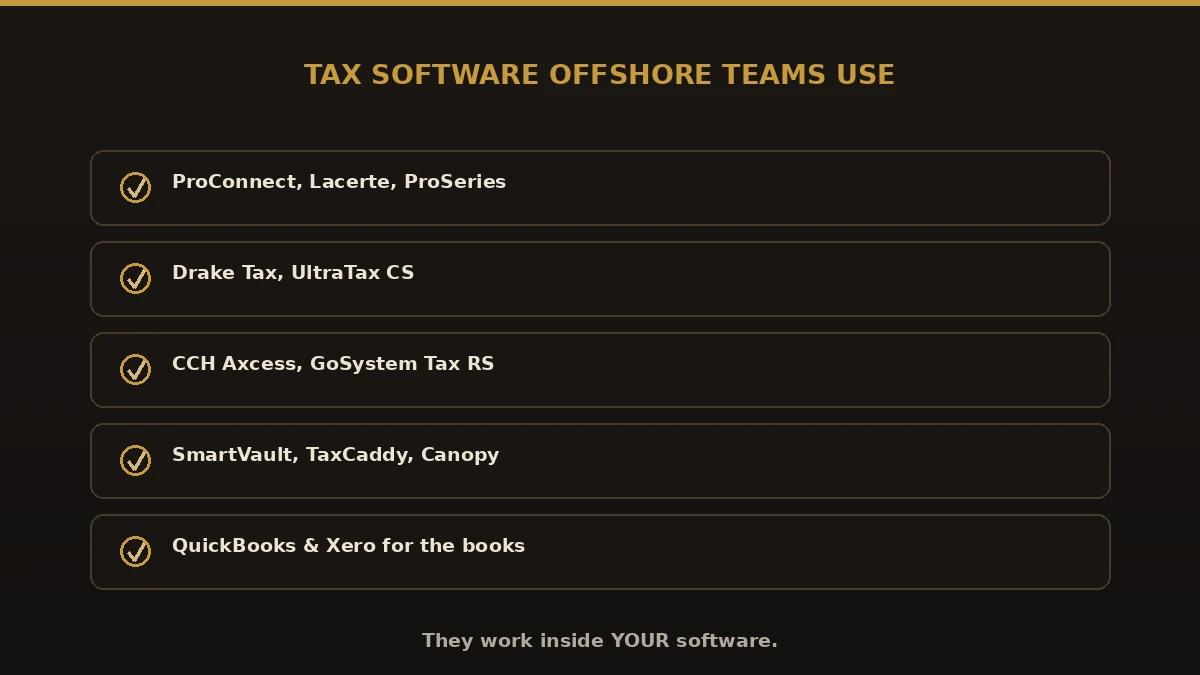
A good offshore team works inside your software, not their own. That keeps your workflow, your data, and your review process intact. Here is the full landscape of tools involved in US tax preparation outsourcing:
Professional tax preparation software
| Software | Vendor | Common with |
|---|---|---|
| Intuit ProConnect Tax | Intuit | Cloud-based firms |
| Lacerte | Intuit | Complex, high-volume firms |
| ProSeries | Intuit | Small and mid-size firms |
| Drake Tax | Drake Software | Value-focused firms |
| UltraTax CS | Thomson Reuters | Mid to large firms |
| CCH Axcess Tax | Wolters Kluwer | Cloud, larger firms |
| GoSystem Tax RS | Thomson Reuters | Large firms, complex returns |
| ATX, TaxWise | Wolters Kluwer | Smaller and high-volume shops |
| TaxAct Professional | TaxAct | Budget-conscious preparers |
Workflow, document, and portal tools
| Tool | Used for |
|---|---|
| SmartVault, Citrix ShareFile | Secure document exchange |
| TaxCaddy | Client document collection |
| Canopy, Karbon, Jetpack Workflow | Practice and workflow management |
| SafeSend Returns | Return delivery and e-sign |
| QuickBooks Online, QuickBooks Enterprise, Xero | Underlying bookkeeping data |
The bookkeeping behind a return usually lives in QuickBooks Online, QuickBooks Enterprise, or Xero, so clean books are the starting point for a clean return. That is why many firms pair tax outsourcing with bookkeeping support.
How the outsourcing process works, step by step
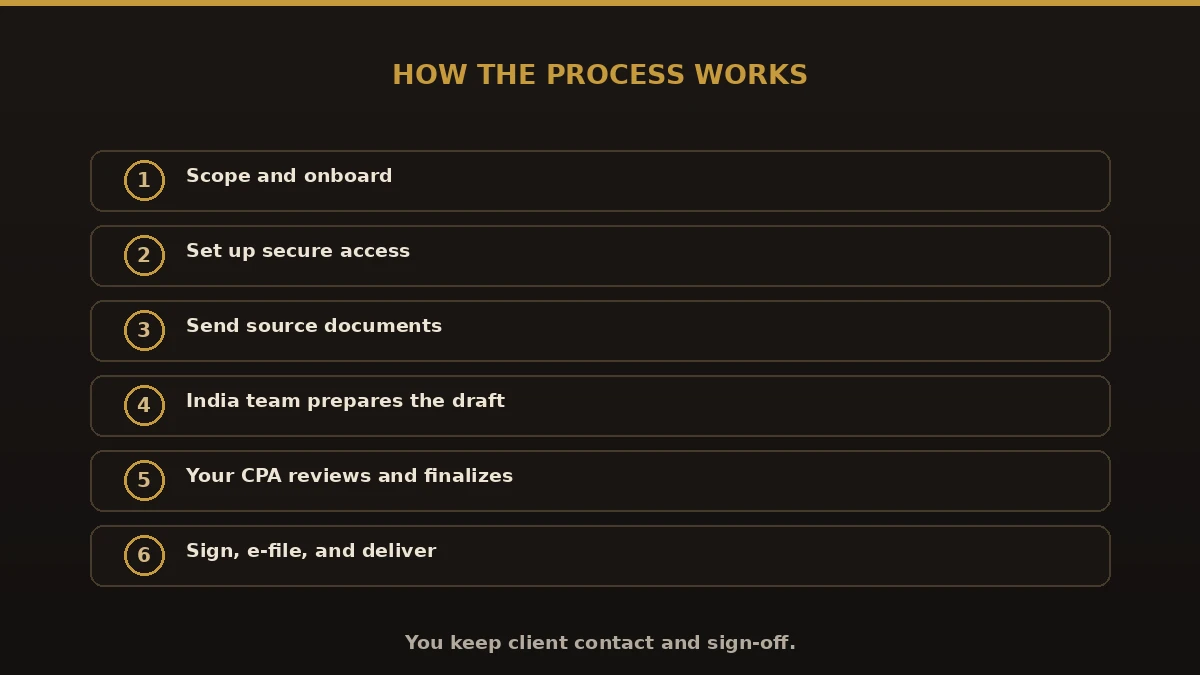
- Scope and onboard. You agree on return types, software, turnaround, and security.
- Set up secure access. The team works in your software through a secure, controlled connection.
- Send source documents. You upload W-2s, 1099s, K-1s, and prior returns to a portal.
- Preparation. The India team keys in data, builds the draft, and lists open questions.
- Review. Your CPA checks the draft, resolves questions, and finalizes.
- File and deliver. Your firm signs, e-files, and delivers to the client.
Turnaround is often 24 to 48 hours per return in the thick of season, because of the time-zone overlap.
Data security and IRS compliance
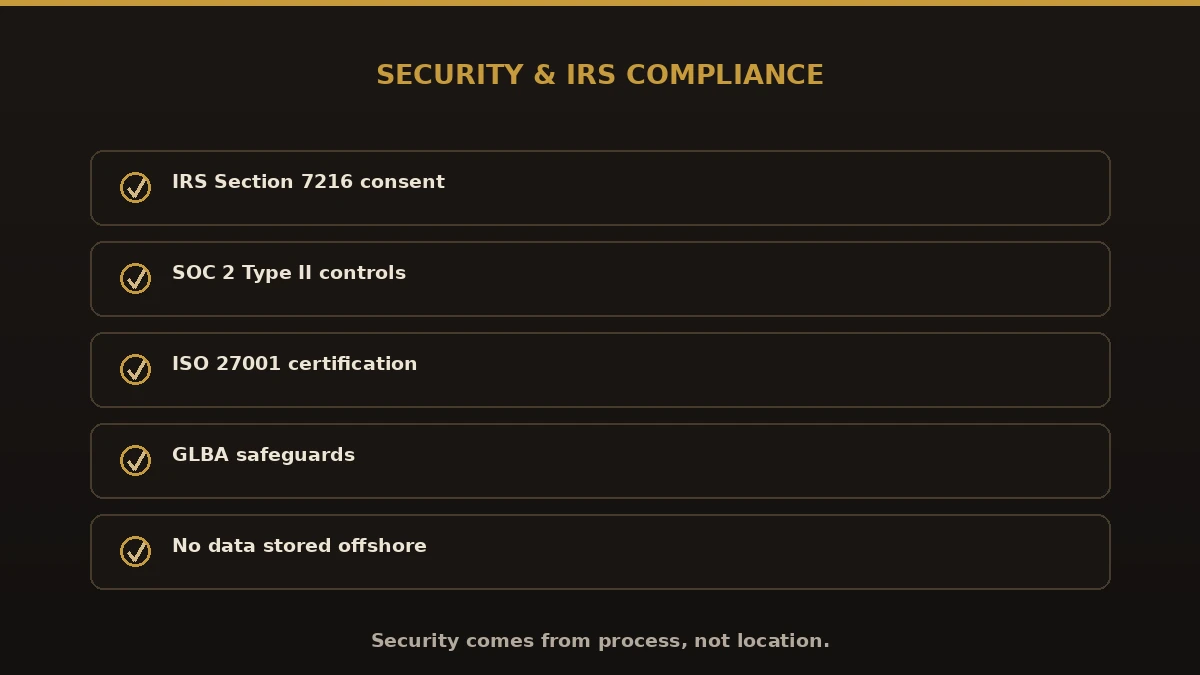
Security is the number one concern, and rightly so. Two rules matter most.
First, IRS Section 7216 governs how a preparer may use or disclose tax return information. When return data is sent outside the US, the IRS generally requires specific written taxpayer consent before the disclosure. A serious partner builds this consent into onboarding. You can read the rule directly on IRS.gov.
Second, look for recognized security standards. The AICPA and industry practice point to controls like:
- SOC 2 Type II reports on the provider’s controls
- ISO 27001 information-security certification
- GLBA safeguards for financial data
- No local data storage — work done inside your systems
- Restricted access, NDAs, and audit trails
The safest model keeps the data on your servers or cloud. The India team logs in and works there, so nothing is downloaded or stored offshore.
What does it cost?
Pricing usually follows one of three models. The right one depends on your volume and how predictable your work is.
| Model | How it works | Best for |
|---|---|---|
| Per return | A flat fee per return by type | Variable or seasonal volume |
| Hourly | Billed by preparer hours | Complex or irregular work |
| Dedicated FTE | A full-time offshore preparer, monthly | Steady, high volume |
As a rough guide, offshore preparation runs a fraction of US labor cost per return, which is why firms see 50% or more in savings even after review time. Always confirm what review, revisions, and software access are included so the quote is truly all-in.
Benefits of outsourcing tax return preparation to India
- Lower cost per return and higher margins
- Capacity to take on more clients without hiring
- Faster turnaround thanks to the time difference
- Your US staff focused on review and advisory
- A far less brutal busy season for your team
- Scalable up and down with demand
Common mistakes to avoid
- Skipping 7216 consent. Sending data offshore without proper consent is a compliance risk.
- No review process. Offshore prep still needs your CPA’s final review and sign-off.
- Poor document quality. Garbled or incomplete source docs slow everything down.
- Choosing on price alone. The cheapest option often lacks security and quality controls.
- No clear communication channel. Questions must flow quickly during season.
- Weak onboarding. The first season fails when expectations are not set up front.
Best practices for a smooth engagement
- Start with a small pilot batch before peak season.
- Standardize how you collect and label source documents.
- Confirm SOC 2, ISO 27001, and 7216 consent are in place.
- Keep the team working inside your own software and cloud.
- Set clear turnaround times and a fast question channel.
- Keep your CPA review step firm — never skip it.
- Review results after season one and scale what worked.
How to choose the right partner
Not every provider is equal. When you compare firms for tax return outsourcing to India, weigh these points:
- Experience with US returns and your specific software
- Documented security — SOC 2, ISO 27001, GLBA, 7216
- A clear review and quality-control process
- Transparent, all-in pricing
- Responsive communication in your time zone
- References from firms like yours
If you want a shortlist to start from, see our roundup of the best tax outsourcing companies in India and our broader guide to accounting outsourcing in India.
The talent gap driving this shift
The move offshore is not really about cost alone — it is about people. The US has fewer accounting graduates each year, more CPAs retiring than entering, and fierce competition for the preparers who remain. For a small firm, losing one experienced preparer in January can put the whole season at risk.
India changed that math. It produces a large number of accounting and finance graduates every year, many of whom train specifically in US tax and accounting standards. That deep, English-speaking talent pool, combined with a mature outsourcing industry, is why offshore tax preparation services went from a niche experiment to a mainstream strategy for US firms of every size.
In-house vs. offshore vs. onshore preparation
Outsourcing to India is one of three ways to get returns done. Each has trade-offs, and many firms end up blending them.
| Approach | Cost | Best for |
|---|---|---|
| In-house US staff | Highest | Complex, high-touch clients |
| Onshore US outsourcing | High | Firms wanting domestic-only data |
| Offshore India outsourcing | Lowest | High-volume prep and scaling |
A common pattern: keep your most complex or sensitive returns in-house, send high-volume 1040s and straightforward business returns offshore, and use the savings to grow. You do not have to choose just one lane.
Myths about outsourcing tax prep to India
A few worries come up every time, so it helps to separate myth from reality.
“My clients will find out and leave.”
Your clients deal with your firm, not the preparer. With proper 7216 consent handled professionally, this is a normal, disclosed part of how modern firms operate. The client experience does not change — often it improves because turnaround is faster.
“The quality will be worse.”
Quality comes from your process, not the zip code. A good offshore team of trained US-tax preparers, plus your CPA review, produces returns as accurate as an in-house junior would — and your review is the safety net either way.
“My data will not be safe.”
This is the real one, and it is why security standards matter. When the team works inside your systems under SOC 2 and ISO 27001 controls, with nothing stored offshore, the data is as protected as it is in your own office.
What your first tax season with an offshore team looks like
Firms that start small have the smoothest first season. Here is a realistic timeline.
- Off-season setup. Choose a partner, sign agreements, and set up secure access and 7216 consent language.
- Pilot batch. Send a handful of straightforward returns to test the workflow and communication.
- Ramp up. As trust builds, increase volume and add return types.
- Peak season. The team handles preparation overnight; your staff reviews by day.
- Debrief. After April, review turnaround, quality, and cost, then plan next year.
The firms that struggle are the ones that dump their whole client list on a new partner in March. Ramp in, and season one becomes the proof you needed.
Who benefits most from tax outsourcing?
- Solo and small CPA firms that turn work away in busy season
- Growing firms that cannot hire fast enough
- Bookkeeping firms adding tax as a service line
- Firms with high 1040 volume and thin margins
- Practices facing partner burnout every spring
Signs your firm is ready to outsource tax prep
Outsourcing is not right for every firm at every moment. But a few signs tell you the timing is good:
- You turned away returns last season because you ran out of capacity
- Your team worked punishing hours from February through April
- You cannot hire qualified preparers fast enough or affordably
- Your senior staff spend busy season on data entry instead of review and advisory
- Margins on individual returns are thin and shrinking
If two or three of those ring true, a pilot next season is worth exploring. The cost of testing is low, and the upside — more capacity without more hiring — is exactly what most firms need.
Beyond returns: what else can be outsourced
Tax preparation is often the first step, but the same offshore model extends across the accounting workflow. Once a firm trusts an outsourcing partner for returns, many add other tasks to smooth out the whole year, not just busy season.
- Bookkeeping and reconciliations that feed clean numbers into returns
- Payroll processing and related filings
- Accounts payable and receivable management
- Month-end close and financial statement preparation
- Sales tax return preparation across states
Pairing tax outsourcing with year-round bookkeeping and payroll support means the data that drives each return is already clean when season arrives. That is where the biggest efficiency gains show up: not just faster returns, but a firm that runs smoothly all twelve months.
Why choose Numerawise
We help US firms and businesses handle tax and accounting work with trained India-based teams, working securely inside your software with a US-standard review process. We keep the compliance pieces — 7216 consent, secure access, and quality control — front and center, and we scale with your season. Explore our full outsourcing services to see how it fits your firm.
Making outsourcing tax return preparation to India work for you
Outsourcing tax return preparation to India is no longer a fringe move — it is how a growing share of US firms survive the staffing crunch and a compressed busy season. The playbook is clear: keep the work in your own software, insist on real security and 7216 consent, never skip your CPA review, and start with a pilot before you scale. Do that, and you get lower costs, more capacity, and a calmer team — without giving up control of your clients or the quality of your returns. Chosen carefully, an offshore tax partner becomes an extension of your firm, not a risk to it.