Sage 300 to QuickBooks Enterprise Conversion Services
Numerawise Solutions migrates your accounts, balances, and complete transaction history from Sage 300 into QuickBooks Enterprise through our Sage 300 to QuickBooks Enterprise conversion service. Every figure is reconciled against the original file and verified before go-live, and the work is performed by Intuit ProAdvisors.
Complimentary file review · Fixed-price quote within 24 hours · Intuit ProAdvisor Gold
Sage 300 → QuickBooks Enterprise
A managed conversion from Sage 300 to QuickBooks Enterprise
Weighing a move from Sage 300 to QuickBooks Enterprise? We manage the entire switch — your chart of accounts, balances, open invoices and bills, multi-currency data, and history — so on go-live day everything reconciles and nothing is missing. It’s a managed conversion, not a raw export you’re left to untangle.
Sage 300 (formerly Accpac) is a capable ERP, but many businesses reach a point where a simpler, more familiar platform fits better. That’s exactly where a careful Sage 300 to QuickBooks Enterprise migration pays off — and where our team, part of our QuickBooks conversion services, steps in.
Reasons to switch
Why move from Sage 300 to QuickBooks Enterprise
Sage 300 (once known as Sage Accpac ERP) earned its reputation for multi-currency and multi-company accounting. The reasons businesses leave it usually aren’t about the software failing — they’re about fit, people, and cost.
Staffing. Far more bookkeepers and accountants know QuickBooks than Sage 300. Covering a leave, replacing a controller, or training a new hire is simply easier when the tool is one most professionals already use.
Consultant dependency. Sage 300 often needs a partner or consultant for changes and upgrades. QuickBooks Enterprise puts far more day-to-day control back in your own team’s hands.
Cost and fit. ERP licensing, module fees, and support add up. For many small-to-mid businesses, QuickBooks Enterprise delivers the reporting and controls they actually use at a more predictable price. Put your own renewal notice through the Sage 300 renewal worksheet before you decide.
One honest caveat: QuickBooks Enterprise is accounting-first, not a full ERP. If you depend on Sage 300’s heavy multi-entity consolidation or deep distribution and manufacturing modules, we assess those workflows before recommending the move — sometimes QuickBooks plus an add-on covers it, sometimes it doesn’t.
Side by side
Sage 300 vs. QuickBooks Enterprise
Here’s how the two compare for a typical small-to-mid business weighing the switch:
| Factor | Sage 300 (Accpac) | QuickBooks Enterprise |
|---|---|---|
| Best fit | Mid-market firms needing ERP modules | Small-to-mid firms wanting robust, familiar accounting |
| Learning curve | Steeper, module-based | Gentler, widely known interface |
| Users | Scales with licenses and modules | Up to 40 simultaneous users (Diamond tier) |
| Multi-currency | Strong, built in | Supported (multi-currency feature) |
| Multi-company | Advanced consolidation | Handled per-company; assess if many entities |
| Staffing pool | Fewer bookkeepers know it | Large pool of QuickBooks-trained pros |
| Typical cost | ERP licensing plus consultants | Predictable annual subscription |
If your needs sit squarely in accounting — AR, AP, payroll, inventory, and clean reporting — QuickBooks Enterprise usually wins on simplicity and staffing.
Scope of the migration
What we migrate from Sage 300
A conversion is only as good as what actually comes across. On a standard Sage 300 to QuickBooks Enterprise migration, we move:
- Chart of accounts
- Customer and vendor lists
- Item and inventory lists
- Open accounts receivable and payable
- Trial balance and account balances
- Multi-currency balances (as scoped)
- Historical transactions (as scoped)
- Reconciled bank and card balances
Before anything moves, we confirm the scope with you — how much history you need, which lists to clean up, and what to leave behind. Well-organized bookkeeping services make this step faster and cheaper.
Our process
How we convert Sage 300 to QuickBooks Enterprise, step by step
We run every migration the same disciplined way, so there are no surprises on go-live day:
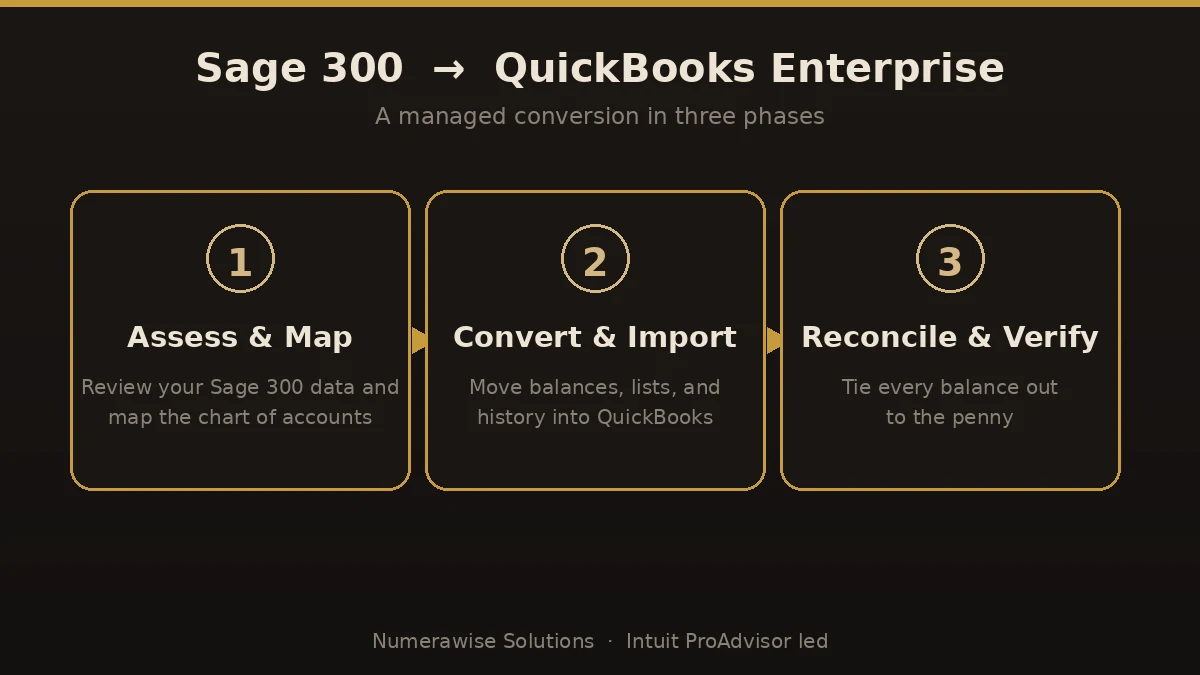
- Assess and map. We review your Sage 300 file, agree on scope, and map your chart of accounts to a clean QuickBooks structure.
- Convert and import. We move lists, balances, open items, multi-currency data, and scoped history into QuickBooks Enterprise — carefully, not with a blind bulk import.
- Reconcile and verify. We tie balances, AR, AP, and key reports back to your original Sage 300 numbers, to the penny.
- Go live and support. We set users and permissions, walk your team through the new file, and stay available afterward.
The payoff
What you gain by switching
Once the switch is done cleanly, the benefits show up quickly:
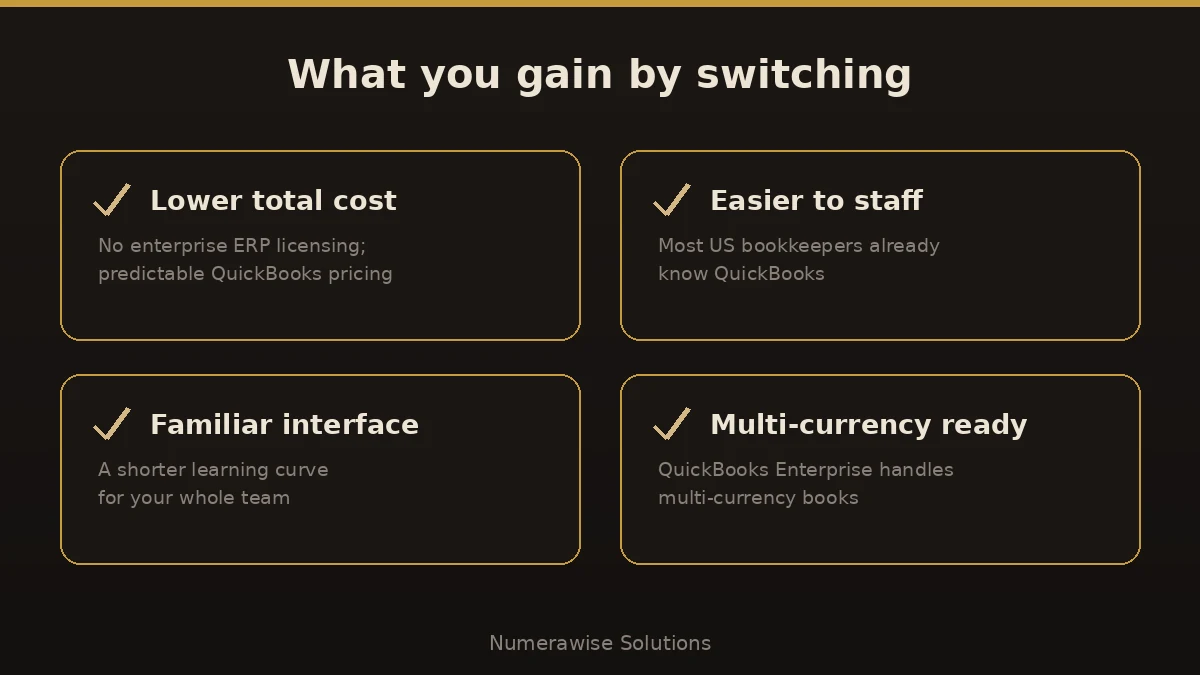
- Lower total cost of ownership
- A team that’s far easier to hire for
- A familiar interface with a short learning curve
- Multi-currency support without ERP overhead
- Strong reporting your team can run itself
- Room to grow to 40 users on the Diamond tier
Pitfalls
Where Sage 300 conversions go wrong
Most migration horror stories trace back to a handful of avoidable errors. Here’s where Sage 300 to QuickBooks Enterprise conversions go sideways:
- Blind bulk imports. Dumping data without mapping the chart of accounts creates a mess that takes longer to fix than the migration saved.
- Skipping reconciliation. If the new balances aren’t verified against Sage 300, you’re building on numbers you can’t trust.
- Mishandling multi-currency. Currency balances and exchange settings need care, or your foreign accounts won’t tie out.
- Migrating the mess. Converting a messy file just moves the problem. A quick cleanup first pays off for years.
- Going live mid-period. A clean cut at period- or year-end avoids split reporting and confusion.
Best practices
How to keep the migration smooth
A smooth migration isn’t luck — it’s a checklist:
- Pick a clean cutover date, ideally at period- or year-end.
- Decide how much history and which currencies you truly need before you start.
- Reconcile Sage 300 to the penny first, so you have a trustworthy baseline.
- Map the chart of accounts deliberately — don’t auto-generate it.
- Verify AR, AP, multi-currency, and the trial balance in QuickBooks against the originals.
- Keep your Sage 300 data archived for reference and compliance.

Why Numerawise
Why organizations choose us for their Sage 300 migration
Intuit ProAdvisors
Your records are handled by Intuit ProAdvisors (Gold tier) and experienced bookkeepers who understand the accounting behind the migration, not only the software.
Verified against your Sage 300 file
A conversion is not considered complete until the trial balance and the primary reports agree with your original records.
Fixed, agreed pricing
The fee is confirmed before the engagement begins. There is no hourly billing.
Confidential throughout
Your information is handled securely and accessed only by the personnel assigned to your conversion. Ongoing bookkeeping is also available.
Who performs the work
Led by an Intuit ProAdvisor

Ram — Founder & Principal
Ram is the founder of Numerawise Solutions in Atlanta. An Intuit ProAdvisor (Gold tier) and a former Intuit Technical Support engineer, he has personally led more than 200 accounting-software conversions, including Sage 300 and QuickBooks Enterprise engagements, for small and mid-market firms across the United States.
More about Ram Verified on UpworkCommon questions
Sage 300 to QuickBooks Enterprise conversion FAQs
How long does a Sage 300 to QuickBooks Enterprise conversion take?
Most conversions finish within a few business days to about two weeks. The timeline depends on your file size, how much historical and multi-currency data you keep, and the condition of the records. After we review your Sage 300 file, you get a firm timeline before any work begins.
Will I lose any data moving from Sage 300 to QuickBooks Enterprise?
No. We migrate your chart of accounts, customer and vendor lists, item lists, open AR and AP, balances, and scoped history, then reconcile it against your original Sage 300 file. Your Sage 300 data is also archived, so nothing is deleted and you keep a full reference copy.
Can QuickBooks Enterprise handle Sage 300’s multi-currency data?
Yes. QuickBooks Enterprise supports multi-currency, so foreign customers, vendors, and bank accounts come across. We map currencies and exchange settings carefully and reconcile the balances, so your foreign accounts tie out just like your home-currency ones.
Is QuickBooks Enterprise powerful enough to replace Sage 300?
For most small-to-mid businesses, yes. It handles advanced inventory, up to 40 users, multi-currency, and strong reporting. If you rely on Sage 300’s heavy multi-entity consolidation or deep distribution modules, we assess those first and tell you honestly whether QuickBooks plus add-ons will fit.
How much history can you bring across?
As much as you need and your records support. Many businesses bring one to three years of detail plus opening balances for older periods. Deciding this up front keeps the project efficient. We scope it with you before we start so the timeline and cost are clear.
Do you reconcile the converted data?
Always. Reconciliation is the difference between a real conversion and a data dump. We tie your balances, accounts receivable, accounts payable, multi-currency accounts, and key reports back to your original Sage 300 numbers, to the penny, before we call it done.
Will my team need a lot of training?
Usually far less than expected. QuickBooks Enterprise uses a familiar, widely known interface, so most staff pick it up quickly, and you rely less on outside consultants than with Sage 300. We set up users and permissions, walk your team through the file, and stay available after go-live.
When is the best time to switch?
A clean cutover at the end of a period or fiscal year is ideal, because it avoids split reporting mid-period. That said, we convert files any time of year. If timing is tricky, we plan the cutover around your reporting so nothing falls between the two systems.
Who performs the Sage 300 to QuickBooks Enterprise conversion?
Your migration is handled by Intuit ProAdvisors (Gold tier) and experienced bookkeepers who understand the accounting behind the data, not just the software. That combination is what keeps balances and multi-currency reporting accurate through the switch.
Begin
Ready to move from Sage 300 to QuickBooks Enterprise?
Provide a few details and we will email a fixed-price quote within one business day, with your Sage 300 history reconciled into a clean QuickBooks Enterprise file.