Bookkeeping for Cabinetry Companies
Busy shop, unclear profit? Bookkeeping for cabinetry companies is job-based accounting — job costing, deposits, and work in progress — that shows you exactly which cabinet jobs make money and what to quote next.
Running a cabinet shop is not like running a retail store. You quote custom work months before it ships, buy sheet goods and hardware for specific jobs, collect deposits up front, and carry half-finished cabinets on the floor for weeks. Ordinary bookkeeping misses all of that. Bookkeeping for cabinetry companies has to follow the money by job, or the numbers on your reports simply will not match what is happening in the shop.
This guide covers what makes cabinet-shop books different, the job-costing system that keeps them accurate, the mistakes that hide your real profit, and how to set it all up so every project shows you exactly where you stand.
Why bookkeeping for cabinetry companies is different
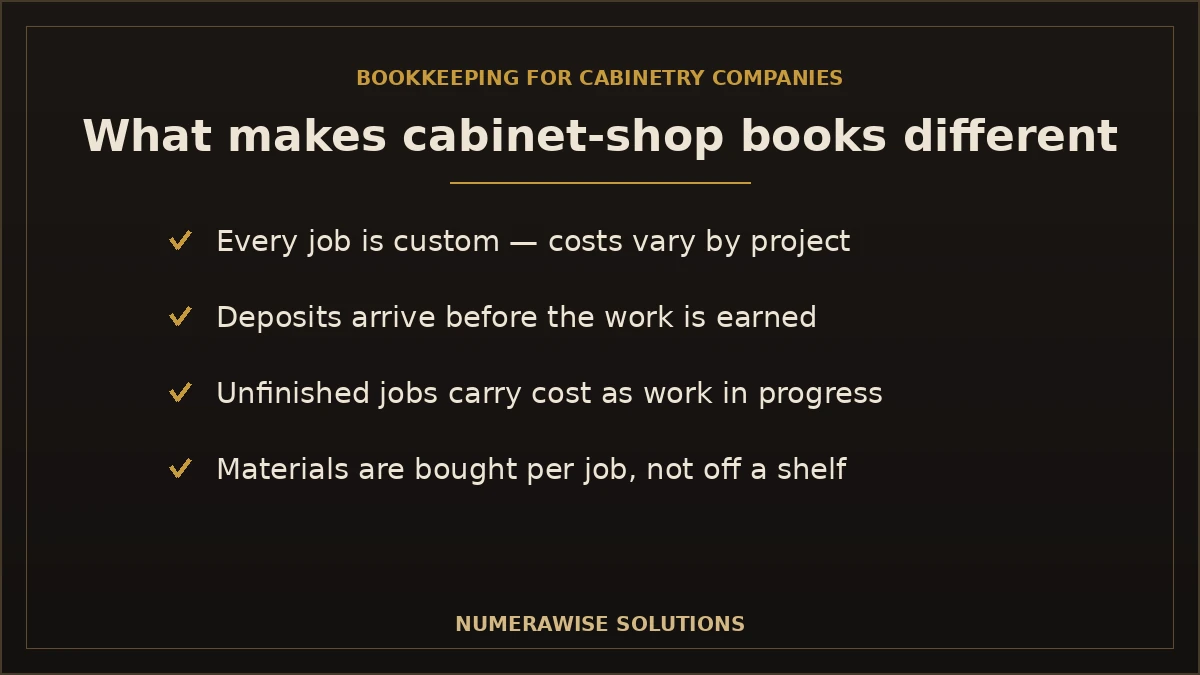
A cabinet business carries costs and revenue that a simple profit-and-loss cannot untangle on its own. Four things make it unusual:
- Every job is custom. Materials and labor differ from one project to the next, so “average” costs mean little.
- Deposits come first. You collect money before the work is done, which is a liability — not income — until you deliver.
- Work sits in progress. Materials and labor pile up on unfinished jobs long before you invoice.
- Materials are bought per job. Plywood, hardwood, hardware, and finish are tied to specific projects, not a general shelf.
Miss these and your monthly reports swing wildly — a huge profit the month a deposit lands, a loss the month you buy lumber — even when the business is steady. Cabinet shops share this with the broader trades, which is why the same discipline behind construction bookkeeping applies here.
Job costing: the heart of cabinet shop bookkeeping
Job costing means tracking every dollar of cost against the specific project it belongs to, then comparing that to what you billed. It is the single most important system in a cabinet shop, because it answers the question that matters: did this job actually make money?
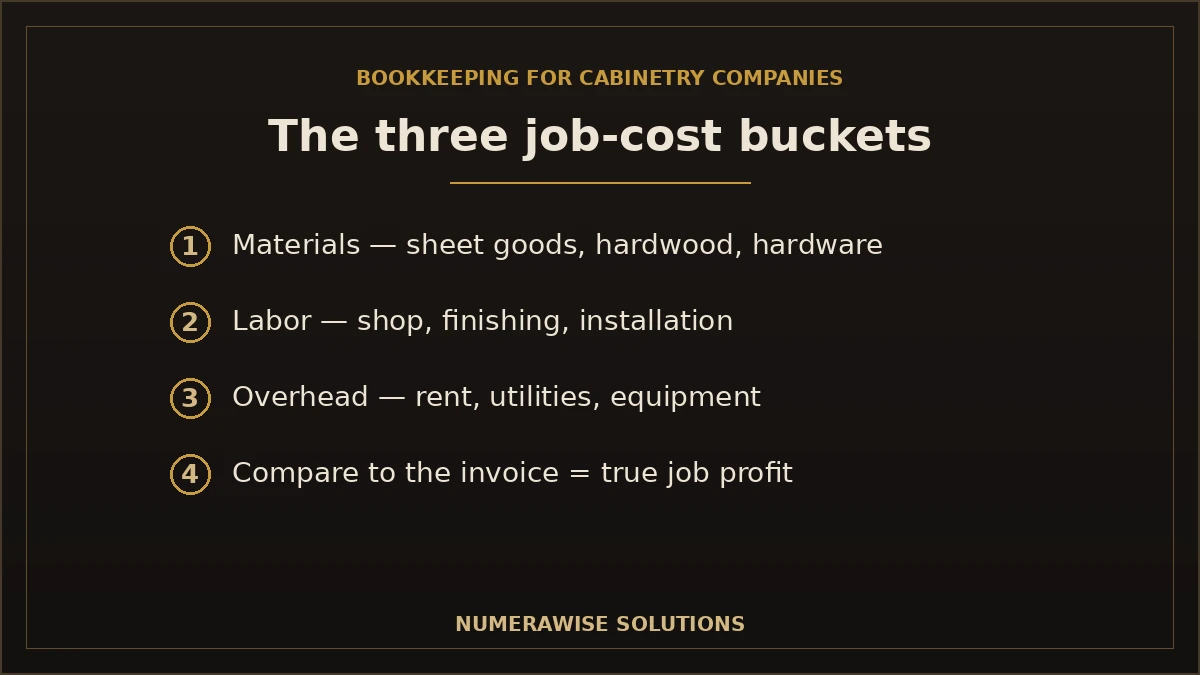
A complete job-costing setup captures three cost buckets per project:
| Cost bucket | What it includes | Why it matters |
|---|---|---|
| Materials | Sheet goods, hardwood, hardware, finish | Often the biggest and most variable cost |
| Labor | Shop hours, finishing, installation | Easy to underestimate on custom work |
| Overhead | Shop rent, utilities, equipment, tools | Must be allocated so job margins are real |
When those three are tracked per job and set against the invoice, you see true profit on every project — not just a lump number at month-end. That is how you learn that your frameless kitchens earn well but your built-in closets barely break even.
Handling customer deposits and progress billing
Most cabinet shops take a deposit — often 40% to 50% — before ordering materials. Here is the rule that trips owners up: a deposit is not income until you earn it. Booked as revenue the day it arrives, it inflates your profit and sets up a tax surprise on money you may still have to refund.
Correct handling looks like this:
- Record the deposit as a liability (customer deposits or unearned revenue) when it lands.
- Recognize revenue as you deliver — at milestones or on completion.
- Apply the deposit against the final invoice so the customer is billed only for the balance.
For larger commercial jobs, progress billing works the same way: bill in stages tied to real progress, and match costs to the same periods so each month tells the truth.
Tracking materials and inventory in a cabinet shop
Materials are usually a cabinet company’s largest and most volatile cost, and how you track them decides whether your job margins are believable.
Buy to the job, not the shelf
Most custom shops expense materials directly to the job they were bought for rather than carrying a big inventory. This keeps job costs accurate and bookkeeping simple. If you keep a real stock of common sheet goods and hardware, that inventory belongs on the balance sheet until it is used.
Watch waste and price swings
Lumber and panel prices move, and offcut waste is real money. Tracking material cost per job over time shows when your estimates have fallen behind actual prices — a common reason shops feel busy but not profitable.
If the shop runs on QuickBooks Online, setting up QuickBooks Online for a small manufacturer shows how to set sheet goods and hardware up as inventory, record production per batch, and keep material cost in the month the cabinets are delivered.
Labor, overhead, and your true shop rate
Custom cabinetry is labor-heavy, and undercounting labor is how shops lose money without noticing. Good bookkeeping ties shop and installation hours to each job, then adds an honest slice of overhead so you know your real cost to produce an hour of work.
That fully-loaded shop rate — wages plus payroll taxes, benefits, rent, utilities, equipment, and tool costs spread across billable hours — is the number you should be quoting from. Shops that quote off wages alone almost always underprice. Clean payroll for construction and trades data feeds this directly, since labor burden starts with accurate payroll.
Sales tax on cabinets: materials vs. installation
Sales tax on cabinetry is genuinely tricky and varies by state. Whether you charge tax on the cabinets, the installation, or both often depends on whether the work is a retail sale or a capital improvement to real property, and on your state’s rules. Installed built-ins are frequently treated differently from cabinets sold over the counter.
The safe approach: separate materials and installation on your invoices, track tax collected as a liability, and confirm your state’s treatment with your state and local tax authority or your CPA. Getting this wrong is a common audit trigger for shops that do both fabrication and installation.
Equipment, tools, and depreciation
Cabinet shops run real capital: CNC routers, panel saws, edgebanders, dust collection, spray booths. These are assets, not expenses — they go on the balance sheet and depreciate over time, and some qualify for accelerated deductions like Section 179. Good bookkeeping tracks each major asset, its depreciation, and the loan or lease behind it, so your balance sheet is accurate and your tax deductions are captured.
The right software for cabinetry bookkeeping
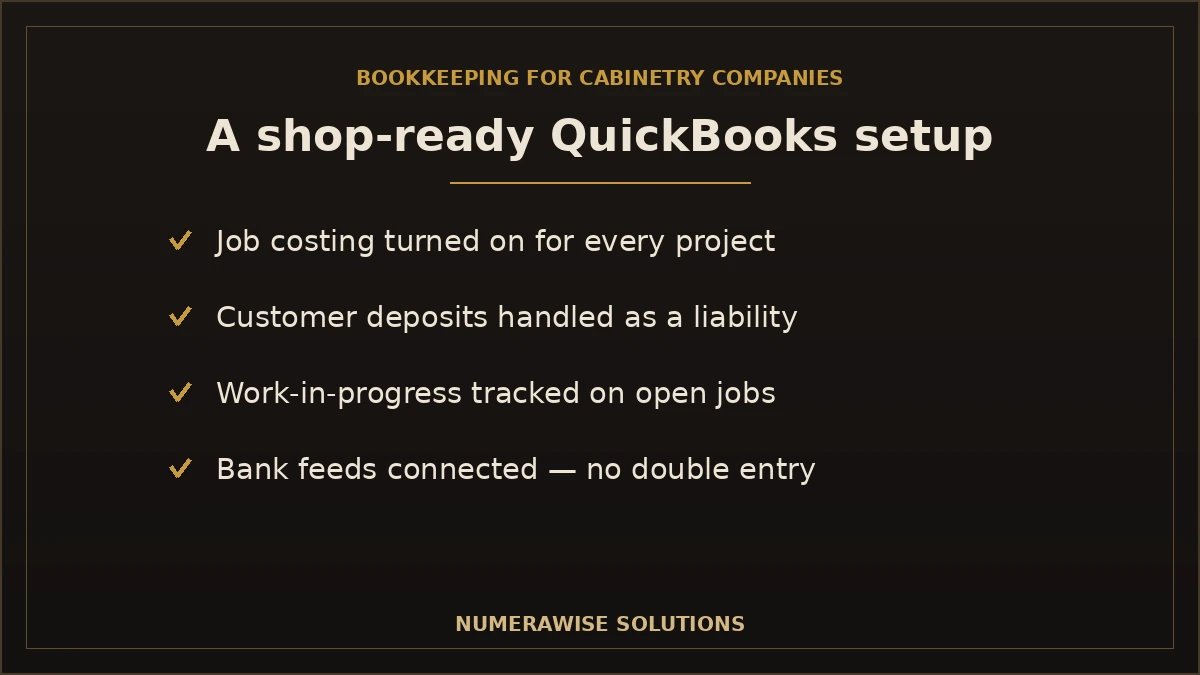
Most cabinet companies run their books on QuickBooks Online with job costing turned on. It handles projects, customer deposits, progress invoicing, and class or location tracking for multiple crews — enough for the large majority of shops. Larger operations sometimes add a dedicated shop-management or estimating tool that feeds costs back into the accounting file.
Whatever the platform, the setup is what matters: a chart of accounts built for a shop, projects enabled, deposit and WIP handling configured, and bank feeds connected so nothing is entered twice. A generic setup is what leaves owners guessing.
Benefits of proper bookkeeping for cabinetry companies
- You know which jobs make money. Job costing turns gut feel into numbers.
- Your quotes get sharper. Real cost data means estimates that hold up.
- Deposits stop distorting your books. Profit reflects work delivered, not cash received.
- Cash flow gets predictable. You see material buys and slow stretches coming.
- Tax season is calm. Clean, job-costed books hand straight to your CPA.
- You look ready for lenders. Banks financing equipment want accurate financials.
Common bookkeeping mistakes cabinet shops make
- Booking deposits as income. Inflates profit and creates a tax surprise on unearned money.
- No job costing. Without it you cannot tell a profitable job from a money-loser.
- Ignoring work in progress. Unfinished jobs full of cost make monthly numbers meaningless.
- Undercounting labor and overhead. Quoting off wages alone quietly underprices every job.
- Mixing materials across jobs. Lumping purchases together destroys job accuracy.
- Mishandling sales tax on installs. A frequent audit trigger for fabricate-and-install shops.
Best practices for cabinet company bookkeeping
- Set up job costing from the start — every cost tagged to a project.
- Record customer deposits as a liability, not revenue.
- Track work in progress so unfinished jobs do not skew the month.
- Buy and code materials to the specific job whenever possible.
- Capture all shop and install labor, then add loaded overhead to find your true rate.
- Reconcile every account monthly and review job-profit reports, not just the P&L.
- Separate materials and installation on invoices for clean sales tax.
Understanding work in progress (WIP)
Work in progress is the value of cabinets you have started but not yet delivered — the materials and labor sitting in half-finished jobs on your floor. It is one of the most overlooked numbers in cabinet shop bookkeeping, and ignoring it is why a shop can look unprofitable one month and flush the next.
Here is the problem: if you expense all your materials and labor as you incur them but only record revenue when a job ships, every month with lots of unfinished work looks like a loss. Tracking WIP holds those costs on the balance sheet until the job is delivered, then matches them against the revenue in the same period. The result is a monthly profit number that actually reflects how the business is doing — not just which jobs happened to close that month.
You do not need to value WIP perfectly to the penny. Even a simple, consistent method — costs accumulated per open job — makes your financials far more honest and useful.
Reading your cabinet shop’s financial reports
Bookkeeping is only worth it if the reports drive decisions. Three reports matter most for a cabinet company:
- Job profitability report: the most important one — profit by project, so you see which work earns.
- Profit & loss: overall performance, with materials, labor, and overhead broken out.
- Balance sheet: deposits, WIP, equipment, and loans — the true financial position.
Reviewed monthly, these turn your books from a tax chore into a management tool. The job report in particular is where owners discover that their busiest product line is not their most profitable one.
Managing cash flow in a cabinet business
Cabinet shops face a specific cash-flow squeeze: you buy materials and pay labor well before a job is finished and paid in full. Deposits help, but a shop that takes on several big jobs at once can be busy and still short on cash. Good bookkeeping shows the pattern early — upcoming material buys, payroll, and the timing of final payments — so you can stage purchases and billing instead of scrambling. Seasonality matters too; many shops slow in winter, and reconciled books let you plan for it rather than feel it.
Getting started with cabinetry bookkeeping
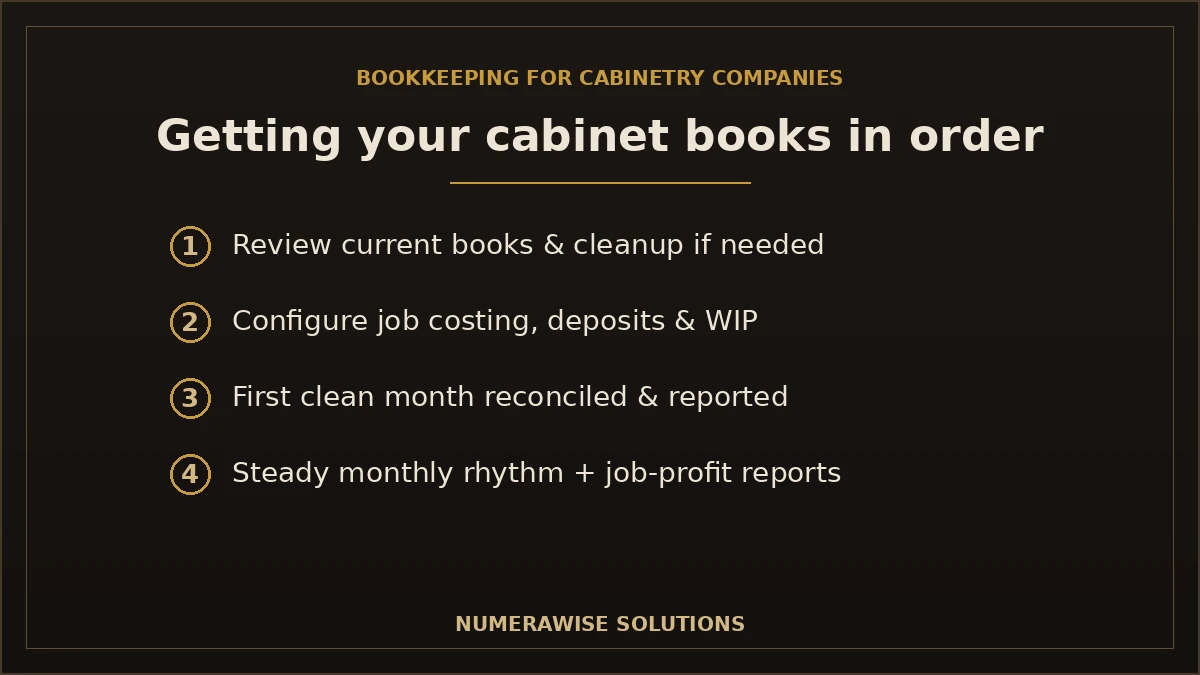
Getting your books in order is a short process. We review your current setup and tell you honestly whether you need a cleanup first, then configure job costing, deposits, and WIP the way a shop actually needs. From there you get steady monthly bookkeeping and job-profit reports you can act on. Whether you are a two-person custom shop or a growing operation with several crews and a showroom, the first step is the same: a quick conversation about how your jobs flow from quote to delivery.
Why choose Numerawise for cabinetry bookkeeping
At Numerawise Solutions, we build books around how your shop actually runs. That means real job costing, proper deposit and work-in-progress handling, and a chart of accounts made for custom fabrication — not a generic template. We handle your monthly bookkeeping, reconciliations, and reports, and we pair the books with payroll for construction and trades and small business bookkeeping services so one team covers the whole back office.
We work with cabinet companies across the United States remotely through secure cloud tools, so you get a specialist who understands job costing and deposits without anyone setting foot in your shop. You get accurate monthly reports, job-profit numbers you can act on, and books that stay filing-ready all year. The result is simple: you finally know which work earns and what to quote next. Shops in related trades — see our work on bookkeeping for restoration companies — rely on the same approach.
The bottom line on bookkeeping for cabinetry companies
Cabinet shops do not fail for lack of work — they fail because they cannot tell which work makes money. Job costing, honest labor and overhead tracking, correct handling of deposits and work in progress, and clean sales tax are what turn a busy shop into a profitable one. Set the books up around your projects, reconcile every month, and read the job-profit reports, and the numbers finally match the sawdust on the floor. For most owners, the smart move is to hand this to a specialist while you build cabinets. Done right, bookkeeping for cabinetry companies stops being guesswork and becomes the tool that shows you exactly which jobs to chase and what to charge.
Key takeaways
- Job costing is essential — it is the only way to know which cabinet jobs earn.
- Deposits are a liability, not income, until the work is delivered.
- Track work in progress and materials by job so monthly reports stay honest.
- Use a fully-loaded shop rate — wages, taxes, and overhead — when you quote.
- Handle installation sales tax carefully; it is a common audit trigger.
Quick answers.
What is bookkeeping for cabinetry companies?
Bookkeeping for cabinetry companies is job-based accounting built around how cabinet shops earn money. It tracks cost by project, records customer deposits as a liability, values work in progress, and separates materials, labor, and overhead. The goal is simple: accurate books that show which jobs make money and what your true cost to build is.
Why is job costing so important for cabinet shops?
Because every job is custom, average numbers hide the truth. Job costing tags every material and labor dollar to the specific project, then compares it to the invoice. That is the only way to see real profit per job — and it often reveals that your busiest product line is not your most profitable one, so you can quote and chase the right work.
How should I handle customer deposits in my books?
Record a deposit as a liability (customer deposits or unearned revenue), not income, when it arrives. Recognize revenue as you deliver the work, then apply the deposit against the final invoice. Booking deposits as income inflates your profit and creates a tax surprise on money you have not truly earned yet — and may even have to refund.
What is work in progress (WIP) for a cabinet company?
Work in progress is the value of materials and labor tied up in jobs you have started but not delivered. Tracking WIP holds those costs on the balance sheet until the job ships, then matches them to revenue in the same period. Without it, months with lots of unfinished work look like losses even when the shop is doing fine.
What software is best for cabinetry bookkeeping?
Most cabinet shops run QuickBooks Online with job costing enabled. It handles projects, deposits, progress invoicing, and class tracking for multiple crews — enough for the large majority of shops. Larger operations may add a shop-management or estimating tool that feeds costs back into the accounting file. The setup matters more than the brand.
How is sales tax handled on cabinets and installation?
It varies by state and is genuinely tricky. Whether you charge tax on cabinets, installation, or both often depends on whether the work is a retail sale or a capital improvement to real property. Separate materials and installation on invoices, track collected tax as a liability, and confirm your state’s rules with your tax authority or CPA to avoid a common audit trigger.
Can you track materials by job?
Yes, and you should. Most custom shops expense sheet goods, hardwood, and hardware directly to the job they were bought for, which keeps job costs accurate. If you carry a real stock of common materials, that inventory sits on the balance sheet until used. Tracking material cost per job over time also shows when your estimates have fallen behind rising prices.
How much does bookkeeping for a cabinet shop cost?
It depends on volume, number of accounts, and whether payroll and sales tax are involved. Small shops typically pay a few hundred dollars a month; larger operations with multiple crews pay more. Cleanup is quoted separately. An outsourced service costs far less than a full-time in-house bookkeeper and gives you a whole team instead of one person.
Do I need a bookkeeper who knows the cabinet industry?
It helps a lot. A bookkeeper who understands job costing, deposits, and work in progress will set your books up to match how a shop runs, instead of applying a generic retail template. That difference is what gives you reliable job-profit numbers. General bookkeeping can record transactions, but industry-aware bookkeeping tells you which jobs actually earn.
How do I get started?
Start with a short review of your current books to see whether you need a cleanup first. Then job costing, deposit handling, and work-in-progress tracking get configured for your shop, and steady monthly bookkeeping begins. Whether you are a two-person custom shop or a multi-crew operation, the first step is a quick conversation about how your jobs flow from quote to delivery.
Get a free scoping call.
Tell us what you’re working on. We respond same business day.

Ram · Founder & Principal
Founder of Numerawise Solutions, established MMXXIV in Atlanta. Intuit ProAdvisor Gold tier. Former Intuit Technical Support engineer. Has personally led two hundred accounting software conversions for US small businesses since founding the practice. Reachable directly at [email protected].
Free: The Clean-Cutover Checklist
The step-by-step checklist we use to migrate businesses to QuickBooks without losing data — bank rec, opening balances, payroll YTD, and the validation tie-out. Get it in your inbox.
No spam — just the checklist and the occasional QuickBooks tip.