Outsourced Bookkeeping Services
A full bookkeeping team, without the hire. Our outsourced bookkeeping services keep your books accurate, reconciled, and tax-ready for a predictable monthly fee — so you get your time back and reports you can trust.
Most business owners did not start their company to spend evenings categorizing transactions and chasing reconciliations. Yet that is exactly where the books end up — on the owner’s plate, done late, and never quite trusted. Outsourced bookkeeping services solve that. Instead of hiring, training, and managing a bookkeeper, you hand the whole function to a team that does it every day, delivers clean monthly reports, and keeps you tax-ready year round.
The frustrations are familiar: books that fall behind, a balance sheet that does not make sense, a scramble every tax season, and no clear picture of whether the business is actually profitable. Outsourcing removes all of it. You get expert bookkeeping, modern software, and a predictable monthly fee — without the cost, management, or single-point-of-failure risk of an employee. Numerawise Solutions provides exactly this for US businesses: accurate, reliable, secure outsourced bookkeeping, backed by real people who answer when you email. This page explains everything you need to know before you hire.
Ready to Outsource Your Bookkeeping?
Let Numerawise Solutions manage your bookkeeping so you can focus on growing your business. Schedule your free consultation today.
Schedule a Free ConsultationWhat are outsourced bookkeeping services?
Outsourced bookkeeping services mean a third-party team keeps your books instead of an in-house employee. All of the work — recording transactions, reconciling accounts, tracking receivables and payables, supporting payroll, and producing financial statements — is handled remotely through secure cloud accounting software. Distance does not matter; accuracy and timeliness do.
How outsourcing works
You connect your accounts to cloud software, share documents through a secure portal, and your bookkeeping team does the rest. Bank feeds pull in transactions automatically, your team categorizes and reconciles them, and each month you receive clean financial reports. Your involvement drops to a few minutes — answering the occasional question and reading the numbers.
Virtual and cloud bookkeeping
Modern outsourced bookkeeping is virtual and cloud-based. Your books live in the cloud — QuickBooks Online, Xero, or another platform — which means you and your accountant can see them anytime, from anywhere. There is no software to install, no file to email, and no single computer holding your only copy.
Dedicated bookkeeping teams and remote collaboration
The best outsourced services give you a dedicated bookkeeper or team who knows your business, backed by the depth of a firm. You collaborate remotely through secure portals and quick messaging, so you get responsive help without anyone needing to sit in your office. It is the reliability of an in-house hire with the resilience of a team.
Who benefits most
Outsourcing fits a wide range of businesses, but it benefits most those without a finance team who need clean books but cannot justify a hire, growing companies whose bookkeeping has outgrown the owner’s evenings, and firms with messy or behind books that need a cleanup and a steady hand going forward. If you are spending nights on your books or unsure your numbers are right, outsourced bookkeeping is almost certainly worth it. For a deeper look, see our companion guide on outsourced bookkeeping services.
What is included in our outsourced bookkeeping services?
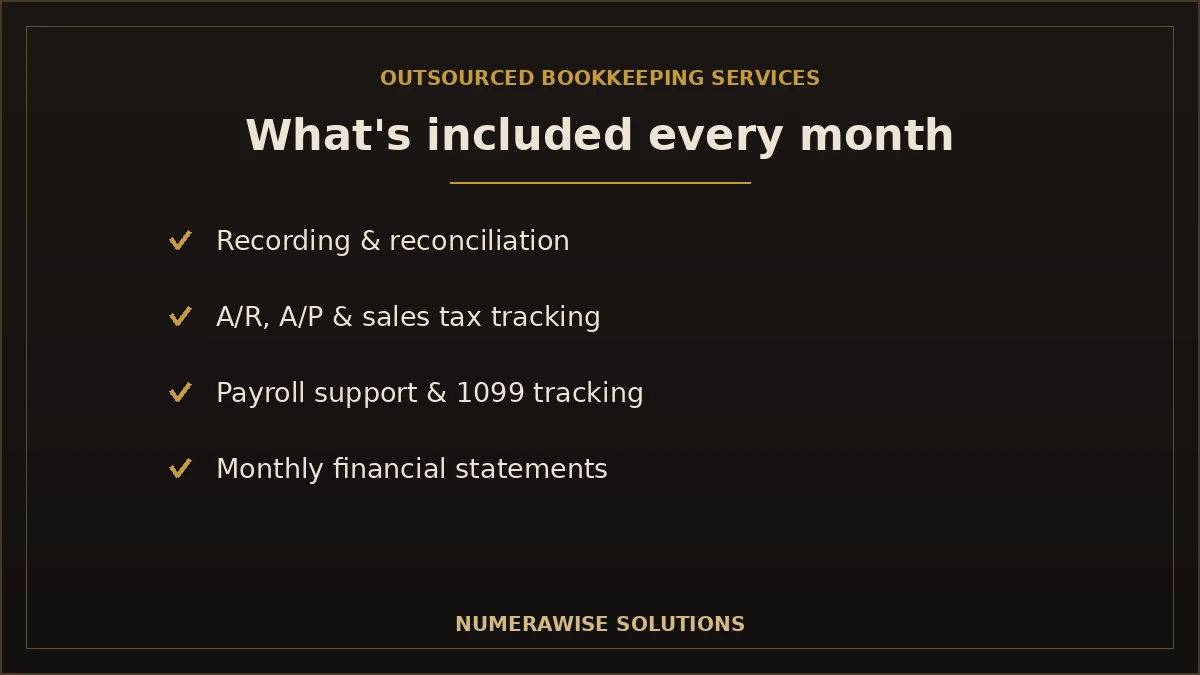
Our outsourced bookkeeping is a complete monthly system, not occasional data entry. Here is everything we handle, so nothing about your books is left to you.
Transaction recording
Every sale and expense recorded and categorized against rules built for your business, so your income and costs are accurate and complete.
Bank reconciliation
Every bank account reconciled to its statement each month, so your books match reality — the foundation of trustworthy financials.
Credit card reconciliation
Business and company credit cards reconciled, catching duplicates and miscoded charges that distort your expenses.
Accounts payable
We track what you owe, so bills are recorded accurately and nothing is missed or paid twice.
Accounts receivable
We track who owes you, so receivables stay current and you can chase overdue invoices before they become write-offs.
Payroll support
Wages and payroll taxes recorded correctly and reconciled, so payroll flows cleanly into your books. See our payroll services for full processing.
Journal entries
Manual and adjusting entries booked correctly — accruals, depreciation, owner distributions — so your books follow proper accounting.
General ledger maintenance
We keep the general ledger clean and accurate across every account, so your reporting foundation is solid.
Month-end close
A disciplined monthly close — reconciled accounts, reviewed entries, finalized numbers — so each period is complete and comparable.
Financial statements
A clean profit and loss and balance sheet every month, in a format you can actually read and act on.
Cash flow reporting
A clear view of the cash moving through your business, so you can see a slow month coming instead of feeling it.
Budget tracking
Where you use a budget, we track actuals against it so you know where you stand versus plan.
Sales tax support
Sales tax collected and tracked as a liability and organized for on-time filing, so it never becomes a surprise.
1099 preparation support
Contractor payments tracked through the year so 1099 preparation at year-end is accurate and painless.
QuickBooks management
As QuickBooks specialists, we keep your file set up correctly, rules maintained, and feeds clean — and handle QuickBooks conversion services if you are switching platforms.
Historical bookkeeping cleanup
If your books are messy, our bookkeeping cleanup rebuild their accuracy before we take over the monthly work.
Catch-up bookkeeping
Behind by months or years? Our catch-up bookkeeping brings you current no matter how far back, then keeps you there.
Talk to a Bookkeeping Specialist
From monthly books to cleanup and reporting, we handle the whole function. Schedule your free consultation today.
Schedule a Free Consultation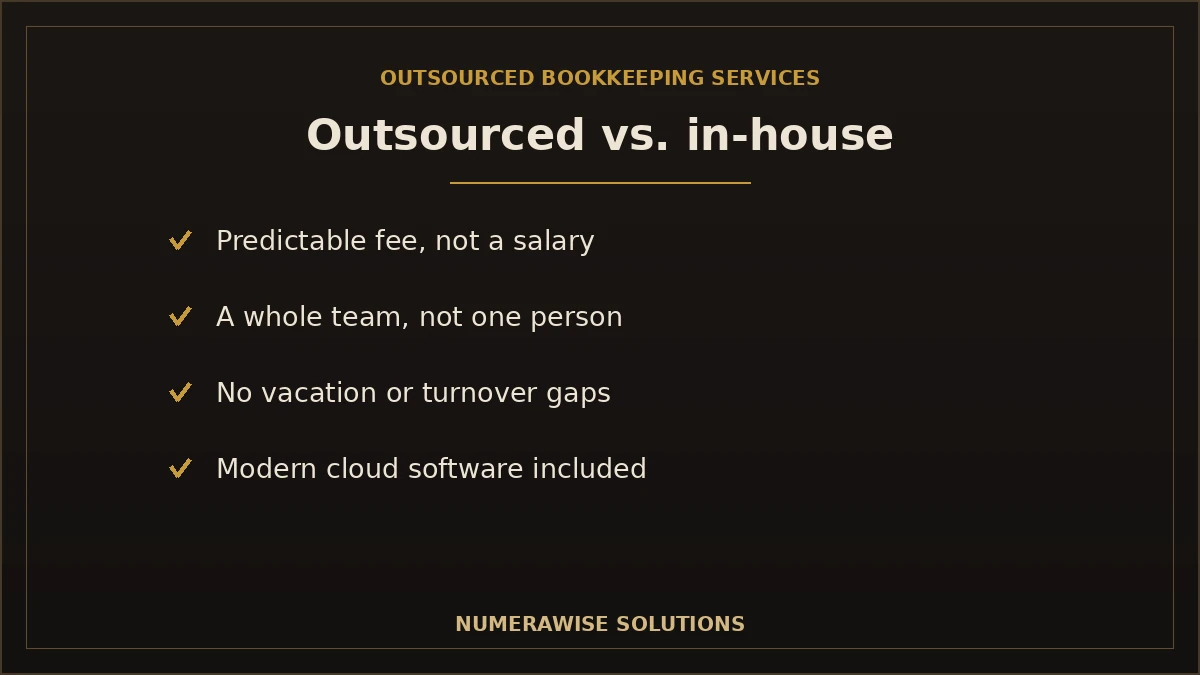
Industries we serve
Good bookkeeping is tuned to how a business actually earns and spends. We serve businesses across many industries, each with its own setup:
Construction
Job costing and progress billing so you see profit by project, plus proper handling of retainage and subcontractors. See our approach to construction-related bookkeeping.
Real estate
Per-property income and expenses, security deposits as liabilities, and correct mortgage and escrow handling. Explore our real estate bookkeeping cleanup.
Restaurants
Daily sales reconciliation, food and labor cost tracking, tips, and delivery-app fees. See our guide to restaurant bookkeeping.
Healthcare
Accurate, compliant books for practices with mixed hourly and salaried staff and insurance reconciliations.
Law firms
Trust and client accounting handled carefully, with clean receivables and matter-level tracking where needed.
Manufacturing
Inventory, cost of goods, and job or product profitability tracked accurately.
Wholesale
Purchasing, pricing, and inventory across a high volume of transactions.
Retail
Point-of-sale and inventory reconciliation so margins are real, not guessed.
Professional services
Clean receivables, simple project tracking, and reliable monthly reporting.
Nonprofits
Fund and grant tracking with reporting that satisfies boards and funders.
Technology
SaaS and tech companies needing clean books, deferred revenue handling, and investor-ready financials.
Ecommerce
High transaction volume across sales channels and payment processors, reconciled cleanly.
How our outsourced bookkeeping process works
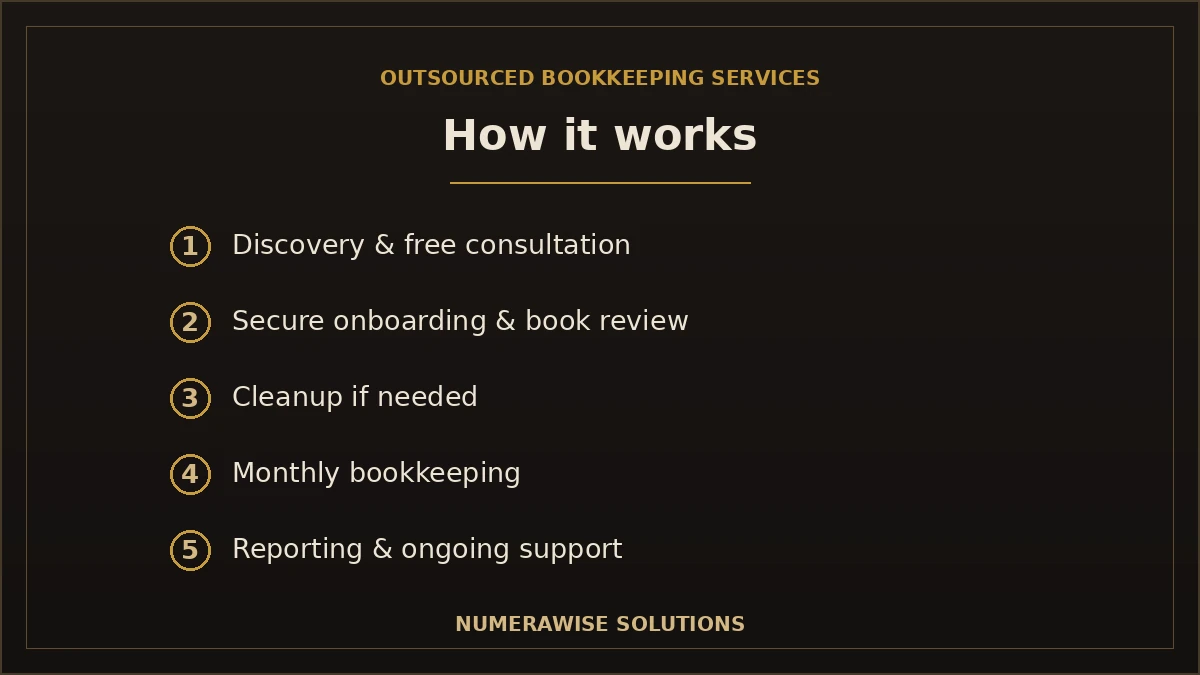
We make onboarding simple for you and rigorous behind the scenes. Eight steps take you from a first conversation to reliable monthly books.
Step 1: Discovery
We learn your business, your books, and your goals, so we understand exactly what you need.
Step 2: Free consultation
We review your situation at no cost, answer your questions, and tell you honestly what we recommend.
Step 3: Secure onboarding
We set up secure access to your accounting file and documents, with encrypted transfer and role-based permissions.
Step 4: Review existing books
We assess the state of your current books and identify anything that needs correcting.
Step 5: Cleanup
If needed, we clean up and reconcile your books so we start from an accurate foundation.
Step 6: Monthly bookkeeping
We take over the monthly work — coding, reconciling, and reviewing — on a reliable schedule.
Step 7: Financial reporting
Each month you receive clean financial statements, with a note on anything unusual.
Step 8: Ongoing support
A real person answers your questions and keeps your books accurate and tax-ready year round.
Trust signal: you always own your data
Your books live in your own QuickBooks or Xero file that you own and control. We work inside your account, you can see everything in real time, and you can grant or revoke access at any time. You are never locked into a system you cannot take with you.
Why businesses outsource bookkeeping
The reasons owners choose outsourcing come down to cost, expertise, and time:
- Lower costs. A whole team for a fraction of a full-time salary.
- No hiring. No job postings, interviews, or training — you are up and running quickly.
- No employee benefits. No payroll taxes, health insurance, or paid time off to fund.
- Expert knowledge. Experienced professionals who do bookkeeping every day, not one generalist.
- Scalability. Add payroll or more accounts as you grow, without hiring.
- Cloud access. Your books are a login away, from anywhere.
- Better reporting. Clean monthly financials that turn into decisions.
- Tax-ready books. Clean records hand straight to your CPA at filing time.
- More time to grow. Hours back every month to spend on the business, not the books.
In-house bookkeeper vs. outsourced bookkeeping
The trade-offs are clear when you lay them side by side:
Whichever way that comparison lands, the harder question is how to judge the firm on the other side of it. Credentials, representation rights and who actually signs the return are all verifiable for free before you sign anything — our guide to choosing a US accounting firm sets out the three checks and where to run them.
| Factor | In-house bookkeeper | Outsourced bookkeeping |
|---|---|---|
| Cost | Salary + taxes + benefits | Predictable monthly fee |
| Hiring | Post, interview, train | Onboard in days |
| Software | You buy and maintain it | Modern cloud tools included |
| Expertise | Limited to one person | A team of specialists |
| Scalability | Hire another | Scale up or down easily |
| Vacation coverage | Gaps when they are out | No gaps — a team covers you |
| Turnaround | Depends on one person | Consistent, reliable delivery |
| Security | Ad hoc | Encrypted, role-based access |
| Technology | You manage it | Handled for you |
In-house makes sense at real scale or when you need someone on-site daily. For the large majority of small and mid-sized businesses, outsourcing delivers the same result for less — and a team instead of a single person who can quit, get sick, or go on vacation.
Signs you need outsourced bookkeeping
Most owners wait too long. These are the signals it is time:
- Your books are behind. Months of transactions unrecorded or unreconciled.
- Bank reconciliation problems. The books do not match the bank, and no one is sure why.
- Tax season stress. Every year is a scramble to get the numbers ready.
- Cash flow uncertainty. You cannot answer basic questions about your cash.
- Business growth. More transactions, staff, and accounts than you can keep up with.
- No financial reports. You are running the business without a monthly P&L or balance sheet.
- Too much owner involvement. You are doing books at night instead of running the company.
Expert tip
If two or three of these sound familiar, outsourced bookkeeping will likely pay for itself in reclaimed time and cleaner numbers. The cost of staying disorganized — missed deductions, bad decisions, and year-end cleanup fees — usually dwarfs the monthly fee.
Software we support
We work in the platforms US businesses actually use, and keep your books in software you own:
| Platform | What we do |
|---|---|
| QuickBooks Online | Our specialty — full monthly bookkeeping in the cloud |
| QuickBooks Desktop | Desktop bookkeeping and support, plus cloud migration when ready |
| Xero | Complete bookkeeping in Xero |
| Sage | Bookkeeping support across Sage products |
| NetSuite | Bookkeeping support for businesses on NetSuite |
| FreshBooks | Bookkeeping for FreshBooks users |
| Zoho Books | Bookkeeping in Zoho Books |
| Wave | Bookkeeping for Wave users |
| Microsoft Dynamics | Bookkeeping support for Dynamics |
| Other platforms | Ask us — we work across most accounting software |
If you are on the wrong platform or want to move, our QuickBooks conversion services handle the switch cleanly, and we keep the books accurate throughout.
Bookkeeping cleanup & catch-up services
Many businesses come to us behind or with messy books — and that is completely fixable. We catch you up and clean you up no matter the situation:
| How far behind | What we do |
|---|---|
| One month behind | Quick catch-up before it snowballs |
| Six months behind | Reconstruct and reconcile half a year of activity |
| Multiple years behind | Year-by-year reconstruction until you are current |
| Tax-ready cleanup | Fast-tracked so your CPA files on accurate numbers |
| Historical corrections | Prior-period errors fixed so your books tie out |
Once your books are clean and current, we keep them that way with ongoing monthly bookkeeping. Our bookkeeping cleanup and catch-up bookkeeping cover the full range, and if the file itself is a mess, our QuickBooks cleanup straightens it out first.
Data security
Your financial data is sensitive, and we treat it that way. Our safeguards:
- Encrypted file transfers. Documents move through secure, encrypted channels — never plain email.
- Role-based access. People access only what their work requires.
- Secure cloud software. Your books live in encrypted, backed-up cloud platforms.
- Confidentiality. Your data is handled as strictly confidential throughout.
- Data backup. Cloud platforms back up your data automatically, so nothing is lost.
- Compliance best practices. We follow careful practices for handling financial information.
Trust signal: your data stays yours
Outsourced bookkeeping is often more secure than a spreadsheet on one laptop. You keep ownership of your file, access is controlled, and everything is encrypted and backed up. Security is built into how we work, not added as an afterthought.
How much do outsourced bookkeeping services cost?
There is no single price, and anyone quoting one before seeing your books is guessing. Cost tracks transaction volume, number of accounts, and whether payroll and sales tax are involved. Here is the range most businesses land in:
| Business profile | Typical monthly fee | What drives it |
|---|---|---|
| Solo / very small | $200–$500 | Low volume, one or two accounts |
| Growing small business | $500–$1,200 | Payroll, A/R and A/P, multiple accounts |
| Established operation | $1,000–$2,500+ | High volume, multiple entities |
| Cleanup / catch-up | Quoted per project | Months behind or messy data |
Now compare that to hiring in-house: a full-time bookkeeper means salary plus payroll taxes, benefits, software, and management — often $50,000 or more a year before a single account is reconciled. Outsourced bookkeeping gives you a whole team for a fraction of that, with no vacation gaps and no single point of failure. We assess your books first and give you a clear, flat monthly quote based on your actual needs.
How outsourced bookkeeping saves you money
The monthly fee is only part of the value. Outsourcing saves money in ways that add up fast: you avoid the full cost of an employee (salary, taxes, benefits, software, management); you reclaim the hours you or your staff spend on books and put them back into revenue-generating work; you cut year-end cleanup fees because your CPA receives clean, reconciled books instead of a mess; and you make better decisions because accurate numbers show which products, jobs, or clients actually earn. Many owners find the leaks a good bookkeeper catches — duplicate payments, forgotten subscriptions, missed deductions — more than cover the cost of the service. Bookkeeping done well is not an expense; it pays for itself.
What you receive each month
Outsourced bookkeeping is only worth it if it lands as something you can use. Each month you get:
- Every account reconciled to its statement, to the penny
- Transactions categorized against rules built for your business
- A clean profit and loss, balance sheet, and cash-flow view
- A short note on anything unusual we found and fixed
- Books that are ready for your CPA at any time
- A real person to answer questions about your numbers
Outsourced bookkeeping vs. software alone
Accounting software like QuickBooks is powerful, but software does not do the bookkeeping — it just makes it possible. Owners who rely on software alone still have to categorize transactions, reconcile accounts, chase discrepancies, and produce reports, and the software will happily let them do all of it wrong. A miscategorized transaction, an unreconciled account, or a bank feed that double-imported will sit there quietly until tax time. Outsourced bookkeeping pairs the software with the expertise to use it correctly — so your books are not just possible, they are accurate. The software is the tool; the service is the result.
Working with your CPA or accountant
Outsourced bookkeeping does not replace your CPA — it makes them more effective. We keep your books accurate and current all year; your accountant uses those clean books to file taxes and advise on strategy. The two roles complement each other, and we work directly with your CPA, sharing access and reports so tax season is a smooth handoff instead of a scramble. Accountants often prefer clients who use a professional bookkeeper, because it means less time untangling records and more time on high-value advice. If you do not have a CPA yet, we can help coordinate that relationship too.
Real-world examples
Examples show how outsourcing fits different businesses:
- A busy restaurant drowning in daily card batches and delivery-app payouts gets daily sales reconciliation and a monthly prime-cost report — and the owner stops doing books at midnight.
- A growing ecommerce brand with sales across several channels gets clean, reconciled books that finally show true margins by channel.
- A contractor tracking multiple jobs gets job-costed books that reveal which projects actually make money.
- A law firm gets careful trust accounting and clean receivables without hiring an in-house bookkeeper.
- A startup gets investor-ready financials and clean deferred-revenue handling without overhead.
The common thread: each business hands off the books, gets accurate numbers, and reclaims the time and clarity to grow.
How quickly can you start?
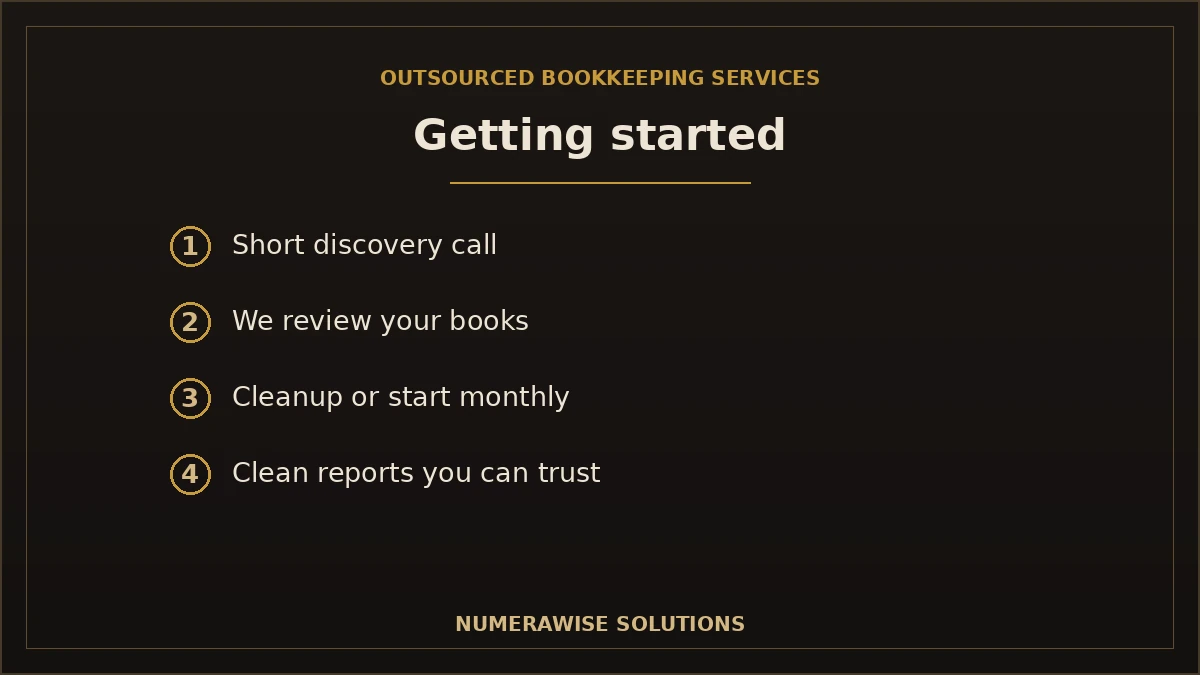
Onboarding is fast. After a short discovery call and a review of your books, we set up secure access, decide whether a cleanup is needed first, and begin your first month of bookkeeping — often within days. If your books are current, we can be running your monthly bookkeeping almost immediately; if they are behind, we start with a catch-up and then move into the steady monthly rhythm. Either way, the first step is simple: a short conversation about where your books stand today.
Why choose Numerawise Solutions
- A dedicated bookkeeper who knows your business, backed by a team.
- US-managed service tuned to American accounting and tax practices.
- QuickBooks specialists for both Online and Desktop.
- Migration expertise if you need to switch or upgrade platforms.
- Transparent pricing with clear, honest quotes and no surprises.
- Fast communication — a real person who answers when you email.
- Monthly reports so you always know where the business stands.
- Scalable support that grows with you, from solo owner to a larger team.
Bookkeeping is the core of what we do, not a bolt-on. We pair it with bookkeeping services, payroll services, and specialized services so one team can cover your whole back office — and your books stay accurate, reconciled, and tax-ready all year.
Focus on your business — let us handle the books
Outsourced bookkeeping put professional books within reach of every business. You no longer need to hire an employee, manage software, or spend your evenings on data entry — you need a qualified team, secure tools, and a steady monthly rhythm. Hand off the busywork, keep ownership of your data, read your reports, and your books become the quiet engine behind decisions you can trust. For most owners, the smart move is to let a specialist own the day-to-day while they grow the business. Done right, outsourced bookkeeping services stop being a cost and become the system that shows you what is working, what is not, and what you can afford next. Numerawise Solutions is ready to be that partner for your business.
Ready to Outsource Your Bookkeeping?
Let Numerawise Solutions manage your bookkeeping so you can focus on growing your business. Schedule your free consultation today.
Schedule a Free ConsultationKey takeaways
- Outsourced bookkeeping services give you a full bookkeeping team for a predictable monthly fee.
- They cost a fraction of an in-house hire — and remove the single-point-of-failure risk.
- Everything is included: recording, reconciliation, payroll support, reporting, cleanup, and catch-up.
- You keep ownership of your data, secured with encryption and role-based access.
- We serve businesses across industries and support QuickBooks, Xero, and more.
Quick answers.
What are outsourced bookkeeping services?
Outsourced bookkeeping services hand your day-to-day books to an external team instead of an in-house hire. They record transactions, reconcile accounts, support payroll, track sales tax, and deliver monthly financial reports through secure cloud software. You get a full bookkeeping team — the same work an employee would do — for a predictable monthly fee, without the cost or management of hiring.
How much do outsourced bookkeeping services cost?
Most businesses pay $200–$500 a month for solo or very small operations, $500–$1,200 as they grow, and $1,000–$2,500+ for established companies with payroll and multiple accounts. Cleanup is quoted separately. Price depends on transaction volume, number of accounts, and whether payroll and sales tax are involved — far less than the $50,000+ a year a full-time in-house bookkeeper costs.
Is outsourced bookkeeping secure?
Yes, often more secure than a spreadsheet on one laptop. Cloud platforms encrypt your data, back it up automatically, and require multi-factor login. We add role-based access so people see only what they need, and secure document sharing instead of email attachments. You keep ownership of your file and can revoke access anytime. Security is built into how we work, not added afterward.
Do I keep access to QuickBooks?
Yes, always. Your books live in your own QuickBooks (or Xero) file that you own and control. We work inside your account, you can see everything in real time, and you can grant or revoke our access at any point. You are never locked into a proprietary system you cannot take with you — the file and the data remain yours.
Can you work with my CPA?
Yes. We work directly with your CPA or accountant, sharing access and reports so tax season is a smooth handoff instead of a scramble. We keep the books accurate all year; your CPA files taxes and advises on strategy from those clean books. Accountants often prefer clients who use a professional bookkeeper, because it means less time untangling records.
Do you support payroll?
Yes. We record wages and payroll taxes correctly and reconcile payroll into your books, and we offer fuller payroll support and processing as needed. Clean payroll records feed the rest of your financials, so whether you run payroll yourself or through us, we make sure it is recorded accurately. We can also record and track 1099 contractor payments for year-end filing.
Can you clean up old or messy books?
Yes. Cleanup and catch-up are core services. Whether you are a month behind, a year behind, or several years behind, we reconstruct and reconcile your books from bank statements and records, correct prior-period errors, and make them tax-ready. Once your books are clean and current, we keep them that way with ongoing monthly bookkeeping so they never fall behind again.
Do you support multiple businesses or entities?
Yes. We handle bookkeeping for owners with several businesses and for companies with multiple entities, keeping each set of books cleanly separated with its own reconciliation and reporting. This is common for real estate investors, franchise owners, and holding companies. We scope multi-entity work together and keep everything organized so nothing gets mixed between businesses.
How quickly can we start?
Onboarding is fast. After a short discovery call and a review of your books, we set up secure access and can often begin your first month within days. If your books are current, we start monthly bookkeeping almost immediately; if they are behind, we begin with a catch-up and then move into the steady monthly rhythm. The first step is a quick conversation about your books.
What software do you use for bookkeeping?
We specialize in QuickBooks Online and Desktop, and we also work in Xero, Sage, NetSuite, FreshBooks, Zoho Books, Wave, Microsoft Dynamics, and other platforms. Your books stay in software you own. If you are on the wrong platform or want to move, we handle the conversion cleanly and keep your books accurate throughout the switch.
Will I get monthly financial reports?
Yes. Each month you receive a clean profit and loss, balance sheet, and cash-flow view, plus a short note on anything unusual we found and fixed. Reports are only useful if you can act on them, so we deliver them in a format you can read and use for decisions — not just a raw ledger. A real person is available to walk you through the numbers.
Is outsourced bookkeeping cheaper than hiring in-house?
Usually, significantly. A full-time bookkeeper means salary plus payroll taxes, benefits, software, and management, often $50,000 or more a year. Outsourced bookkeeping gives you a whole team for a predictable monthly fee, with no vacation gaps and no single point of failure. For most small and mid-sized businesses, outsourcing delivers the same result for a fraction of the cost.
What is included in outsourced bookkeeping?
Our service includes transaction recording, bank and credit card reconciliation, accounts payable and receivable, payroll support, journal entries, general ledger maintenance, month-end close, financial statements, cash flow reporting, budget tracking, sales tax support, 1099 preparation support, QuickBooks management, and cleanup or catch-up as needed. It is the complete bookkeeping function, so nothing about your books is left to you.
Do I need to be in a specific location to use your service?
No. Outsourced bookkeeping is virtual and cloud-based, so we serve businesses across the United States remotely. Your books live in the cloud, documents move through a secure portal, and communication happens through messaging and email. Location is never a barrier — what matters is accurate, timely bookkeeping and responsive support, which we deliver wherever you are.
How does the onboarding process work?
Onboarding starts with discovery and a free consultation to understand your business and books. We then set up secure access, review your existing books, and decide whether a cleanup is needed first. From there we begin monthly bookkeeping and send you clean reports each period. It is designed to be simple for you — a few steps to hand off the books and start receiving accurate financials.
What industries do you serve?
We serve businesses across many industries, including construction, real estate, restaurants, healthcare, law firms, manufacturing, wholesale, retail, professional services, nonprofits, technology, and ecommerce. Each has its own bookkeeping needs — job costing, security deposits, daily sales, trust accounting, inventory — and we tune the setup to how that business actually earns and spends.
Can you handle sales tax?
Yes. We track sales tax collected as a liability and keep it organized for on-time filing, so it never becomes a surprise. Accurate sales tax handling is a common weak point in DIY books — treating collected tax as income overstates profit and sets up problems. We keep it recorded correctly, and can coordinate with your CPA or filing service as needed.
Do you provide catch-up bookkeeping for tax season?
Yes, and it is a common request. We fast-track tax-season catch-up and cleanup so your books are accurate and reconciled before filing. Clean books mean your CPA files from correct numbers instead of untangling a mess at extra cost — which helps you claim every legitimate deduction and turns a stressful scramble into a smooth handoff.
Will outsourcing my bookkeeping save me time?
Yes, significantly. Owners routinely reclaim 5–15 hours a month by handing off their books. Instead of categorizing transactions and chasing reconciliations, your involvement drops to answering the occasional question and reading your monthly reports. That time goes back into running and growing the business — which is where an owner's hours are worth the most.
How do I share my documents and data with you securely?
Through a secure, encrypted portal — never plain email. You connect your bank feeds so most transactions flow in automatically, and you upload receipts and statements to the portal as needed. Access is role-based, so only the specialists on your account can see your data. Your original accounting file stays yours, and everything is handled confidentially and backed up.
What happens if my bookkeeper is unavailable?
Nothing stops. Unlike a single in-house hire, an outsourced service is a team, so there are no gaps when someone is on vacation or out sick. Your books keep moving and your monthly close still happens on schedule. This continuity — no single point of failure — is one of the biggest advantages of outsourcing over relying on one employee.
Can you help me switch accounting platforms?
Yes. If you need to move — QuickBooks Desktop to Online, or between platforms — our conversion services handle the switch cleanly, mapping and reconciling your data so your new books tie out. We keep your bookkeeping accurate throughout the transition, so you gain the benefits of a better platform without a gap or a mess in your records.
Do you offer bookkeeping and payroll together?
Yes. We can cover both, so one team handles your whole back office. Bookkeeping keeps your financials accurate; payroll support ensures wages and payroll taxes are recorded and reconciled correctly. Combining them means your labor costs are always reflected accurately in your books, and you have a single point of contact for both — simpler and more consistent than juggling two providers.
How is outsourced bookkeeping different from accounting software?
Software like QuickBooks makes bookkeeping possible, but it does not do the work — you still have to categorize, reconcile, and report, and the software will let you do it wrong. Outsourced bookkeeping pairs the software with expertise, so your books are not just possible but accurate. The software is the tool; the service is the trustworthy result you can actually rely on.
Ready to outsource — how do I get started with Numerawise Solutions?
Start with a free consultation. We learn your business and review your books, tell you honestly whether you need a cleanup first, and quote a clear monthly price with no surprises. From there we take over the monthly work and hand you financials you can trust. Whether you are a solo owner buried in receipts or a growing company that has outgrown its evenings, the first step is a short conversation.
Get a free scoping call.
Tell us what you’re working on. We respond same business day.

Ram · Founder & Principal
Founder of Numerawise Solutions, established MMXXIV in Atlanta. Intuit ProAdvisor Gold tier. Former Intuit Technical Support engineer. Has personally led two hundred accounting software conversions for US small businesses since founding the practice. Reachable directly at [email protected].
Free: The Clean-Cutover Checklist
The step-by-step checklist we use to migrate businesses to QuickBooks without losing data — bank rec, opening balances, payroll YTD, and the validation tie-out. Get it in your inbox.
No spam — just the checklist and the occasional QuickBooks tip.
Related bookkeeping & accounting services
- Virtual bookkeeping services — secure, cloud-based bookkeeping with real-time access.
- Bookkeeping services in Atlanta, Georgia — local, dedicated bookkeeping for Atlanta businesses.