Restaurant Bookkeeping
Busy floor, unclear profit? Restaurant bookkeeping tracks daily sales, food and labor cost, tips, and prime cost — so you can see your true profit and fix the leaks before they sink the month.
Restaurants run on razor-thin margins, high transaction volume, and costs that move every single day. That is why restaurant bookkeeping is not the same as bookkeeping for a shop or an office. Miss a few percentage points on food or labor and a busy month can still lose money. Get the books right and you can see exactly where every dollar goes — and fix problems while they are still small.
This guide covers what makes restaurant books different, the numbers that decide whether you profit, how daily sales and costs are tracked, the mistakes that quietly drain margins, and how to set it all up so your restaurant runs on facts instead of guesses.
Why restaurant bookkeeping is different
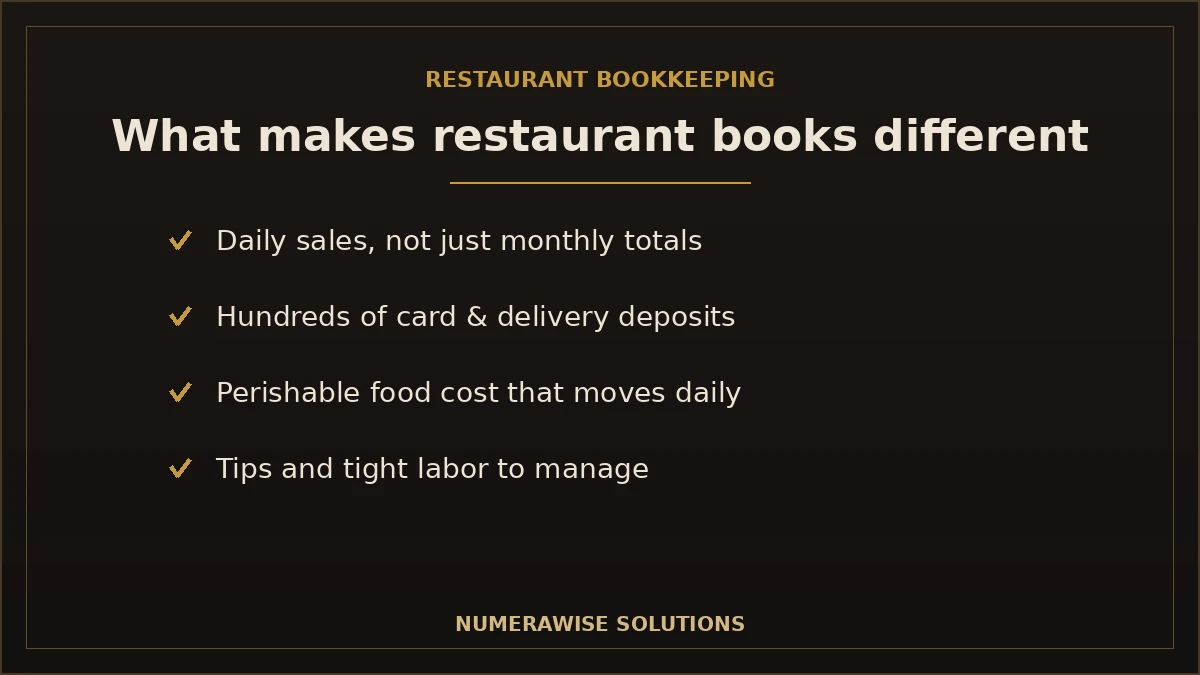
A restaurant carries costs and revenue patterns that ordinary bookkeeping cannot handle well. Four things make it unusual:
- Daily sales, not monthly. Restaurants think in days and shifts, not just months, so sales are tracked and reconciled daily.
- High transaction volume. Hundreds of card batches, cash, and third-party delivery deposits have to tie out.
- Perishable cost of goods. Food spoils, prices swing, and waste is real money — inventory matters.
- Tips and tight labor. Tip handling and labor scheduling directly affect both compliance and margin.
Because of this, restaurant books live and die on two ratios most other businesses barely track: food cost and labor cost. The same discipline applies to any food operation, which is why bookkeeping for commercial kitchens follows the same playbook.
Prime cost: the number that decides your profit
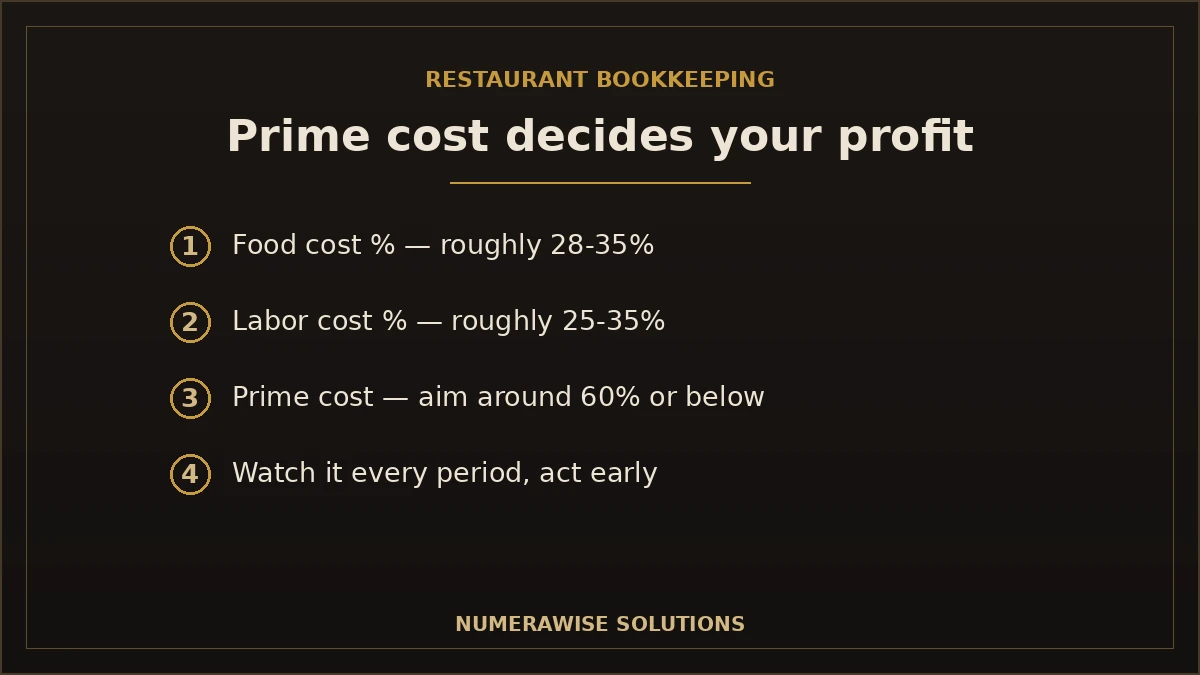
If you learn one thing from restaurant bookkeeping, make it prime cost. Prime cost is your total cost of goods sold (food and beverage) plus total labor. It is the biggest chunk of what you spend, and it is the number you can actually control.
| Metric | How it is calculated | Healthy target |
|---|---|---|
| Food cost % | Cost of food ÷ food sales | Roughly 28–35% |
| Labor cost % | Total labor ÷ total sales | Roughly 25–35% |
| Prime cost % | (COGS + labor) ÷ total sales | Around 60% or below |
These are general benchmarks, not rules — a fine-dining room and a quick-service counter look different. But the principle holds: when prime cost creeps past about 60% of sales, profit gets very hard. Good restaurant bookkeeping puts this number in front of you every period so you can act before the month is lost.
What restaurant bookkeeping covers
A complete engagement is a repeatable system, not occasional data entry. It usually includes:
- Daily sales reconciliation: POS sales matched to bank and card deposits every day.
- Cost of goods tracking: food and beverage purchases coded so food cost is accurate.
- Labor and payroll: wages, tips, and payroll taxes recorded correctly.
- Accounts payable: vendor invoices tracked and paid on time.
- Sales tax: collected, tracked as a liability, and filed on schedule.
- Monthly reports: a restaurant-style profit and loss, prime cost, and cash flow.
The output is numbers you can run the restaurant on — and books that hand straight to your CPA at tax time.
Daily sales reconciliation: the heartbeat of the books
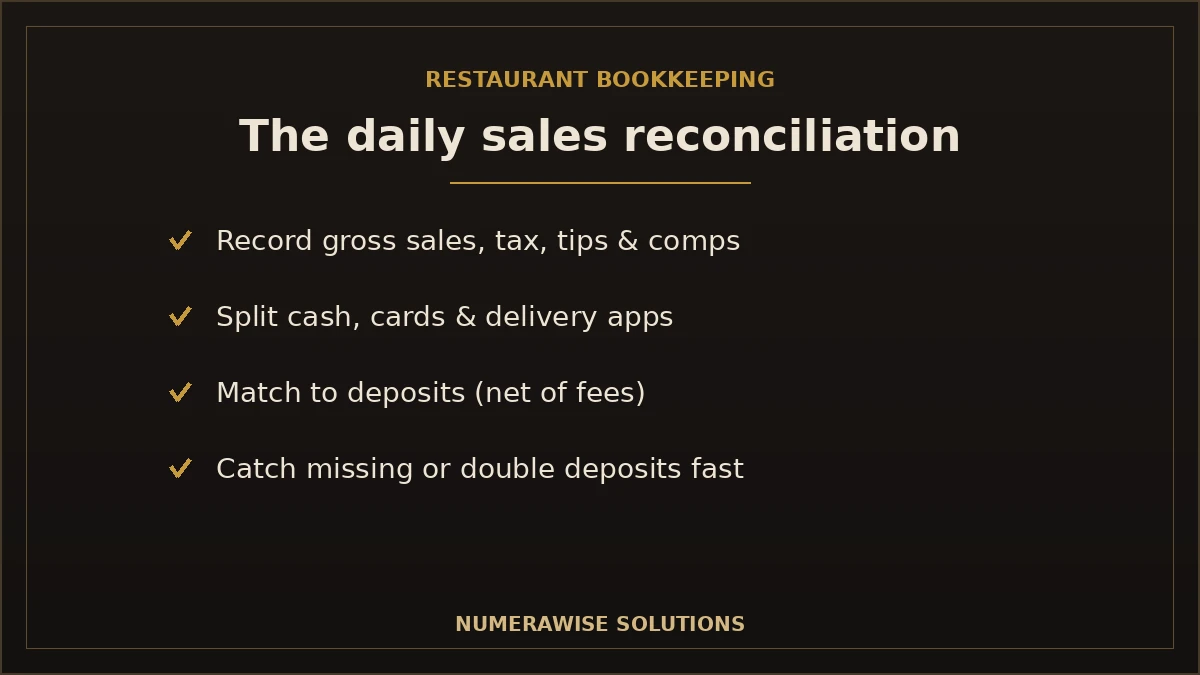
The single most important habit in restaurant bookkeeping is reconciling sales every day. Your point-of-sale system records what you sold; your bank shows what actually landed. They must match.
A daily sales entry captures gross sales, sales tax collected, tips, comps and discounts, and the split across cash, cards, and delivery apps. Then those figures are matched to the deposits that hit your account — often a day or two later, and net of processing and delivery fees. When this is done daily, a missing deposit or a double charge shows up immediately. When it is skipped, errors hide for weeks and the month never ties out.
Daily sales vs bank deposits: a worksheet for your own numbers
For each business day, write down what the POS says should reach the bank, channel by channel, and then what actually arrived and on what date. The difference column should be zero or carry a named reason. A difference with no reason that is still open a week later is the leak. Four reports feed it: the POS end-of-day sales summary by tender type, the card processor’s settlement report, each delivery app’s payout statement, and the bank statement.
| Line | Where the number comes from | Expected | Actual in bank | Difference |
|---|---|---|---|---|
| A. Card sales, card tips included | POS sales summary by tender type | 4,841 | ||
| B. Less processor fees, if deducted daily | Processor settlement report | (140) | ||
| C. Expected card deposit (A − B) | Bank: processor batch deposit | 4,701 | 4,701 (Mon) | 0 |
| D. Cash sales | POS cash tender | 1,350 | ||
| E. Less card tips paid to staff in cash from the till, and paid-outs | Tip-out sheet, paid-out slips | (300) | ||
| F. Expected cash deposit (D − E) | Bank: deposit slip | 1,050 | 1,030 (Mon) | (20) |
| G. Delivery app sales, gross, for the payout period | Each app’s payout statement | 3,900 | ||
| H. Less commissions, marketing fees, refunds | Same statement | (1,010) | ||
| I. Expected app payout (G − H) | Bank: app transfer | 2,890 | 2,890 (Tue) | 0 |
| J. Gift cards sold, house accounts charged | POS non-cash tenders | no deposit today | liability, not a miss |
Reading the example. The figures are illustrative, for one Saturday (the delivery lines cover that app’s weekly payout, because apps pay on their own schedule, not daily). Cards tie once the $140 of fees on the processor statement is booked as merchant fees rather than netted against sales. Delivery ties once commissions and marketing fees are booked as expenses at gross. Cash is $20 short with no slip to explain it, so it stays on the list. One $20 day is noise; the same $20 on every Saturday is a pattern worth a conversation with whoever closes the till.
The usual reasons a line will not tie
- Timing. Weekend and holiday batches often land together on the next business day. Match by batch date, not deposit date, and it clears on its own.
- A batch that never closed. One deposit is missing and the next is roughly double. Check the processor portal before you chase anyone.
- Fees, chargebacks and refunds taken out of a deposit. Book each one; never adjust sales to force a match.
- Card tips paid out in cash. They lower the cash deposit and clear tips payable, so record them on the day they leave the drawer.
- Voids or comps after the day closed. The POS report changes after you printed it. Re-run it before you mark a difference unexplained.
- Gift cards and house accounts. They are sales without a same-day deposit; they belong in a liability or receivable, not in the difference column.
Do this daily for the first month and the pattern of normal differences becomes obvious; after that, a weekly pass over the same four reports is enough for most single-location restaurants. The journal entry behind lines A to F, with the card clearing and tips payable accounts, is worked through in the five restaurant entries that break the books, and the month-end bank tie-out itself in bank reconciliation in QuickBooks.
Handling tips, delivery apps, and third-party fees
Three modern headaches trip up most restaurant books:
For a line-by-line worked day, including the exact journal entry for sales, tips payable and card clearing, see the five restaurant entries that break the books.
Tips
Tips are not restaurant income — they belong to staff and must flow through correctly for payroll and tax. Credit-card tips, tip pooling, and tip-out rules all have to be recorded accurately, and the IRS has specific reporting expectations you can review at IRS tip recordkeeping guidance.
Delivery apps
Third-party platforms deposit sales net of hefty commissions. Booking only the deposit hides the real sales and the fee. Good bookkeeping records the gross sale and the commission separately so you see what delivery truly costs you.
Merchant fees
Card processing fees quietly eat margin. Tracking them as their own expense — not buried in deposits — shows you the real cost of accepting cards.
Inventory and food cost control
Food is perishable and prices move, so inventory is where margin is won or lost. Most restaurants take periodic inventory counts — weekly or monthly — and compare usage against sales to calculate real food cost. When your theoretical food cost (what recipes say you should have used) drifts from actual, that gap is waste, over-portioning, or theft. Restaurant bookkeeping turns those counts into a food cost number you can act on, so a rising beef price or a heavy-handed line cook shows up in the books, not just the bank balance.
The right chart of accounts for a restaurant
A generic chart of accounts hides what a restaurant needs to see. A restaurant-specific setup separates food sales from beverage and, ideally, from delivery; splits cost of goods into food and beverage; and breaks labor into kitchen, front-of-house, and management. That structure is what makes food cost, beverage cost, and labor cost fall out of the books automatically instead of requiring a spreadsheet every month. Setting this up correctly from the start is one of the highest-value things a restaurant bookkeeper does.
Restaurant bookkeeping by type
The playbook is the same; the emphasis shifts by concept.
Full-service restaurants
Higher labor and complex menus mean prime cost and scheduling get the most attention.
Quick-service and fast casual
High volume and lower ticket sizes make daily reconciliation and speed of reporting critical.
Bars and breweries
Beverage cost, pour control, and shrinkage are the margin levers to watch.
Cafes and food trucks
Simpler operations, but tight margins mean every fee and food cost still counts.
Software and POS integration
Most restaurants run their books on QuickBooks Online connected to their point-of-sale system, so daily sales flow in automatically instead of being keyed by hand. The right integration links your POS, payroll, and bank feeds to the books, and often adds an inventory or bill-pay app. What matters is not the brand but the setup: a restaurant chart of accounts, connected sales, and clean daily reconciliation. A generic setup is what leaves owners guessing at their own numbers.
Benefits of proper restaurant bookkeeping
- You know your prime cost. The number that decides profit, in front of you every period.
- Food and labor stay in line. Drifts show up early, while you can still fix them.
- Daily numbers you trust. Sales and deposits tie out, so nothing goes missing.
- Cash flow you can plan. You see slow weeks and big vendor bills coming.
- Tax season without panic. Clean books hand straight to your CPA.
- Ready for lenders and landlords. Accurate financials when you need to expand.
Common restaurant bookkeeping mistakes
- Not reconciling daily. Skip it and missing deposits and errors hide for weeks.
- Booking delivery deposits as sales. This hides real sales and the commission you paid.
- Ignoring prime cost. Without it, you cannot see why a busy month lost money.
- Mishandling tips. Tip errors create payroll and tax problems fast.
- Skipping inventory. No food cost means no control over your biggest variable expense.
- Using a generic chart of accounts. It hides the numbers a restaurant must see.
Best practices for restaurant bookkeeping
- Reconcile sales to deposits every day.
- Track food and labor cost every period and watch prime cost.
- Record delivery gross sales and commissions separately.
- Handle tips correctly through payroll.
- Count inventory on a regular schedule and calculate real food cost.
- Use a restaurant-specific chart of accounts.
- Review a restaurant-style P&L monthly, not just at tax time.
The 13-period accounting calendar
Here is a detail that trips up owners using a normal monthly calendar: many restaurants close their books on a 13-period calendar instead of 12 months. Each period is exactly four weeks, so every period contains the same number of Fridays and Saturdays — the days that drive restaurant sales. Compare a normal February (four weekends) to a normal August (five), and monthly numbers look misleading even when nothing changed. Four-week periods make each close truly comparable, so you can see whether sales and prime cost are actually moving or whether the calendar just handed you an extra weekend. Not every restaurant needs this, but for volume-driven concepts it turns period-over-period reporting from noisy into meaningful. A restaurant bookkeeper can set your books up either way and keep the comparisons honest.
Restaurant bookkeeping near you
Restaurant finances follow the same rules everywhere, but sales tax, labor rules, and local costs differ by state and city. We provide restaurant bookkeeping across the United States and maintain dedicated local pages for many markets:
New York · Chicago · Miami · California · Florida · Colorado · New Jersey · Virginia · Cincinnati · Alabama
Do not see your city? We work with restaurants nationwide through secure cloud tools connected to your POS, so location is never a barrier to getting your books right.
How often should restaurant books be done?
Restaurants run on a faster clock than most businesses. Sales reconciliation is daily, so nothing slips between the POS and the bank. Vendor invoices and payroll follow their own weekly or biweekly cycles. Inventory is counted weekly or monthly depending on volume. And a full close — reconciled accounts and a restaurant profit and loss with prime cost — happens every month, sometimes every accounting period of four weeks. The pattern is simple: reconcile daily, count regularly, and close monthly so you always know where you stand.
What restaurant bookkeeping costs
There is no single price, and anyone quoting one before seeing your operation is guessing. Cost tracks the number of locations, sales volume, how many revenue channels you run (dine-in, takeout, delivery), and whether payroll and inventory are included. A single small cafe is a modest monthly engagement; a busy multi-channel restaurant or a group of locations costs more. Weigh it against the alternative: a full-time in-house bookkeeper means salary, taxes, and benefits, while an outsourced service gives you a whole team — and a specialist who knows prime cost — for a fraction of that.
Getting started with restaurant bookkeeping
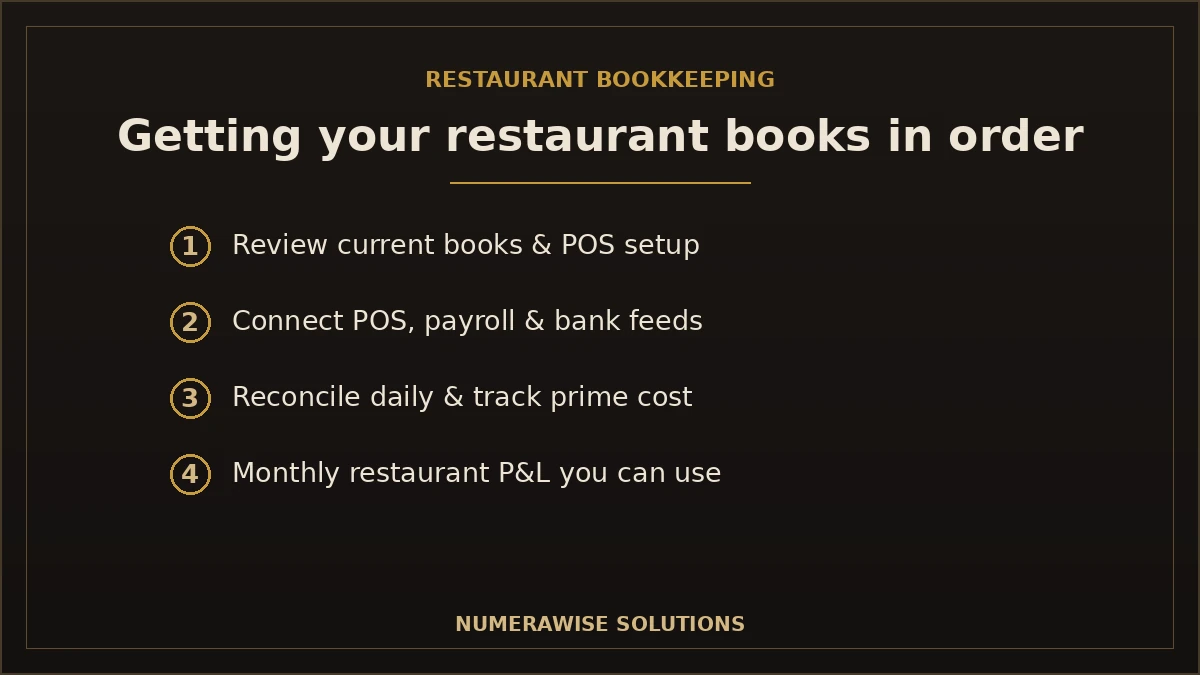
Getting started is simple. We review your current books and POS setup, tell you honestly whether you need a cleanup first, and quote a clear monthly price. From there we connect your systems, reconcile daily, and hand you a restaurant P&L with prime cost you can actually use. Whether you run one cafe or several full-service rooms, the first step is the same: a short conversation about how your restaurant makes and spends money.
Why choose Numerawise for restaurant bookkeeping
At Numerawise Solutions, we build books around how a restaurant actually runs — daily sales reconciliation, real food and labor tracking, correct tip and delivery handling, and a chart of accounts made for hospitality, not a generic template. We handle your monthly bookkeeping, reconciliations, and reports, and we pair the books with payroll services and small business bookkeeping services so one team covers your whole back office.
We work with restaurants across the United States remotely through secure cloud tools connected to your POS, so you get a specialist who understands prime cost and daily deposits without anyone standing in your kitchen. You get accurate monthly reports, a prime-cost number you can act on, and books that stay filing-ready all year. We also serve specific markets — see, for example, restaurant bookkeeping in New York — so local operators get the same rigor tuned to their city.
The bottom line on restaurant bookkeeping
Restaurants rarely fail for lack of customers — they fail because they cannot see where the money goes. Daily sales reconciliation, honest food and labor tracking, correct handling of tips and delivery, and a restaurant-specific chart of accounts are what turn a busy kitchen into a profitable one. Watch your prime cost, reconcile every day, and read a real restaurant P&L each month, and the numbers finally match what happens on the floor. For most owners, the smart move is to hand this to a specialist while you run service. Done right, restaurant bookkeeping stops being a shoebox of receipts and becomes the tool that shows you exactly what to fix and what to charge.
Key takeaways
- Prime cost decides profit — keep COGS plus labor around 60% of sales or below.
- Reconcile sales to deposits daily; it is the heartbeat of restaurant books.
- Record delivery gross and commissions separately, and handle tips through payroll.
- Count inventory to get a real food cost you can control.
- Use a restaurant-specific chart of accounts so the key ratios fall out automatically.
Quick answers.
What is restaurant bookkeeping?
Restaurant bookkeeping is specialized accounting built for how restaurants make and spend money — daily sales, food and labor costs, tips, and thin margins. It reconciles sales to deposits every day, tracks cost of goods and labor, handles tips and delivery fees, and produces a restaurant-style profit and loss with prime cost, so owners can see their true profit and fix problems early.
What is prime cost in a restaurant?
Prime cost is your cost of goods sold (food and beverage) plus total labor. It is the largest and most controllable share of restaurant spending, which is why it is the number that decides profit. A common healthy target is around 60% of sales or below. When prime cost climbs higher, profit gets very hard — so restaurant bookkeeping keeps it in front of you every period.
How often should a restaurant reconcile its books?
Sales should be reconciled to bank and card deposits daily — it is the heartbeat of restaurant bookkeeping. Vendor bills and payroll follow weekly or biweekly cycles, inventory is counted weekly or monthly, and a full close with a restaurant profit and loss happens every month or accounting period. Reconciling daily is what catches missing deposits and errors before they hide for weeks.
How do I match restaurant POS sales to bank deposits?
Work channel by channel. Take card sales from the POS, subtract any fees the processor deducts, and match the result to the processor batch deposit; take cash sales, subtract card tips and paid-outs taken from the till, and match the deposit slip; take each delivery app gross for its payout period, subtract its commissions and fees, and match the transfer. Any difference should be timing or a named item; one with no reason after a week is the problem to chase.
What is a good food cost percentage for a restaurant?
Food cost percentage is the cost of food divided by food sales, and many restaurants aim for roughly 28–35%, though it varies by concept. Fine dining and quick service look different. What matters is tracking it consistently: when your actual food cost drifts above target, that gap points to waste, over-portioning, price increases, or theft you can then address.
How do you handle delivery app sales in the books?
Third-party delivery platforms deposit sales net of large commissions, so booking only the deposit hides both your real sales and the fee you paid. Good restaurant bookkeeping records the gross sale and the commission separately. That way you see true sales volume and exactly what delivery costs you — often a meaningful margin drain worth watching closely.
How are tips handled in restaurant bookkeeping?
Tips are not restaurant income — they belong to staff and must flow through payroll correctly. Credit-card tips, tip pooling, and tip-outs all need accurate recording for payroll and tax, and the IRS has specific reporting expectations. Mishandling tips creates payroll and tax problems quickly, so correct tip tracking is a core part of restaurant bookkeeping.
What software is best for restaurant bookkeeping?
Most restaurants use QuickBooks Online connected to their point-of-sale system, so daily sales flow in automatically. The right setup links POS, payroll, and bank feeds, often with an inventory or bill-pay app. The software brand matters less than the configuration: a restaurant chart of accounts, connected sales, and clean daily reconciliation are what make the numbers trustworthy.
Why does a restaurant need a special chart of accounts?
A generic chart of accounts hides what a restaurant must see. A restaurant-specific setup separates food, beverage, and delivery sales, splits cost of goods into food and beverage, and breaks labor into kitchen, front-of-house, and management. That structure makes food cost, beverage cost, and labor cost fall out of the books automatically instead of requiring a spreadsheet every month.
How much does restaurant bookkeeping cost?
There is no single price. Cost depends on your number of locations, sales volume, how many revenue channels you run, and whether payroll and inventory are included. A small cafe is a modest monthly engagement; a busy multi-channel restaurant costs more. Compared with a full-time in-house hire, an outsourced service gives you a whole team and a prime-cost specialist for a fraction of the cost.
Can you do bookkeeping for my restaurant remotely?
Yes. We work with restaurants across the United States through secure cloud tools connected to your POS, so location is never a barrier. You get daily sales reconciliation, real food and labor tracking, correct tip and delivery handling, and a monthly restaurant profit and loss with prime cost — all without anyone needing to stand in your kitchen.
Get a free scoping call.
Tell us what you’re working on. We respond same business day.

Ram · Founder & Principal
Founder of Numerawise Solutions, established MMXXIV in Atlanta. Intuit ProAdvisor Gold tier. Former Intuit Technical Support engineer. Has personally led two hundred accounting software conversions for US small businesses since founding the practice. Reachable directly at [email protected].
Free: The Clean-Cutover Checklist
The step-by-step checklist we use to migrate businesses to QuickBooks without losing data — bank rec, opening balances, payroll YTD, and the validation tie-out. Get it in your inbox.
No spam — just the checklist and the occasional QuickBooks tip.